{"title":"Retroperitoneal hemorrhage following spinal anesthesia: A case report.","authors":"Haneen Hawsawi, Lamia ALjeraisy, Rothana Aljehani, Majed Alharbi","doi":"10.4103/sja.sja_350_24","DOIUrl":null,"url":null,"abstract":"<p><p>Serious neurological problems following spinal anesthesia are rare, although they can occur. We report a case of a 31-year-old female patient, parturient, Gravida 2 Para 1, with a body mass index (BMI) of 25 kg/m2 who had a paramedian approach spinal anesthesia using 23-gauge Quincke spinal needle for an emergent cesarean section due to failure to progress. Four attempts were required to achieve successful spinal blockade. The procedure was successfully performed with no complications. On the first postoperative day, the patient started to complain of pressure headache and abdominal pain radiating to the lower back. Magnetic resonance imaging (MRI) lumbar spine revealed right peri-nephric and retroperitoneal subacute hematoma and no evidence of cerebrospinal fluid (CSF) leak or collection. Computed tomography (CT) angiography affirmed the diagnosis of large retroperitoneal hematoma extending to inferior vena cava, measuring about 5 × 15 × 16 cm in its maximum antero-posterior, transverse, and cranio-caudal diameters, respectively, corresponding to about 620 ml volume. No active bleeding was demonstrated.</p>","PeriodicalId":21533,"journal":{"name":"Saudi Journal of Anaesthesia","volume":"19 1","pages":"95-97"},"PeriodicalIF":1.4000,"publicationDate":"2025-01-01","publicationTypes":"Journal Article","fieldsOfStudy":null,"isOpenAccess":false,"openAccessPdf":"https://www.ncbi.nlm.nih.gov/pmc/articles/PMC11829687/pdf/","citationCount":"0","resultStr":null,"platform":"Semanticscholar","paperid":null,"PeriodicalName":"Saudi Journal of Anaesthesia","FirstCategoryId":"1085","ListUrlMain":"https://doi.org/10.4103/sja.sja_350_24","RegionNum":0,"RegionCategory":null,"ArticlePicture":[],"TitleCN":null,"AbstractTextCN":null,"PMCID":null,"EPubDate":"","PubModel":"","JCR":"Q3","JCRName":"ANESTHESIOLOGY","Score":null,"Total":0}
引用次数: 0
Abstract
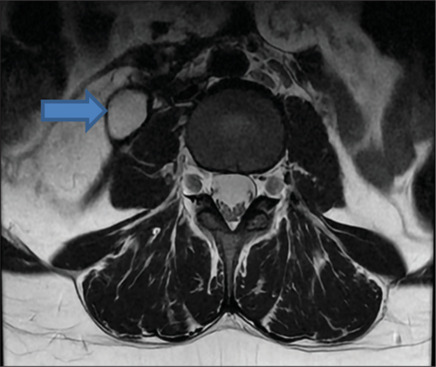
Serious neurological problems following spinal anesthesia are rare, although they can occur. We report a case of a 31-year-old female patient, parturient, Gravida 2 Para 1, with a body mass index (BMI) of 25 kg/m2 who had a paramedian approach spinal anesthesia using 23-gauge Quincke spinal needle for an emergent cesarean section due to failure to progress. Four attempts were required to achieve successful spinal blockade. The procedure was successfully performed with no complications. On the first postoperative day, the patient started to complain of pressure headache and abdominal pain radiating to the lower back. Magnetic resonance imaging (MRI) lumbar spine revealed right peri-nephric and retroperitoneal subacute hematoma and no evidence of cerebrospinal fluid (CSF) leak or collection. Computed tomography (CT) angiography affirmed the diagnosis of large retroperitoneal hematoma extending to inferior vena cava, measuring about 5 × 15 × 16 cm in its maximum antero-posterior, transverse, and cranio-caudal diameters, respectively, corresponding to about 620 ml volume. No active bleeding was demonstrated.




 京公网安备 11010802042870号
京ICP备2023020795号-1
京公网安备 11010802042870号
京ICP备2023020795号-1

 分享
分享
 求助内容:
求助内容: 应助结果提醒方式:
 扫码关注我们
