Prognostic Impact of Programmed Death-Ligand 1 Determination in Unresectable Locally Advanced Head and Neck Squamous Cell Carcinoma: A Retrospective Analysis in a Portuguese Centre.
Luís Guilherme Santos, Ana Rita Garcia, Margarida Teixeira
{"title":"Prognostic Impact of Programmed Death-Ligand 1 Determination in Unresectable Locally Advanced Head and Neck Squamous Cell Carcinoma: A Retrospective Analysis in a Portuguese Centre.","authors":"Luís Guilherme Santos, Ana Rita Garcia, Margarida Teixeira","doi":"10.7759/cureus.79084","DOIUrl":null,"url":null,"abstract":"<p><p>Locally advanced head and neck squamous cell carcinoma (HNSCC) is treated with definitive concurrent chemoradiation if deemed unresectable. Contrarily to the metastatic/recurrent setting, there is no current role for immunotherapy in the locally advanced setting, all trials being negative in their primary endpoints. As such, and although it may still be performed, determination of programmed death-ligand 1 (PD-L1) is not mandatory in locally advanced disease. We aimed to assess if there was any correlation with PD-L1 positivity (when obtained), disease characteristics, and recurrence-free survival in unresectable, locally advanced HNSCC eligible for concurrent chemoradiation in a Portuguese centre. We retrospectively analysed 164 patients for five years, most of whom had unresectable stage IV disease treated with cisplatin-based chemoradiation. PD-L1 was determined in 35% of patients. While it did not correlate to anatomical disease location, treatment tolerance, p16 status, or clinical staging at diagnosis, PD-L1 over-expression seemed to identify a group of patients in which recurrence-free survival was shorter, highlighting the need for continued clinical trials assessing the role of PD-L1 testing and immunotherapy in this setting.</p>","PeriodicalId":93960,"journal":{"name":"Cureus","volume":"17 2","pages":"e79084"},"PeriodicalIF":1.3000,"publicationDate":"2025-02-16","publicationTypes":"Journal Article","fieldsOfStudy":null,"isOpenAccess":false,"openAccessPdf":"https://www.ncbi.nlm.nih.gov/pmc/articles/PMC11830166/pdf/","citationCount":"0","resultStr":null,"platform":"Semanticscholar","paperid":null,"PeriodicalName":"Cureus","FirstCategoryId":"1085","ListUrlMain":"https://doi.org/10.7759/cureus.79084","RegionNum":0,"RegionCategory":null,"ArticlePicture":[],"TitleCN":null,"AbstractTextCN":null,"PMCID":null,"EPubDate":"2025/2/1 0:00:00","PubModel":"eCollection","JCR":"Q3","JCRName":"MEDICINE, GENERAL & INTERNAL","Score":null,"Total":0}
引用次数: 0
Abstract
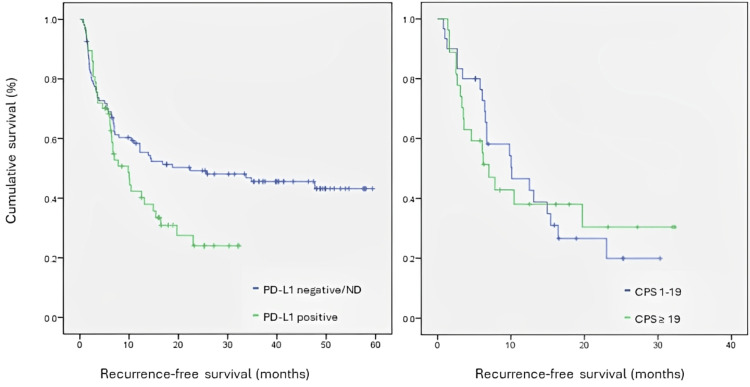
Locally advanced head and neck squamous cell carcinoma (HNSCC) is treated with definitive concurrent chemoradiation if deemed unresectable. Contrarily to the metastatic/recurrent setting, there is no current role for immunotherapy in the locally advanced setting, all trials being negative in their primary endpoints. As such, and although it may still be performed, determination of programmed death-ligand 1 (PD-L1) is not mandatory in locally advanced disease. We aimed to assess if there was any correlation with PD-L1 positivity (when obtained), disease characteristics, and recurrence-free survival in unresectable, locally advanced HNSCC eligible for concurrent chemoradiation in a Portuguese centre. We retrospectively analysed 164 patients for five years, most of whom had unresectable stage IV disease treated with cisplatin-based chemoradiation. PD-L1 was determined in 35% of patients. While it did not correlate to anatomical disease location, treatment tolerance, p16 status, or clinical staging at diagnosis, PD-L1 over-expression seemed to identify a group of patients in which recurrence-free survival was shorter, highlighting the need for continued clinical trials assessing the role of PD-L1 testing and immunotherapy in this setting.





 京公网安备 11010802042870号
京ICP备2023020795号-1
京公网安备 11010802042870号
京ICP备2023020795号-1

 分享
分享

 求助内容:
求助内容: 应助结果提醒方式:
 扫码关注我们
