{"title":"Biopharmaceutical Analysis by HPLC: Practices and Challenges.","authors":"Golshan Mahdi, Ashkan Alamdary, Hooman Kaghazian, Nayebali Ahmadi, Rajab Mardani, Alireza Gholami","doi":"10.4068/cmj.2025.61.1.19","DOIUrl":null,"url":null,"abstract":"<p><p>High-Performance Liquid Chromatography (HPLC) is an essential analytical technique in the biopharmaceutical industry, crucial for the separation, identification, and quantification of complex biological molecules such as monoclonal antibodies and recombinant proteins. It plays a vital role in assessing the purity, potency, and stability of biopharmaceutical products, which are critical for regulatory approval. HPLC offers high resolution and sensitivity, allowing for the detection of small quantities of compounds in complex samples. Its versatility is evident in various modes, including reversed-phase, ion-exchange, size-exclusion, and affinity chromatography. However, challenges remain, such as selecting the appropriate stationary phase, addressing peak overlapping and matrix interference, and optimizing operational parameters like flow rate and mobile phase composition. Standardization and method validation are essential for ensuring reproducibility, accuracy, and regulatory compliance in HPLC analyses. The need for reliable reference materials and calibration methods is also a significant challenge. Recent advancements in HPLC technology, including ultra-high-performance liquid chromatography (UHPLC) and hybrid systems that integrate HPLC with mass spectrometry, are helping to overcome these challenges by enhancing sensitivity, resolution, and analysis speed. In summary, as biopharmaceutical products grow more complex, HPLC's role will continue to evolve, highlighting the need for ongoing research and development to refine this critical analytical tool.</p>","PeriodicalId":94372,"journal":{"name":"Chonnam medical journal","volume":"61 1","pages":"19-31"},"PeriodicalIF":0.0000,"publicationDate":"2025-01-01","publicationTypes":"Journal Article","fieldsOfStudy":null,"isOpenAccess":false,"openAccessPdf":"https://www.ncbi.nlm.nih.gov/pmc/articles/PMC11821985/pdf/","citationCount":"0","resultStr":null,"platform":"Semanticscholar","paperid":null,"PeriodicalName":"Chonnam medical journal","FirstCategoryId":"1085","ListUrlMain":"https://doi.org/10.4068/cmj.2025.61.1.19","RegionNum":0,"RegionCategory":null,"ArticlePicture":[],"TitleCN":null,"AbstractTextCN":null,"PMCID":null,"EPubDate":"2025/1/24 0:00:00","PubModel":"Epub","JCR":"","JCRName":"","Score":null,"Total":0}
引用次数: 0
Abstract
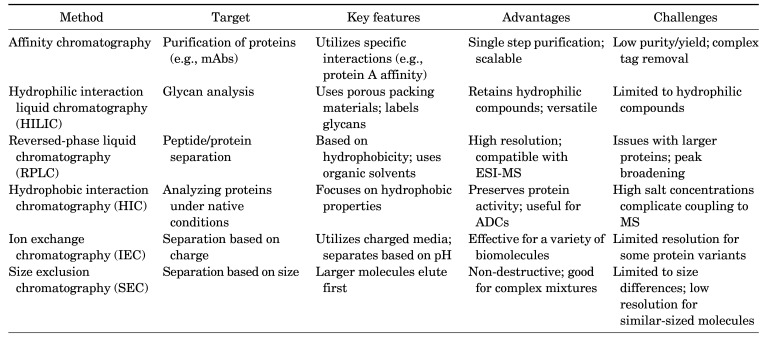
High-Performance Liquid Chromatography (HPLC) is an essential analytical technique in the biopharmaceutical industry, crucial for the separation, identification, and quantification of complex biological molecules such as monoclonal antibodies and recombinant proteins. It plays a vital role in assessing the purity, potency, and stability of biopharmaceutical products, which are critical for regulatory approval. HPLC offers high resolution and sensitivity, allowing for the detection of small quantities of compounds in complex samples. Its versatility is evident in various modes, including reversed-phase, ion-exchange, size-exclusion, and affinity chromatography. However, challenges remain, such as selecting the appropriate stationary phase, addressing peak overlapping and matrix interference, and optimizing operational parameters like flow rate and mobile phase composition. Standardization and method validation are essential for ensuring reproducibility, accuracy, and regulatory compliance in HPLC analyses. The need for reliable reference materials and calibration methods is also a significant challenge. Recent advancements in HPLC technology, including ultra-high-performance liquid chromatography (UHPLC) and hybrid systems that integrate HPLC with mass spectrometry, are helping to overcome these challenges by enhancing sensitivity, resolution, and analysis speed. In summary, as biopharmaceutical products grow more complex, HPLC's role will continue to evolve, highlighting the need for ongoing research and development to refine this critical analytical tool.



 京公网安备 11010802042870号
京ICP备2023020795号-1
京公网安备 11010802042870号
京ICP备2023020795号-1

 分享
分享

 求助内容:
求助内容: 应助结果提醒方式:
 扫码关注我们
