{"title":"Randomized controlled trial on the efficacy of topical urea-based cream in preventing capecitabine-associated hand-foot syndrome.","authors":"Concord Wongkraisri, Kriengkrai Chusuwanrak, Apirom Laocharoenkeat, Leena Chularojanamontri, Akarin Nimmannit, Suthinee Ithimakin","doi":"10.1186/s12885-025-13684-1","DOIUrl":null,"url":null,"abstract":"<p><strong>Background: </strong>Hand-foot syndrome (HFS) is a common adverse event of capecitabine causing treatment modifications. Topical urea cream can reduce sorafenib-induced hand-foot skin reaction. However, its benefit in preventing capecitabine-associated HFS was not seen early in the course and had been unknown with long-term use. The aim of this study was to evaluate the efficacy of urea cream for HFS prophylaxis throughout capecitabine treatment.</p><p><strong>Methods: </strong>Patients with cancer who received capecitabine were randomized (1:1) to receive usual care alone or in combination with urea-based cream. The incidence and degree of HFS were assessed at each capecitabine cycle. The primary endpoint was the proportion of patients with any grade HFS. The secondary endpoints included the proportion of patients with severe (≥ grade 3) HFS, modifications in capecitabine because of HFS, and HFS onset.</p><p><strong>Results: </strong>After a median of six capecitabine cycles, any grade HFS was reported by 68 of 109 patients (62.4%) who received usual care and by 60 of 107 patients (56%) who used urea cream (p = 0.36). The patients who received usual care and urea cream had similar proportions of grade 3 HFS occurrence [52 (47.7%) vs. 44 (41.1%), respectively, p = 0.34] and needed capecitabine modification because of HFS [20 patients (18.3%) vs. 17 patients (15.9%), respectively, p = 0.89], as well as similar HFS onset.</p><p><strong>Conclusions: </strong>Urea-based cream did not prevent capecitabine-associated HFS, reduce capecitabine modification, and delay HFS onset. However, it had a tendency to lessen HFS severity, especially in the later cycles of capecitabine.</p><p><strong>Clinical trial registration number: </strong>ClinicalTrials.gov Identifier: NCT05348278, registered on April 21, 2022.</p>","PeriodicalId":9131,"journal":{"name":"BMC Cancer","volume":"25 1","pages":"275"},"PeriodicalIF":3.4000,"publicationDate":"2025-02-17","publicationTypes":"Journal Article","fieldsOfStudy":null,"isOpenAccess":false,"openAccessPdf":"https://www.ncbi.nlm.nih.gov/pmc/articles/PMC11831840/pdf/","citationCount":"0","resultStr":null,"platform":"Semanticscholar","paperid":null,"PeriodicalName":"BMC Cancer","FirstCategoryId":"3","ListUrlMain":"https://doi.org/10.1186/s12885-025-13684-1","RegionNum":2,"RegionCategory":"医学","ArticlePicture":[],"TitleCN":null,"AbstractTextCN":null,"PMCID":null,"EPubDate":"","PubModel":"","JCR":"Q2","JCRName":"ONCOLOGY","Score":null,"Total":0}
引用次数: 0
Abstract
Background: Hand-foot syndrome (HFS) is a common adverse event of capecitabine causing treatment modifications. Topical urea cream can reduce sorafenib-induced hand-foot skin reaction. However, its benefit in preventing capecitabine-associated HFS was not seen early in the course and had been unknown with long-term use. The aim of this study was to evaluate the efficacy of urea cream for HFS prophylaxis throughout capecitabine treatment.
Methods: Patients with cancer who received capecitabine were randomized (1:1) to receive usual care alone or in combination with urea-based cream. The incidence and degree of HFS were assessed at each capecitabine cycle. The primary endpoint was the proportion of patients with any grade HFS. The secondary endpoints included the proportion of patients with severe (≥ grade 3) HFS, modifications in capecitabine because of HFS, and HFS onset.
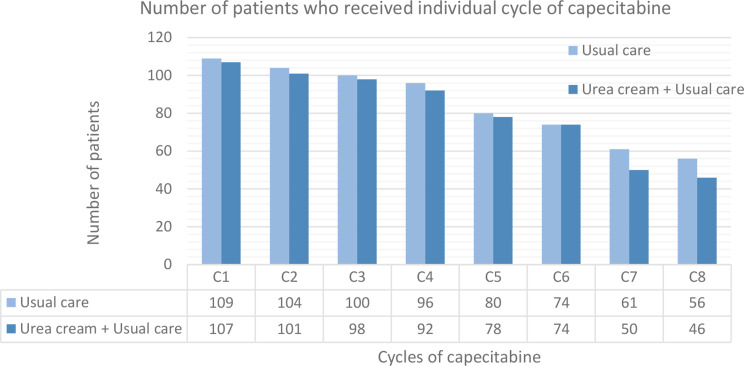
Results: After a median of six capecitabine cycles, any grade HFS was reported by 68 of 109 patients (62.4%) who received usual care and by 60 of 107 patients (56%) who used urea cream (p = 0.36). The patients who received usual care and urea cream had similar proportions of grade 3 HFS occurrence [52 (47.7%) vs. 44 (41.1%), respectively, p = 0.34] and needed capecitabine modification because of HFS [20 patients (18.3%) vs. 17 patients (15.9%), respectively, p = 0.89], as well as similar HFS onset.
Conclusions: Urea-based cream did not prevent capecitabine-associated HFS, reduce capecitabine modification, and delay HFS onset. However, it had a tendency to lessen HFS severity, especially in the later cycles of capecitabine.
Clinical trial registration number: ClinicalTrials.gov Identifier: NCT05348278, registered on April 21, 2022.
期刊介绍:
BMC Cancer is an open access, peer-reviewed journal that considers articles on all aspects of cancer research, including the pathophysiology, prevention, diagnosis and treatment of cancers. The journal welcomes submissions concerning molecular and cellular biology, genetics, epidemiology, and clinical trials.






 京公网安备 11010802042870号
京ICP备2023020795号-1
京公网安备 11010802042870号
京ICP备2023020795号-1

 分享
分享
 求助内容:
求助内容: 应助结果提醒方式:
 扫码关注我们
