[Electroacupuncture alleviates facial nerve injury-induced anxiety-like behavior by raising the excitability of glutamatergic neurons in the anterior cingulate cortex of mice].
Zhi-Qing Zhang, Chen-Wei Shen, Xiao-Yu Zang, Wen-Zi Xu, Chang Ji, Wen-Jie Zhang, Cong Wang, Lin Wang, Jian-Hua Liu
{"title":"[Electroacupuncture alleviates facial nerve injury-induced anxiety-like behavior by raising the excitability of glutamatergic neurons in the anterior cingulate cortex of mice].","authors":"Zhi-Qing Zhang, Chen-Wei Shen, Xiao-Yu Zang, Wen-Zi Xu, Chang Ji, Wen-Jie Zhang, Cong Wang, Lin Wang, Jian-Hua Liu","doi":"10.13702/j.1000-0607.20240789","DOIUrl":null,"url":null,"abstract":"<p><strong>Objectives: </strong>To investigate the effect and mechanism of electroacupuncture (EA) at \"Siguan\" acupoints (bilateral Hegu [LI4] and bilateral Taichong [LR3]) in ameliorating facial nerve injury-induced anxiety-like behavior in mice.</p><p><strong>Methods: </strong>Thirty male C57BL/6J mice were randomly divided into control, model (unilateral facial nerve injury), and EA groups, with 10 mice in each group. The facial nerve injury model was established by lightly clamping the isolated facial nerve for about 30 s, twice altogether after operation. The mice of the EA group were subjected to EA stimulation (2 Hz, 0.5 mA) of bilateral LI4 and bilateral LR3 for 30 min, once per day for consecutive 7 d. The anxiety-like behavior of mice was evaluated by light-dark chamber (LDC) and elevated plus maze (EPM) tests after EA intervention. The calcium activity of glutamatergic neurons in the anterior cingulate cortex (ACC) was analyzed by fiber photometry. The intrinsic excitability level of ACC glutamatergic neurons was estimated by using whole-cell patch clamp recording.</p><p><strong>Results: </strong>Compared with the control group, the dwell time in the light chamber and the number of entries into the light chamber of LDC tests, and the dwell time in the open arms and the number of entries into the open arms of the EPM tests were significantly decreased in the model group (<i>P</i><0.01). In comparison with the model group, the dwell time in the light chamber and the number of entries into the light chamber, and the dwell time in the open arms and the number of entries into the open arms were significantly increased in the EA group (<i>P</i><0.01, <i>P</i><0.05). Results of fiber photometry showed a decreased activity of ACC glutamatergic neurons when the mice moved from the closed arm to the open arm in an EPM, a decrease of input resistance and the number of discharge spikes induced by 300 pA current injection in the model group (<i>P</i><0.05, <i>P</i><0.01). Compared with the model group, the excitability of the glutamatergic neurons, input resistance and the number of discharge spikes (induced by 300 pA current injection) were considerably increased in the EA group (<i>P</i><0.05).</p><p><strong>Conclusions: </strong>EA of \"Siguan\" acupoints alleviates the facial nerve injury-induced anxiety-like behavior, probably by decreasing the excitability of glutamatergic neurons in the ACC.</p>","PeriodicalId":34919,"journal":{"name":"针刺研究","volume":"50 1","pages":"14-21"},"PeriodicalIF":0.0000,"publicationDate":"2025-01-25","publicationTypes":"Journal Article","fieldsOfStudy":null,"isOpenAccess":false,"openAccessPdf":"","citationCount":"0","resultStr":null,"platform":"Semanticscholar","paperid":null,"PeriodicalName":"针刺研究","FirstCategoryId":"1085","ListUrlMain":"https://doi.org/10.13702/j.1000-0607.20240789","RegionNum":0,"RegionCategory":null,"ArticlePicture":[],"TitleCN":null,"AbstractTextCN":null,"PMCID":null,"EPubDate":"","PubModel":"","JCR":"Q3","JCRName":"Medicine","Score":null,"Total":0}
引用次数: 0
Abstract
Objectives: To investigate the effect and mechanism of electroacupuncture (EA) at "Siguan" acupoints (bilateral Hegu [LI4] and bilateral Taichong [LR3]) in ameliorating facial nerve injury-induced anxiety-like behavior in mice.
Methods: Thirty male C57BL/6J mice were randomly divided into control, model (unilateral facial nerve injury), and EA groups, with 10 mice in each group. The facial nerve injury model was established by lightly clamping the isolated facial nerve for about 30 s, twice altogether after operation. The mice of the EA group were subjected to EA stimulation (2 Hz, 0.5 mA) of bilateral LI4 and bilateral LR3 for 30 min, once per day for consecutive 7 d. The anxiety-like behavior of mice was evaluated by light-dark chamber (LDC) and elevated plus maze (EPM) tests after EA intervention. The calcium activity of glutamatergic neurons in the anterior cingulate cortex (ACC) was analyzed by fiber photometry. The intrinsic excitability level of ACC glutamatergic neurons was estimated by using whole-cell patch clamp recording.
Results: Compared with the control group, the dwell time in the light chamber and the number of entries into the light chamber of LDC tests, and the dwell time in the open arms and the number of entries into the open arms of the EPM tests were significantly decreased in the model group (P<0.01). In comparison with the model group, the dwell time in the light chamber and the number of entries into the light chamber, and the dwell time in the open arms and the number of entries into the open arms were significantly increased in the EA group (P<0.01, P<0.05). Results of fiber photometry showed a decreased activity of ACC glutamatergic neurons when the mice moved from the closed arm to the open arm in an EPM, a decrease of input resistance and the number of discharge spikes induced by 300 pA current injection in the model group (P<0.05, P<0.01). Compared with the model group, the excitability of the glutamatergic neurons, input resistance and the number of discharge spikes (induced by 300 pA current injection) were considerably increased in the EA group (P<0.05).
Conclusions: EA of "Siguan" acupoints alleviates the facial nerve injury-induced anxiety-like behavior, probably by decreasing the excitability of glutamatergic neurons in the ACC.
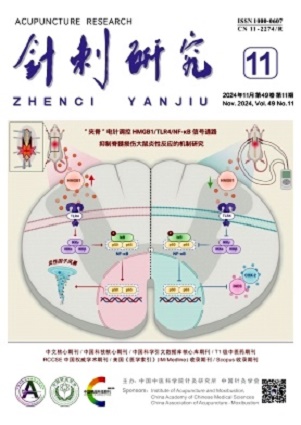
期刊介绍:
Acupuncture Research was founded in 1976. It is an acupuncture academic journal supervised by the State Administration of Traditional Chinese Medicine, co-sponsored by the Institute of Acupuncture of the China Academy of Chinese Medical Sciences and the Chinese Acupuncture Association. This journal is characterized by "basic experimental research as the main focus, taking into account clinical research and reporting". It is the only journal in my country that focuses on reporting the mechanism of action of acupuncture.
The journal has been changed to a monthly journal since 2018, published on the 25th of each month, and printed in full color. The manuscript acceptance rate is about 10%, and provincial and above funded projects account for about 80% of the total published papers, reflecting the latest scientific research results in the acupuncture field and has a high academic level. Main columns: mechanism discussion, clinical research, acupuncture anesthesia, meridians and acupoints, theoretical discussion, ideas and methods, literature research, etc.



 京公网安备 11010802042870号
京ICP备2023020795号-1
京公网安备 11010802042870号
京ICP备2023020795号-1

 分享
分享
 求助内容:
求助内容: 应助结果提醒方式:
 扫码关注我们
