{"title":"Functional near-infrared spectroscopy for the assessment and treatment of patients with disorders of consciousness.","authors":"Nan Wang, Yifang He, Sipeng Zhu, Dongsheng Liu, Xiaoke Chai, Qiheng He, Tianqing Cao, Jianghong He, Jingqi Li, Juanning Si, Yi Yang, Jizong Zhao","doi":"10.3389/fneur.2025.1524806","DOIUrl":null,"url":null,"abstract":"<p><strong>Background: </strong>Advances in neuroimaging have significantly enhanced our understanding of brain function, providing critical insights into the diagnosis and management of disorders of consciousness (DoC). Functional near-infrared spectroscopy (fNIRS), with its real-time, portable, and noninvasive imaging capabilities, has emerged as a promising tool for evaluating functional brain activity and nonrecovery potential in DoC patients. This review explores the current applications of fNIRS in DoC research, identifies its limitations, and proposes future directions to optimize its clinical utility.</p><p><strong>Aim: </strong>This review examines the clinical application of fNIRS in monitoring DoC. Specifically, it investigates the potential value of combining fNIRS with brain-computer interfaces (BCIs) and closed-loop neuromodulation systems for patients with DoC, aiming to elucidate mechanisms that promote neurological recovery.</p><p><strong>Methods: </strong>A systematic analysis was conducted on 155 studies published between January 1993 and October 2024, retrieved from the Web of Science Core Collection database.</p><p><strong>Results: </strong>Analysis of 21 eligible studies on neurological diseases involving 262 DoC patients revealed significant findings. The prefrontal cortex was the most frequently targeted brain region. fNIRS has proven crucial in assessing brain functional connectivity and activation, facilitating the diagnosis of DoC. Furthermore, fNIRS plays a pivotal role in diagnosis and treatment through its application in neuromodulation techniques such as deep brain stimulation (DBS) and spinal cord stimulation (SCS).</p><p><strong>Conclusion: </strong>As a noninvasive, portable, and real-time neuroimaging tool, fNIRS holds significant promise for advancing the assessment and treatment of DoC. Despite limitations such as low spatial resolution and the need for standardized protocols, fNIRS has demonstrated its utility in evaluating residual brain activity, detecting covert consciousness, and monitoring therapeutic interventions. In addition to assessing consciousness levels, fNIRS offers unique advantages in tracking hemodynamic changes associated with neuroregulatory treatments, including DBS and SCS. By providing real-time feedback on cortical activation, fNIRS facilitates optimizing therapeutic strategies and supports individualized treatment planning. Continued research addressing its technical and methodological challenges will further establish fNIRS as an indispensable tool in the diagnosis, prognosis, and treatment monitoring of DoC patients.</p>","PeriodicalId":12575,"journal":{"name":"Frontiers in Neurology","volume":"16 ","pages":"1524806"},"PeriodicalIF":2.8000,"publicationDate":"2025-02-03","publicationTypes":"Journal Article","fieldsOfStudy":null,"isOpenAccess":false,"openAccessPdf":"https://www.ncbi.nlm.nih.gov/pmc/articles/PMC11830608/pdf/","citationCount":"0","resultStr":null,"platform":"Semanticscholar","paperid":null,"PeriodicalName":"Frontiers in Neurology","FirstCategoryId":"3","ListUrlMain":"https://doi.org/10.3389/fneur.2025.1524806","RegionNum":3,"RegionCategory":"医学","ArticlePicture":[],"TitleCN":null,"AbstractTextCN":null,"PMCID":null,"EPubDate":"2025/1/1 0:00:00","PubModel":"eCollection","JCR":"Q2","JCRName":"CLINICAL NEUROLOGY","Score":null,"Total":0}
引用次数: 0
Abstract
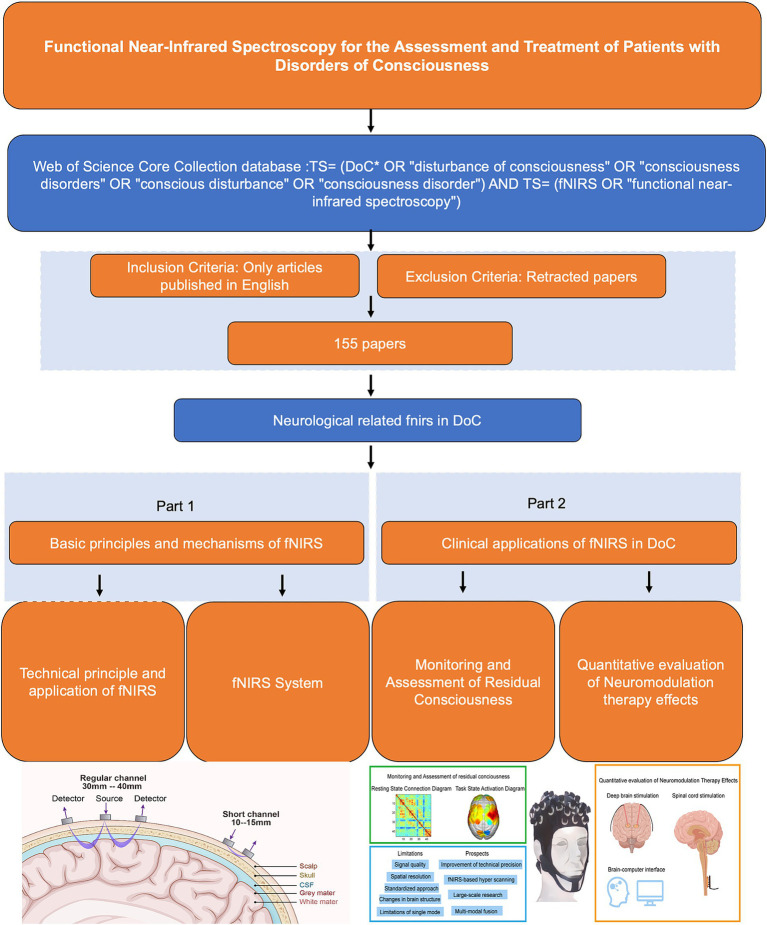
Background: Advances in neuroimaging have significantly enhanced our understanding of brain function, providing critical insights into the diagnosis and management of disorders of consciousness (DoC). Functional near-infrared spectroscopy (fNIRS), with its real-time, portable, and noninvasive imaging capabilities, has emerged as a promising tool for evaluating functional brain activity and nonrecovery potential in DoC patients. This review explores the current applications of fNIRS in DoC research, identifies its limitations, and proposes future directions to optimize its clinical utility.
Aim: This review examines the clinical application of fNIRS in monitoring DoC. Specifically, it investigates the potential value of combining fNIRS with brain-computer interfaces (BCIs) and closed-loop neuromodulation systems for patients with DoC, aiming to elucidate mechanisms that promote neurological recovery.
Methods: A systematic analysis was conducted on 155 studies published between January 1993 and October 2024, retrieved from the Web of Science Core Collection database.
Results: Analysis of 21 eligible studies on neurological diseases involving 262 DoC patients revealed significant findings. The prefrontal cortex was the most frequently targeted brain region. fNIRS has proven crucial in assessing brain functional connectivity and activation, facilitating the diagnosis of DoC. Furthermore, fNIRS plays a pivotal role in diagnosis and treatment through its application in neuromodulation techniques such as deep brain stimulation (DBS) and spinal cord stimulation (SCS).
Conclusion: As a noninvasive, portable, and real-time neuroimaging tool, fNIRS holds significant promise for advancing the assessment and treatment of DoC. Despite limitations such as low spatial resolution and the need for standardized protocols, fNIRS has demonstrated its utility in evaluating residual brain activity, detecting covert consciousness, and monitoring therapeutic interventions. In addition to assessing consciousness levels, fNIRS offers unique advantages in tracking hemodynamic changes associated with neuroregulatory treatments, including DBS and SCS. By providing real-time feedback on cortical activation, fNIRS facilitates optimizing therapeutic strategies and supports individualized treatment planning. Continued research addressing its technical and methodological challenges will further establish fNIRS as an indispensable tool in the diagnosis, prognosis, and treatment monitoring of DoC patients.
背景:神经影像学的进步大大提高了我们对大脑功能的理解,为意识障碍(DoC)的诊断和治疗提供了重要的见解。功能性近红外光谱(fNIRS)具有实时、便携和无创成像能力,已成为评估DoC患者功能性脑活动和不恢复潜力的一种很有前途的工具。本文综述了近红外光谱在DoC研究中的应用现状,指出了其局限性,并提出了优化其临床应用的未来方向。目的:综述fNIRS在监测DoC中的临床应用。具体而言,研究fNIRS联合脑机接口(bci)和闭环神经调节系统对DoC患者的潜在价值,旨在阐明促进神经功能恢复的机制。方法:系统分析Web of Science Core Collection数据库1993年1月至2024年10月间发表的155篇论文。结果:对21项符合条件的神经系统疾病研究(262例DoC)进行了分析,发现了显著的结果。前额叶皮层是最常被攻击的大脑区域。fNIRS已被证明在评估脑功能连接和激活方面至关重要,有助于诊断DoC。此外,fNIRS通过在脑深部刺激(DBS)和脊髓刺激(SCS)等神经调节技术中的应用,在诊断和治疗中发挥着关键作用。结论:fNIRS作为一种无创、便携、实时的神经成像工具,在推进DoC的评估和治疗方面具有重要的前景。尽管存在诸如低空间分辨率和需要标准化协议等限制,但fNIRS已经证明了它在评估残余大脑活动、检测隐蔽意识和监测治疗干预方面的实用性。除了评估意识水平外,fNIRS在追踪与神经调节治疗(包括DBS和SCS)相关的血流动力学变化方面具有独特的优势。通过提供皮层激活的实时反馈,fNIRS有助于优化治疗策略并支持个性化治疗计划。针对其技术和方法挑战的持续研究将进一步确立fNIRS作为DoC患者诊断、预后和治疗监测中不可或缺的工具。
期刊介绍:
The section Stroke aims to quickly and accurately publish important experimental, translational and clinical studies, and reviews that contribute to the knowledge of stroke, its causes, manifestations, diagnosis, and management.





 京公网安备 11010802042870号
京ICP备2023020795号-1
京公网安备 11010802042870号
京ICP备2023020795号-1

 分享
分享
 求助内容:
求助内容: 应助结果提醒方式:
 扫码关注我们
