Na Young Kim, Deog Kyeom Kim, Shinhee Park, Yong Il Hwang, Hyewon Seo, Dongil Park, Seoung Ju Park, Jin Hwa Lee, Kwang Ha Yoo, Hyun Woo Lee
{"title":"Risk Factors of FEV₁/FVC Decline in COPD Patients.","authors":"Na Young Kim, Deog Kyeom Kim, Shinhee Park, Yong Il Hwang, Hyewon Seo, Dongil Park, Seoung Ju Park, Jin Hwa Lee, Kwang Ha Yoo, Hyun Woo Lee","doi":"10.3346/jkms.2025.40.e32","DOIUrl":null,"url":null,"abstract":"<p><strong>Background: </strong>Factors influencing the decline in forced expiratory volume in one second (FEV₁)/forced vital capacity (FVC) for chronic obstructive pulmonary disease (COPD) progression remain uncertain. We aimed to identify risk factors associated with rapid FEV₁/FVC decline in patients with COPD.</p><p><strong>Methods: </strong>This multi-center observational study was conducted from January 2012 to December 2022. Eligible patients were monitored with symptoms, spirometric tests, and treatment patterns over 3 years. Rapid FEV₁/FVC decliners were defined as the quartile of patients exhibiting the highest annualized percentage decline in FEV₁/FVC.</p><p><strong>Results: </strong>Among 1,725 patients, 435 exhibited rapid FEV₁/FVC decline, with an annual change of -2.5%p (interquartile range, -3.5 to -2.0). Rapid FEV₁/FVC decliners exhibited lower body mass index (BMI), higher smoking rates, elevated post-bronchodilator (BD) FEV₁, higher post-BD FEV₁/FVC, and a lower prevalence of Staging of Airflow Obstruction by Ratio (STAR) stage IV. Rapid FEV₁/FVC decline was not linked to the annual exacerbation rate, but there was an association with symptom deterioration and FEV₁ decline. In multivariable analyses, low BMI, current smoking, increased modified Medical Research Council dyspnoea score, low post-BD FEV₁, low STAR stage, high forced mid-expiratory flow (FEF<sub>25-75%</sub>), accelerated FEV₁ decline, and not initiating dual BD therapy were identified as independent risk factors for rapid FEV₁/FVC decline.</p><p><strong>Conclusion: </strong>We identified the risk factors for rapid FEV₁/FVC decline, including BMI, smoking, symptoms deterioration, FEV₁ decline, and adherence to standard inhaler treatment. Our findings underscore the potential benefits of maintaining consistent use of long-acting beta-agonist/long-acting muscarinic antagonist even in the presence of worsening symptoms, in attenuating FEV₁/FVC decline.</p>","PeriodicalId":16249,"journal":{"name":"Journal of Korean Medical Science","volume":"40 6","pages":"e32"},"PeriodicalIF":2.3000,"publicationDate":"2025-02-17","publicationTypes":"Journal Article","fieldsOfStudy":null,"isOpenAccess":false,"openAccessPdf":"https://www.ncbi.nlm.nih.gov/pmc/articles/PMC11832881/pdf/","citationCount":"0","resultStr":null,"platform":"Semanticscholar","paperid":null,"PeriodicalName":"Journal of Korean Medical Science","FirstCategoryId":"3","ListUrlMain":"https://doi.org/10.3346/jkms.2025.40.e32","RegionNum":3,"RegionCategory":"医学","ArticlePicture":[],"TitleCN":null,"AbstractTextCN":null,"PMCID":null,"EPubDate":"","PubModel":"","JCR":"Q1","JCRName":"MEDICINE, GENERAL & INTERNAL","Score":null,"Total":0}
引用次数: 0
Abstract
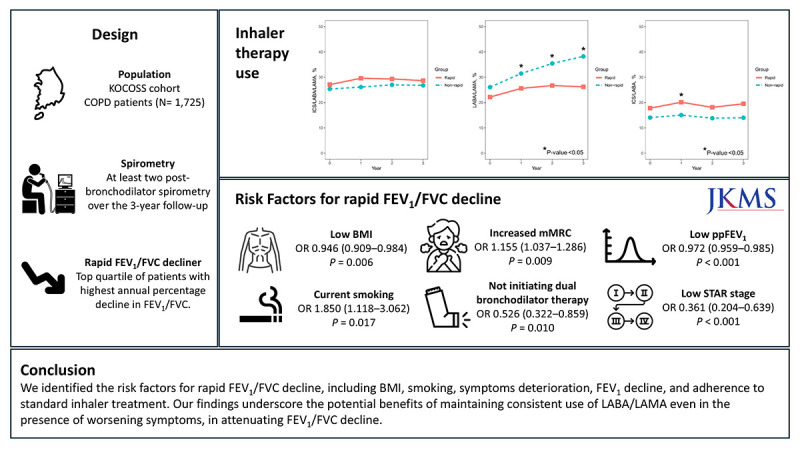
Background: Factors influencing the decline in forced expiratory volume in one second (FEV₁)/forced vital capacity (FVC) for chronic obstructive pulmonary disease (COPD) progression remain uncertain. We aimed to identify risk factors associated with rapid FEV₁/FVC decline in patients with COPD.
Methods: This multi-center observational study was conducted from January 2012 to December 2022. Eligible patients were monitored with symptoms, spirometric tests, and treatment patterns over 3 years. Rapid FEV₁/FVC decliners were defined as the quartile of patients exhibiting the highest annualized percentage decline in FEV₁/FVC.
Results: Among 1,725 patients, 435 exhibited rapid FEV₁/FVC decline, with an annual change of -2.5%p (interquartile range, -3.5 to -2.0). Rapid FEV₁/FVC decliners exhibited lower body mass index (BMI), higher smoking rates, elevated post-bronchodilator (BD) FEV₁, higher post-BD FEV₁/FVC, and a lower prevalence of Staging of Airflow Obstruction by Ratio (STAR) stage IV. Rapid FEV₁/FVC decline was not linked to the annual exacerbation rate, but there was an association with symptom deterioration and FEV₁ decline. In multivariable analyses, low BMI, current smoking, increased modified Medical Research Council dyspnoea score, low post-BD FEV₁, low STAR stage, high forced mid-expiratory flow (FEF25-75%), accelerated FEV₁ decline, and not initiating dual BD therapy were identified as independent risk factors for rapid FEV₁/FVC decline.
Conclusion: We identified the risk factors for rapid FEV₁/FVC decline, including BMI, smoking, symptoms deterioration, FEV₁ decline, and adherence to standard inhaler treatment. Our findings underscore the potential benefits of maintaining consistent use of long-acting beta-agonist/long-acting muscarinic antagonist even in the presence of worsening symptoms, in attenuating FEV₁/FVC decline.
期刊介绍:
The Journal of Korean Medical Science (JKMS) is an international, peer-reviewed Open Access journal of medicine published weekly in English. The Journal’s publisher is the Korean Academy of Medical Sciences (KAMS), Korean Medical Association (KMA). JKMS aims to publish evidence-based, scientific research articles from various disciplines of the medical sciences. The Journal welcomes articles of general interest to medical researchers especially when they contain original information. Articles on the clinical evaluation of drugs and other therapies, epidemiologic studies of the general population, studies on pathogenic organisms and toxic materials, and the toxicities and adverse effects of therapeutics are welcome.






 京公网安备 11010802042870号
京ICP备2023020795号-1
京公网安备 11010802042870号
京ICP备2023020795号-1

 分享
分享
 求助内容:
求助内容: 应助结果提醒方式:
 扫码关注我们
