Bjarki T Alexandersson, Michael P Jones, Anna Forsberg, Charlotte R H Hedin, Ellionore Järbrink-Sehgal, Susanna Walter, Nicholas J Talley, Lars Agreus, Anna Andreasson, Peter T Schmidt
{"title":"Uncomplicated Diverticulosis Is Not Associated With Abdominal Pain or Abnormal Bowel Habit-A Population-Based Swedish Cohort Study.","authors":"Bjarki T Alexandersson, Michael P Jones, Anna Forsberg, Charlotte R H Hedin, Ellionore Järbrink-Sehgal, Susanna Walter, Nicholas J Talley, Lars Agreus, Anna Andreasson, Peter T Schmidt","doi":"10.1111/nmo.70000","DOIUrl":null,"url":null,"abstract":"<p><strong>Background: </strong>Whether uncomplicated diverticulosis gives rise to symptoms is controversial. Diary-based studies of abdominal pain and stool habits in general populations are scarce, and we therefore investigated symptom patterns in diverticulosis from prospectively collected symptom diaries in a random sample of the general population who completed a research colonoscopy.</p><p><strong>Methods: </strong>In the Swedish population-based colonoscopy (PopCol) study, 745 individuals from the general population underwent a colonoscopy of which 130 had diverticulosis, and none had diverticulitis. Seven-day symptom diaries were completed by 258 participants (age 54, women 64%) of which 50 had diverticulosis. The frequency and location of abdominal pain, bowel habit and other gastrointestinal symptoms were compared between individuals with and without diverticulosis using logistic regression.</p><p><strong>Key results: </strong>Diverticulosis was not associated with abdominal pain (OR 1.24, CI 0.61-2.55) or left lower quadrant (LLQ) abdominal pain (OR 1.59, CI 0.73-3.49). Pain duration and severity were not associated with diverticulosis. When individuals with diverticulosis had pain, it was more often in the LLQ (OR 2.45, CI 1.02-5.86) compared with those without diverticulosis. Diverticulosis was not linked to altered bowel habits. Irritable bowel syndrome prevalence was 16% in the diverticulosis group and 19% in the non-diverticulosis group.</p><p><strong>Conclusions and inferences: </strong>Participants with diverticulosis did not report more abdominal pain or more LLQ abdominal pain than participants without diverticulosis. Bowel habit was not abnormal in diverticulosis. Our results do not support that uncomplicated diverticulosis cause symptoms in individuals without a history of acute diverticulitis.</p>","PeriodicalId":19123,"journal":{"name":"Neurogastroenterology and Motility","volume":" ","pages":"e70000"},"PeriodicalIF":2.9000,"publicationDate":"2025-06-01","publicationTypes":"Journal Article","fieldsOfStudy":null,"isOpenAccess":false,"openAccessPdf":"https://www.ncbi.nlm.nih.gov/pmc/articles/PMC12075898/pdf/","citationCount":"0","resultStr":null,"platform":"Semanticscholar","paperid":null,"PeriodicalName":"Neurogastroenterology and Motility","FirstCategoryId":"3","ListUrlMain":"https://doi.org/10.1111/nmo.70000","RegionNum":3,"RegionCategory":"医学","ArticlePicture":[],"TitleCN":null,"AbstractTextCN":null,"PMCID":null,"EPubDate":"2025/2/17 0:00:00","PubModel":"Epub","JCR":"Q1","JCRName":"CLINICAL NEUROLOGY","Score":null,"Total":0}
引用次数: 0
Abstract
Background: Whether uncomplicated diverticulosis gives rise to symptoms is controversial. Diary-based studies of abdominal pain and stool habits in general populations are scarce, and we therefore investigated symptom patterns in diverticulosis from prospectively collected symptom diaries in a random sample of the general population who completed a research colonoscopy.
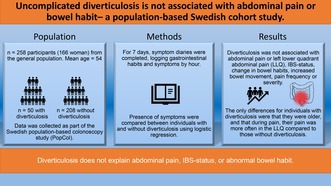
Methods: In the Swedish population-based colonoscopy (PopCol) study, 745 individuals from the general population underwent a colonoscopy of which 130 had diverticulosis, and none had diverticulitis. Seven-day symptom diaries were completed by 258 participants (age 54, women 64%) of which 50 had diverticulosis. The frequency and location of abdominal pain, bowel habit and other gastrointestinal symptoms were compared between individuals with and without diverticulosis using logistic regression.
Key results: Diverticulosis was not associated with abdominal pain (OR 1.24, CI 0.61-2.55) or left lower quadrant (LLQ) abdominal pain (OR 1.59, CI 0.73-3.49). Pain duration and severity were not associated with diverticulosis. When individuals with diverticulosis had pain, it was more often in the LLQ (OR 2.45, CI 1.02-5.86) compared with those without diverticulosis. Diverticulosis was not linked to altered bowel habits. Irritable bowel syndrome prevalence was 16% in the diverticulosis group and 19% in the non-diverticulosis group.
Conclusions and inferences: Participants with diverticulosis did not report more abdominal pain or more LLQ abdominal pain than participants without diverticulosis. Bowel habit was not abnormal in diverticulosis. Our results do not support that uncomplicated diverticulosis cause symptoms in individuals without a history of acute diverticulitis.
背景:无并发症的憩室病是否引起症状是有争议的。一般人群腹痛和排便习惯的基于日记的研究很少,因此,我们从完成研究结肠镜检查的普通人群随机样本中前瞻性收集症状日记,研究憩室病的症状模式。方法:在瑞典以人群为基础的结肠镜检查(PopCol)研究中,来自普通人群的745人接受了结肠镜检查,其中130人患有憩室病,没有人患有憩室炎。258名参与者(54岁,女性64%)完成了为期7天的症状日记,其中50名患有憩室病。采用logistic回归比较有憩室病和无憩室病个体腹痛、排便习惯和其他胃肠道症状的发生频率和部位。关键结果:憩室病与腹痛(OR 1.24, CI 0.61-2.55)或左下腹(LLQ)腹痛(OR 1.59, CI 0.73-3.49)无关。疼痛持续时间和严重程度与憩室病无关。当患有憩室病的个体有疼痛时,与没有憩室病的个体相比,LLQ更常见(OR 2.45, CI 1.02-5.86)。憩室病与排便习惯的改变无关。肠易激综合征患病率在憩室病组为16%,在非憩室病组为19%。结论和推论:与没有憩室病的参与者相比,患有憩室病的参与者没有报告更多的腹痛或LLQ型腹痛。憩室病患者排便习惯未见异常。我们的研究结果不支持无急性憩室炎病史的个体引起无并发症的憩室病症状。
期刊介绍:
Neurogastroenterology & Motility (NMO) is the official Journal of the European Society of Neurogastroenterology & Motility (ESNM) and the American Neurogastroenterology and Motility Society (ANMS). It is edited by James Galligan, Albert Bredenoord, and Stephen Vanner. The editorial and peer review process is independent of the societies affiliated to the journal and publisher: Neither the ANMS, the ESNM or the Publisher have editorial decision-making power. Whenever these are relevant to the content being considered or published, the editors, journal management committee and editorial board declare their interests and affiliations.



 京公网安备 11010802042870号
京ICP备2023020795号-1
京公网安备 11010802042870号
京ICP备2023020795号-1

 分享
分享
 求助内容:
求助内容: 应助结果提醒方式:
 扫码关注我们
