Antonio Gonzalez, Manel Tardáguila, Lourdes Ispierto, Jorge Muñoz, Mireia Gea, Serge Jaumà, Gerard Plans, Ramiro Álvarez, Dolores Vilas Rolán
{"title":"Focused Ultrasound as Rescue Treatment of Essential Tremor After Deep Brain Stimulation: 2 Case Reports.","authors":"Antonio Gonzalez, Manel Tardáguila, Lourdes Ispierto, Jorge Muñoz, Mireia Gea, Serge Jaumà, Gerard Plans, Ramiro Álvarez, Dolores Vilas Rolán","doi":"10.1227/neuprac.0000000000000101","DOIUrl":null,"url":null,"abstract":"<p><strong>Background and importance: </strong>Approximately 25% to 55% of patients with essential tremor will eventually develop medication-refractory tremor. Currently, the standard surgical treatment for this condition is deep brain stimulation (DBS) of the ventralis intermedius nucleus of the thalamus and, more recently, the posterior subthalamic area. However, MRI-guided focused ultrasound (FUS) thalamotomy has shown promising results in improving tremor in patients with refractory essential tremor.</p><p><strong>Clinical presentation: </strong>We present 2 cases of patients with a disabling action tremor, recurring after DBS. A 55-year-old right-handed male and a 52-year-old woman presented with bilateral medically refractory action tremor, which began in their second decade of life. Both underwent bilateral DBS-ventralis intermedius, with the first patient showing a good initial response but the second patient showing a suboptimal response within the first year after DBS. In both cases, the DBS system was removed and the patients subsequently underwent left-sided FUS thalamotomy with a dramatic improvement of their tremor.</p><p><strong>Conclusion: </strong>These cases demonstrate the feasibility of performing FUS thalamotomy as a rescue treatment for disabling tremor after DBS.</p>","PeriodicalId":74298,"journal":{"name":"Neurosurgery practice","volume":"5 3","pages":"e00101"},"PeriodicalIF":0.6000,"publicationDate":"2024-07-25","publicationTypes":"Journal Article","fieldsOfStudy":null,"isOpenAccess":false,"openAccessPdf":"https://www.ncbi.nlm.nih.gov/pmc/articles/PMC11783652/pdf/","citationCount":"0","resultStr":null,"platform":"Semanticscholar","paperid":null,"PeriodicalName":"Neurosurgery practice","FirstCategoryId":"1085","ListUrlMain":"https://doi.org/10.1227/neuprac.0000000000000101","RegionNum":0,"RegionCategory":null,"ArticlePicture":[],"TitleCN":null,"AbstractTextCN":null,"PMCID":null,"EPubDate":"2024/9/1 0:00:00","PubModel":"eCollection","JCR":"","JCRName":"","Score":null,"Total":0}
引用次数: 0
Abstract
Background and importance: Approximately 25% to 55% of patients with essential tremor will eventually develop medication-refractory tremor. Currently, the standard surgical treatment for this condition is deep brain stimulation (DBS) of the ventralis intermedius nucleus of the thalamus and, more recently, the posterior subthalamic area. However, MRI-guided focused ultrasound (FUS) thalamotomy has shown promising results in improving tremor in patients with refractory essential tremor.
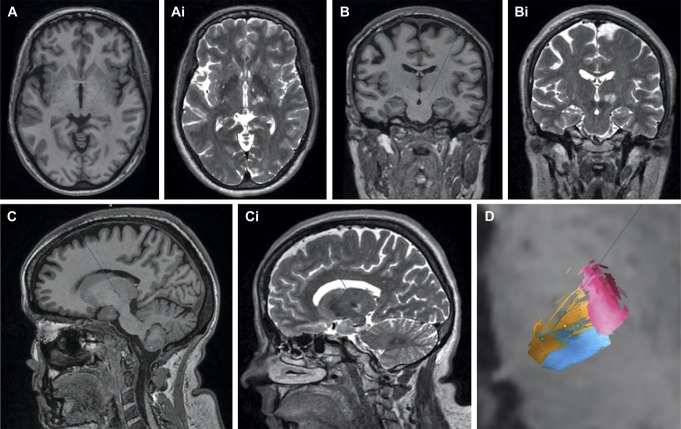
Clinical presentation: We present 2 cases of patients with a disabling action tremor, recurring after DBS. A 55-year-old right-handed male and a 52-year-old woman presented with bilateral medically refractory action tremor, which began in their second decade of life. Both underwent bilateral DBS-ventralis intermedius, with the first patient showing a good initial response but the second patient showing a suboptimal response within the first year after DBS. In both cases, the DBS system was removed and the patients subsequently underwent left-sided FUS thalamotomy with a dramatic improvement of their tremor.
Conclusion: These cases demonstrate the feasibility of performing FUS thalamotomy as a rescue treatment for disabling tremor after DBS.




 京公网安备 11010802042870号
京ICP备2023020795号-1
京公网安备 11010802042870号
京ICP备2023020795号-1

 分享
分享

 求助内容:
求助内容: 应助结果提醒方式:
 扫码关注我们
