Cooperative Hedgehog/GLI and JAK/STAT signaling drives immunosuppressive tryptophan/kynurenine metabolism via synergistic induction of IDO1 in skin cancer.
Dominik P Elmer, Georg Stockmaier, Sandra Grund-Gröschke, Victoria Strobl, Hieu-Hoa Dang, Markus Wiederstein, David Licha, Anna Strobl, Anna Eglseer, Christina Sternberg, Suzana Tesanovic, Wolfgang Gruber, Florian Wolff, Richard Moriggl, Angela Risch, Roland Reischl, Christian G Huber, Peter W Krenn, Nikolaus Fortelny, Jutta Horejs-Hoeck, Fritz Aberger
{"title":"Cooperative Hedgehog/GLI and JAK/STAT signaling drives immunosuppressive tryptophan/kynurenine metabolism via synergistic induction of IDO1 in skin cancer.","authors":"Dominik P Elmer, Georg Stockmaier, Sandra Grund-Gröschke, Victoria Strobl, Hieu-Hoa Dang, Markus Wiederstein, David Licha, Anna Strobl, Anna Eglseer, Christina Sternberg, Suzana Tesanovic, Wolfgang Gruber, Florian Wolff, Richard Moriggl, Angela Risch, Roland Reischl, Christian G Huber, Peter W Krenn, Nikolaus Fortelny, Jutta Horejs-Hoeck, Fritz Aberger","doi":"10.1186/s12964-025-02101-6","DOIUrl":null,"url":null,"abstract":"<p><strong>Background: </strong>Pharmacological targeting of Hedgehog (HH)/GLI has proven effective for certain blood, brain and skin cancers including basal cell carcinoma (BCC). However, limited response rates and the development of drug resistance call for improved anti-HH therapies that take synergistic crosstalk mechanisms and immune evasion strategies into account. In previous work, we demonstrated that cooperation of HH/GLI and Interleukin 6 (IL6)/STAT3 signaling drives BCC growth. Whether synergistic HH-IL6 signaling promotes BCC via the activation of immune evasion mechanisms remained unclear.</p><p><strong>Methods: </strong>HH-IL6 regulated immunosuppressive genes such as indoleamine 2,3-dioxygenase 1 (IDO1) were identified by gene expression profiling. IDO1 expression was evaluated in human BCC and melanoma models by qPCR and Western blot analyses. The cis-regulatory region of IDO1 was interrogated for HH-IL6-regulated GLI and STAT transcription factor binding and epigenetic modifications by targeted chromatin-immunoprecipitation and bisulfite pyrosequencing. Functional analyses of the immunosuppressive effects of IDO1 involved HPLC-MS measurements of its metabolites and the assessment of T cell proliferation via flow cytometry. Bioinformatic analyses of GLI-STAT cooperation were conducted on published bulk and single-cell RNA-seq data of human BCC and melanoma patients.</p><p><strong>Results: </strong>We identified IDO1 as a target gene of cooperative GLI-STAT activity in BCC and melanoma. GLI1 and STAT3 transcription factors synergistically enhanced IDO1 expression by jointly binding to the cis-regulatory region of IDO1 and by increasing active chromatin marks at the histone level. In human melanoma cells, inhibition of GLI1 expression prevented the induction of IDO1 expression in response to IL6/STAT3 and IFNγ/STAT1 signaling. Pharmacological targeting of HH/GLI signaling reduced IDO1 expression, resulting in decreased production of the immunosuppressive metabolite kynurenine. Further, inhibition of GLI1 enhanced the efficacy of the selective IDO1 inhibitor epacadostat and rescued T cell proliferation by attenuating IDO1/kynurenine-mediated immunosuppression. Elevated expression of IDO1 correlated with active HH/GLI and JAK/STAT signaling in skin cancer patients supporting the clinical relevance of the mechanistic data presented.</p><p><strong>Conclusions: </strong>These results identify the immunosuppressive IDO1-kynurenine pathway as a novel pro-tumorigenic target of oncogenic GLI and STAT1/STAT3 cooperation. Our data suggest simultaneous pharmacological targeting of these signaling axes as rational combination therapy in melanoma and non-melanoma skin cancers.</p>","PeriodicalId":55268,"journal":{"name":"Cell Communication and Signaling","volume":"23 1","pages":"91"},"PeriodicalIF":8.2000,"publicationDate":"2025-02-17","publicationTypes":"Journal Article","fieldsOfStudy":null,"isOpenAccess":false,"openAccessPdf":"https://www.ncbi.nlm.nih.gov/pmc/articles/PMC11834474/pdf/","citationCount":"0","resultStr":null,"platform":"Semanticscholar","paperid":null,"PeriodicalName":"Cell Communication and Signaling","FirstCategoryId":"99","ListUrlMain":"https://doi.org/10.1186/s12964-025-02101-6","RegionNum":2,"RegionCategory":"生物学","ArticlePicture":[],"TitleCN":null,"AbstractTextCN":null,"PMCID":null,"EPubDate":"","PubModel":"","JCR":"Q1","JCRName":"CELL BIOLOGY","Score":null,"Total":0}
引用次数: 0
Abstract
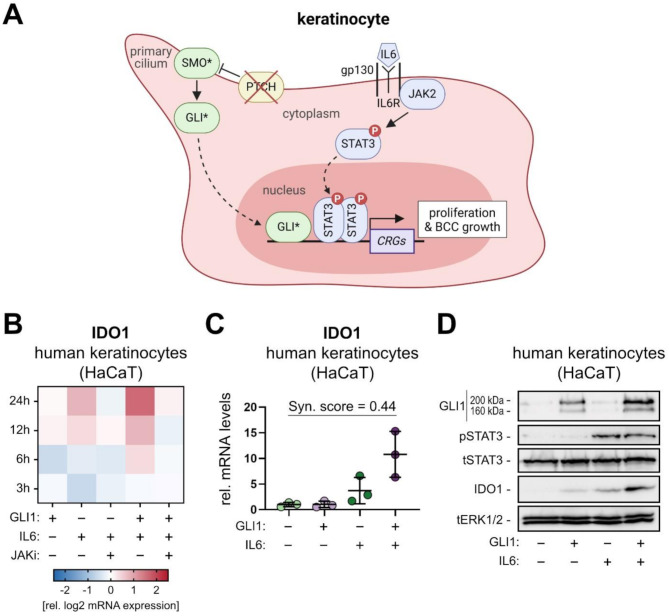
Background: Pharmacological targeting of Hedgehog (HH)/GLI has proven effective for certain blood, brain and skin cancers including basal cell carcinoma (BCC). However, limited response rates and the development of drug resistance call for improved anti-HH therapies that take synergistic crosstalk mechanisms and immune evasion strategies into account. In previous work, we demonstrated that cooperation of HH/GLI and Interleukin 6 (IL6)/STAT3 signaling drives BCC growth. Whether synergistic HH-IL6 signaling promotes BCC via the activation of immune evasion mechanisms remained unclear.
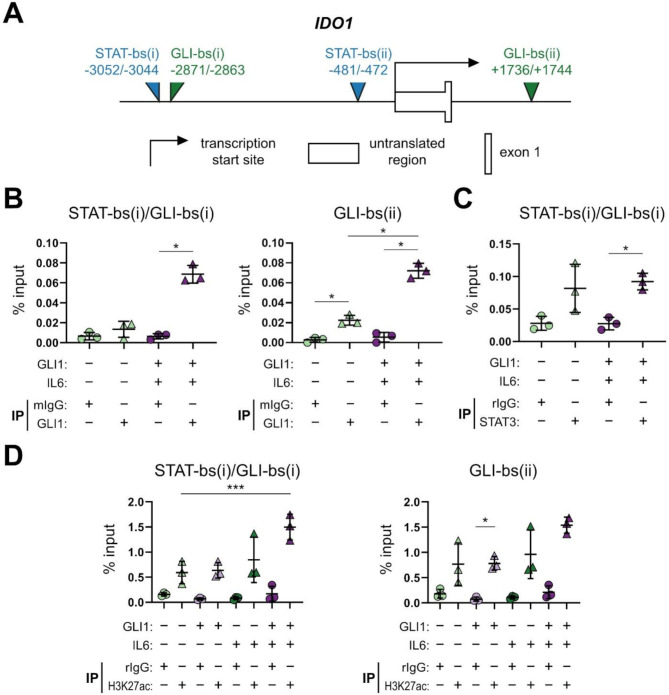
Methods: HH-IL6 regulated immunosuppressive genes such as indoleamine 2,3-dioxygenase 1 (IDO1) were identified by gene expression profiling. IDO1 expression was evaluated in human BCC and melanoma models by qPCR and Western blot analyses. The cis-regulatory region of IDO1 was interrogated for HH-IL6-regulated GLI and STAT transcription factor binding and epigenetic modifications by targeted chromatin-immunoprecipitation and bisulfite pyrosequencing. Functional analyses of the immunosuppressive effects of IDO1 involved HPLC-MS measurements of its metabolites and the assessment of T cell proliferation via flow cytometry. Bioinformatic analyses of GLI-STAT cooperation were conducted on published bulk and single-cell RNA-seq data of human BCC and melanoma patients.
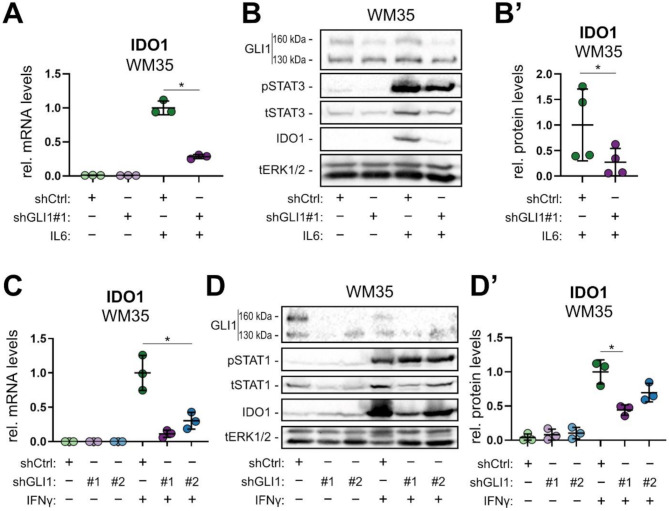
Results: We identified IDO1 as a target gene of cooperative GLI-STAT activity in BCC and melanoma. GLI1 and STAT3 transcription factors synergistically enhanced IDO1 expression by jointly binding to the cis-regulatory region of IDO1 and by increasing active chromatin marks at the histone level. In human melanoma cells, inhibition of GLI1 expression prevented the induction of IDO1 expression in response to IL6/STAT3 and IFNγ/STAT1 signaling. Pharmacological targeting of HH/GLI signaling reduced IDO1 expression, resulting in decreased production of the immunosuppressive metabolite kynurenine. Further, inhibition of GLI1 enhanced the efficacy of the selective IDO1 inhibitor epacadostat and rescued T cell proliferation by attenuating IDO1/kynurenine-mediated immunosuppression. Elevated expression of IDO1 correlated with active HH/GLI and JAK/STAT signaling in skin cancer patients supporting the clinical relevance of the mechanistic data presented.
Conclusions: These results identify the immunosuppressive IDO1-kynurenine pathway as a novel pro-tumorigenic target of oncogenic GLI and STAT1/STAT3 cooperation. Our data suggest simultaneous pharmacological targeting of these signaling axes as rational combination therapy in melanoma and non-melanoma skin cancers.
期刊介绍:
Cell Communication and Signaling (CCS) is a peer-reviewed, open-access scientific journal that focuses on cellular signaling pathways in both normal and pathological conditions. It publishes original research, reviews, and commentaries, welcoming studies that utilize molecular, morphological, biochemical, structural, and cell biology approaches. CCS also encourages interdisciplinary work and innovative models, including in silico, in vitro, and in vivo approaches, to facilitate investigations of cell signaling pathways, networks, and behavior.
Starting from January 2019, CCS is proud to announce its affiliation with the International Cell Death Society. The journal now encourages submissions covering all aspects of cell death, including apoptotic and non-apoptotic mechanisms, cell death in model systems, autophagy, clearance of dying cells, and the immunological and pathological consequences of dying cells in the tissue microenvironment.



 京公网安备 11010802042870号
京ICP备2023020795号-1
京公网安备 11010802042870号
京ICP备2023020795号-1

 分享
分享
 求助内容:
求助内容: 应助结果提醒方式:
 扫码关注我们
