Eagle syndrome with repeated transient disturbances of consciousness diagnosed using digital subtraction angiography with head rotation: illustrative case.
{"title":"Eagle syndrome with repeated transient disturbances of consciousness diagnosed using digital subtraction angiography with head rotation: illustrative case.","authors":"Hiroki Kobayashi, Yoshinori Kotani, Mamoru Ogiso, Yusuke Egashira, Shinji Noda","doi":"10.3171/CASE24744","DOIUrl":null,"url":null,"abstract":"<p><strong>Background: </strong>Eagle syndrome with repeated transient disturbances of consciousness is uncommon, with only a few reported cases. Here, the authors report a rare case of Eagle syndrome with repeated transient disturbances of consciousness in a specific head position, diagnosed using digital subtraction angiography (DSA) with head rotation.</p><p><strong>Observations: </strong>A 74-year-old man experienced several episodes of transient disturbance of consciousness. When he stared downward toward the left, he experienced transient tremors in the right upper and lower limbs and a transient loss of consciousness. Magnetic resonance imaging failed to identify the cause. DSA performed with external head rotation and leftward flexion revealed a delay of blood flow distal to the cervical portion of the left internal carotid artery caused by compression from the left styloid process. A superficial temporal artery-middle cerebral artery (STA-MCA) bypass was required in the right cerebral hemisphere. The styloid process was removed first, as the head needed leftward rotation during surgery. Transient disturbance of consciousness did not recur after surgery. Four months later, a right STA-MCA bypass was performed.</p><p><strong>Lessons: </strong>This case highlights Eagle syndrome as a potential cause of repeated transient disturbances of consciousness. DSA with head rotation proved useful for the diagnosis. https://thejns.org/doi/10.3171/CASE24744.</p>","PeriodicalId":94098,"journal":{"name":"Journal of neurosurgery. Case lessons","volume":"9 7","pages":""},"PeriodicalIF":0.0000,"publicationDate":"2025-02-17","publicationTypes":"Journal Article","fieldsOfStudy":null,"isOpenAccess":false,"openAccessPdf":"https://www.ncbi.nlm.nih.gov/pmc/articles/PMC11833231/pdf/","citationCount":"0","resultStr":null,"platform":"Semanticscholar","paperid":null,"PeriodicalName":"Journal of neurosurgery. Case lessons","FirstCategoryId":"1085","ListUrlMain":"https://doi.org/10.3171/CASE24744","RegionNum":0,"RegionCategory":null,"ArticlePicture":[],"TitleCN":null,"AbstractTextCN":null,"PMCID":null,"EPubDate":"","PubModel":"","JCR":"","JCRName":"","Score":null,"Total":0}
引用次数: 0
Abstract
Background: Eagle syndrome with repeated transient disturbances of consciousness is uncommon, with only a few reported cases. Here, the authors report a rare case of Eagle syndrome with repeated transient disturbances of consciousness in a specific head position, diagnosed using digital subtraction angiography (DSA) with head rotation.
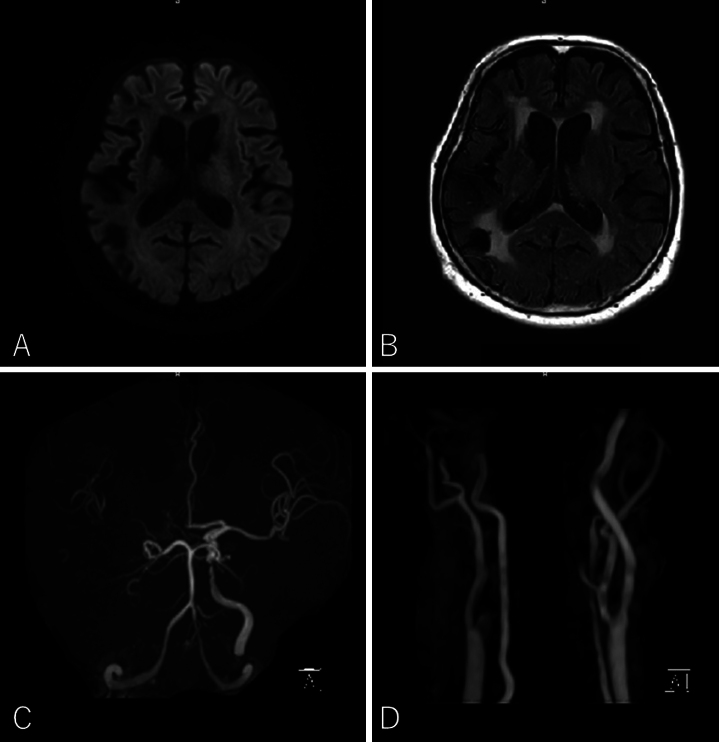
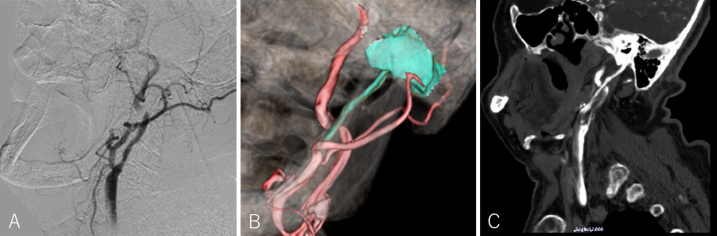
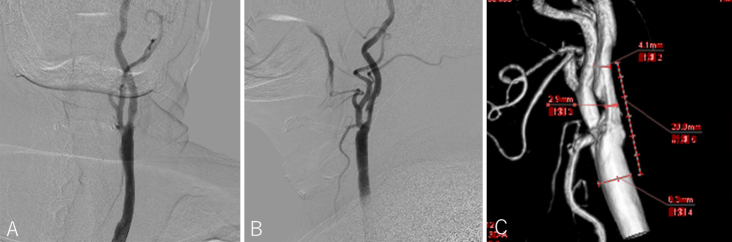
Observations: A 74-year-old man experienced several episodes of transient disturbance of consciousness. When he stared downward toward the left, he experienced transient tremors in the right upper and lower limbs and a transient loss of consciousness. Magnetic resonance imaging failed to identify the cause. DSA performed with external head rotation and leftward flexion revealed a delay of blood flow distal to the cervical portion of the left internal carotid artery caused by compression from the left styloid process. A superficial temporal artery-middle cerebral artery (STA-MCA) bypass was required in the right cerebral hemisphere. The styloid process was removed first, as the head needed leftward rotation during surgery. Transient disturbance of consciousness did not recur after surgery. Four months later, a right STA-MCA bypass was performed.
Lessons: This case highlights Eagle syndrome as a potential cause of repeated transient disturbances of consciousness. DSA with head rotation proved useful for the diagnosis. https://thejns.org/doi/10.3171/CASE24744.




 京公网安备 11010802042870号
京ICP备2023020795号-1
京公网安备 11010802042870号
京ICP备2023020795号-1

 分享
分享

 求助内容:
求助内容: 应助结果提醒方式:
 扫码关注我们
