Yue Zhang, Chu-Yi Zhang, Jing Yuan, Hongyan Jiang, Ping Sun, Li Hui, Li Xu, Ling Yu, Zeyi Guo, Lu Wang, Yi Yang, Ming Li, Shi-Wu Li, Jianzhong Yang, Wei Li, Zhaowei Teng, Xiao Xiao
{"title":"Human mood disorder risk gene Synaptotagmin-14 contributes to mania-like behaviors in mice","authors":"Yue Zhang, Chu-Yi Zhang, Jing Yuan, Hongyan Jiang, Ping Sun, Li Hui, Li Xu, Ling Yu, Zeyi Guo, Lu Wang, Yi Yang, Ming Li, Shi-Wu Li, Jianzhong Yang, Wei Li, Zhaowei Teng, Xiao Xiao","doi":"10.1038/s41380-025-02933-1","DOIUrl":null,"url":null,"abstract":"Bipolar disorder (BD) and major depressive disorder (MDD) are the most prevalent mood disorders and cause considerable burden worldwide. Compelling evidence suggests a pronounced overlap between these two disorders in clinical symptoms, treatment strategies, and genetic etiology. Here we leverage a BD GWAS (1822 cases and 4650 controls) and a MDD GWAS (5303 cases and 5337 controls), followed by independent replications, to investigate their shared genetic basis among Han Chinese. We have herein identified a lead SNP rs126277 at the 1q32.2 locus, which also exhibited nominal associations with mood disorders and several relevant sub-clinical phenotypes (e.g., mania) in European populations. Bulk tissue and single-cell eQTL analyses suggest that the risk G-allele of rs126277 predicted lower SYT14 mRNA expression in human brains. We generated mice lacking Syt14 (Syt14–/–) and mice with insufficient expression of Syt14 in the hippocampus (Syt14-KD), and found that depletion of Syt14 resulted in mania-like behaviors including hyperactivity and anti-depressive behaviors, resembling aspects of mood disorders. We also confirmed that deficiency of this gene in the hippocampus was sufficient to induce hyperactivity in mice. RNA-sequencing analyses of the hippocampus of Syt14–/– mice revealed significant upregulation of Per1 as well as downregulation of Slc7a11 and Ptprb. Ultrastructural analyses showed significant alteration of the number of vesicles within 50 nm to the active zone and the width of synaptic cleft in the ventral hippocampus of Syt14–/– mice compared with the control mice. Overall, we have identified a novel mood disorder risk gene SYT14, and confirmed its impact on mania-like behaviors. While the current study identifies an essential mood disorder risk gene, further investigations elucidating the detailed mechanisms by which SYT14 contributes to the pathogenesis of the illnesses are needed.","PeriodicalId":19008,"journal":{"name":"Molecular Psychiatry","volume":"30 8","pages":"3466-3477"},"PeriodicalIF":10.1000,"publicationDate":"2025-02-18","publicationTypes":"Journal Article","fieldsOfStudy":null,"isOpenAccess":false,"openAccessPdf":"","citationCount":"0","resultStr":null,"platform":"Semanticscholar","paperid":null,"PeriodicalName":"Molecular Psychiatry","FirstCategoryId":"3","ListUrlMain":"https://www.nature.com/articles/s41380-025-02933-1","RegionNum":1,"RegionCategory":"医学","ArticlePicture":[],"TitleCN":null,"AbstractTextCN":null,"PMCID":null,"EPubDate":"","PubModel":"","JCR":"Q1","JCRName":"BIOCHEMISTRY & MOLECULAR BIOLOGY","Score":null,"Total":0}
引用次数: 0
Abstract
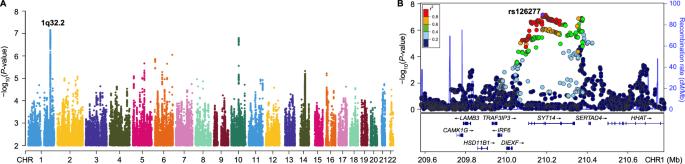
Bipolar disorder (BD) and major depressive disorder (MDD) are the most prevalent mood disorders and cause considerable burden worldwide. Compelling evidence suggests a pronounced overlap between these two disorders in clinical symptoms, treatment strategies, and genetic etiology. Here we leverage a BD GWAS (1822 cases and 4650 controls) and a MDD GWAS (5303 cases and 5337 controls), followed by independent replications, to investigate their shared genetic basis among Han Chinese. We have herein identified a lead SNP rs126277 at the 1q32.2 locus, which also exhibited nominal associations with mood disorders and several relevant sub-clinical phenotypes (e.g., mania) in European populations. Bulk tissue and single-cell eQTL analyses suggest that the risk G-allele of rs126277 predicted lower SYT14 mRNA expression in human brains. We generated mice lacking Syt14 (Syt14–/–) and mice with insufficient expression of Syt14 in the hippocampus (Syt14-KD), and found that depletion of Syt14 resulted in mania-like behaviors including hyperactivity and anti-depressive behaviors, resembling aspects of mood disorders. We also confirmed that deficiency of this gene in the hippocampus was sufficient to induce hyperactivity in mice. RNA-sequencing analyses of the hippocampus of Syt14–/– mice revealed significant upregulation of Per1 as well as downregulation of Slc7a11 and Ptprb. Ultrastructural analyses showed significant alteration of the number of vesicles within 50 nm to the active zone and the width of synaptic cleft in the ventral hippocampus of Syt14–/– mice compared with the control mice. Overall, we have identified a novel mood disorder risk gene SYT14, and confirmed its impact on mania-like behaviors. While the current study identifies an essential mood disorder risk gene, further investigations elucidating the detailed mechanisms by which SYT14 contributes to the pathogenesis of the illnesses are needed.
期刊介绍:
Molecular Psychiatry focuses on publishing research that aims to uncover the biological mechanisms behind psychiatric disorders and their treatment. The journal emphasizes studies that bridge pre-clinical and clinical research, covering cellular, molecular, integrative, clinical, imaging, and psychopharmacology levels.



 京公网安备 11010802042870号
京ICP备2023020795号-1
京公网安备 11010802042870号
京ICP备2023020795号-1

 分享
分享
 求助内容:
求助内容: 应助结果提醒方式:
 扫码关注我们
