Carlo Mazzocca;Abbas Acar;Selcuk Uluagac;Rebecca Montanari;Paolo Bellavista;Mauro Conti
{"title":"A Survey on Decentralized Identifiers and Verifiable Credentials","authors":"Carlo Mazzocca;Abbas Acar;Selcuk Uluagac;Rebecca Montanari;Paolo Bellavista;Mauro Conti","doi":"10.1109/COMST.2025.3543197","DOIUrl":null,"url":null,"abstract":"Digital identity has always been one of the keystones for implementing secure and trustworthy communications among parties. The ever-evolving digital landscape has undergone numerous technological transformations that have profoundly reshaped digital identity management, leading to a major shift from centralized to decentralized identity models. The latest stage of this evolution is represented by the emerging paradigm of Self-Sovereign Identity (SSI), which gives identity owners full control over their data. SSI leverages Decentralized Identifiers (DIDs) and Verifiable Credentials (VCs), which have been recently standardized by the World Wide Web Consortium (W3C). These technologies have the potential to build more secure and decentralized digital identity systems, significantly strengthening communication security in scenarios involving many distributed participants. It is worth noting that use of DIDs and VCs is not limited to individuals but extends to a wide range of entities including cloud, edge, and Internet of Things (IoT) resources. However, due to their novelty, existing literature lacks a comprehensive survey on DIDs and VCs beyond the scope of SSI. This paper fills this gap by providing a comprehensive overview of DIDs and VCs from multiple perspectives. It identifies key security threats and mitigation strategies, analyzes available implementations to guide practitioners in making informed decisions, and reviews the adoption of these technologies across various application domains. Moreover, it also examines related regulations, projects, and consortiums emerging worldwide. Finally, it discusses the primary challenges hindering their real-world adoption and outlines future research directions.","PeriodicalId":55029,"journal":{"name":"IEEE Communications Surveys and Tutorials","volume":"27 6","pages":"3641-3671"},"PeriodicalIF":34.4000,"publicationDate":"2025-02-18","publicationTypes":"Journal Article","fieldsOfStudy":null,"isOpenAccess":false,"openAccessPdf":"","citationCount":"0","resultStr":null,"platform":"Semanticscholar","paperid":null,"PeriodicalName":"IEEE Communications Surveys and Tutorials","FirstCategoryId":"94","ListUrlMain":"https://ieeexplore.ieee.org/document/10891701/","RegionNum":1,"RegionCategory":"计算机科学","ArticlePicture":[],"TitleCN":null,"AbstractTextCN":null,"PMCID":null,"EPubDate":"","PubModel":"","JCR":"Q1","JCRName":"COMPUTER SCIENCE, INFORMATION SYSTEMS","Score":null,"Total":0}
引用次数: 0
Abstract
Digital identity has always been one of the keystones for implementing secure and trustworthy communications among parties. The ever-evolving digital landscape has undergone numerous technological transformations that have profoundly reshaped digital identity management, leading to a major shift from centralized to decentralized identity models. The latest stage of this evolution is represented by the emerging paradigm of Self-Sovereign Identity (SSI), which gives identity owners full control over their data. SSI leverages Decentralized Identifiers (DIDs) and Verifiable Credentials (VCs), which have been recently standardized by the World Wide Web Consortium (W3C). These technologies have the potential to build more secure and decentralized digital identity systems, significantly strengthening communication security in scenarios involving many distributed participants. It is worth noting that use of DIDs and VCs is not limited to individuals but extends to a wide range of entities including cloud, edge, and Internet of Things (IoT) resources. However, due to their novelty, existing literature lacks a comprehensive survey on DIDs and VCs beyond the scope of SSI. This paper fills this gap by providing a comprehensive overview of DIDs and VCs from multiple perspectives. It identifies key security threats and mitigation strategies, analyzes available implementations to guide practitioners in making informed decisions, and reviews the adoption of these technologies across various application domains. Moreover, it also examines related regulations, projects, and consortiums emerging worldwide. Finally, it discusses the primary challenges hindering their real-world adoption and outlines future research directions.
期刊介绍:
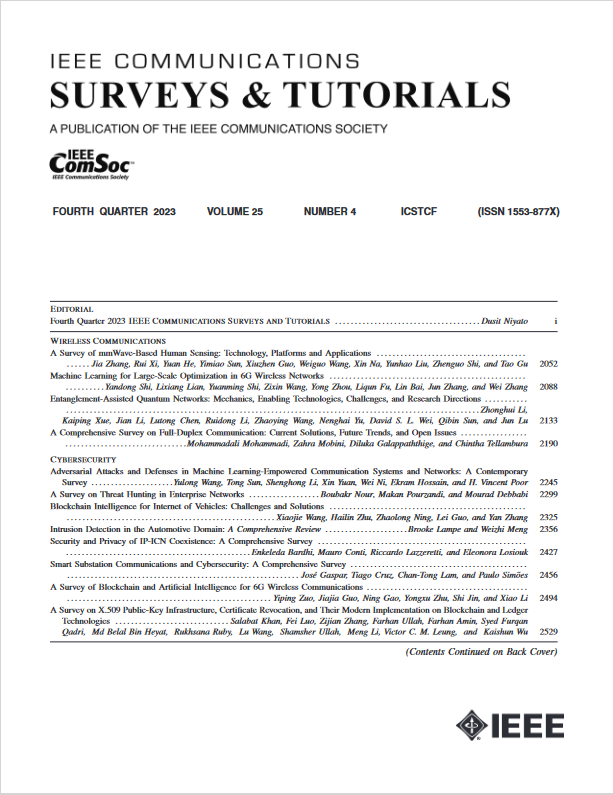
IEEE Communications Surveys & Tutorials is an online journal published by the IEEE Communications Society for tutorials and surveys covering all aspects of the communications field. Telecommunications technology is progressing at a rapid pace, and the IEEE Communications Society is committed to providing researchers and other professionals the information and tools to stay abreast. IEEE Communications Surveys and Tutorials focuses on integrating and adding understanding to the existing literature on communications, putting results in context. Whether searching for in-depth information about a familiar area or an introduction into a new area, IEEE Communications Surveys & Tutorials aims to be the premier source of peer-reviewed, comprehensive tutorials and surveys, and pointers to further sources. IEEE Communications Surveys & Tutorials publishes only articles exclusively written for IEEE Communications Surveys & Tutorials and go through a rigorous review process before their publication in the quarterly issues.
A tutorial article in the IEEE Communications Surveys & Tutorials should be designed to help the reader to become familiar with and learn something specific about a chosen topic. In contrast, the term survey, as applied here, is defined to mean a survey of the literature. A survey article in IEEE Communications Surveys & Tutorials should provide a comprehensive review of developments in a selected area, covering its development from its inception to its current state and beyond, and illustrating its development through liberal citations from the literature. Both tutorials and surveys should be tutorial in nature and should be written in a style comprehensible to readers outside the specialty of the article.




 京公网安备 11010802042870号
京ICP备2023020795号-1
京公网安备 11010802042870号
京ICP备2023020795号-1

 分享
分享
 求助内容:
求助内容: 应助结果提醒方式:
 扫码关注我们
