Xinyi Wang, Xin Wen, Yuchen Yan, Jindong Chen, Guangsai Yang, Guang Peng and Ning Ye
{"title":"From Ca3Be(SeO3)4 to SrBe(SeO3)2: two unprecedented alkaline earth metal beryllium selenites with large band gaps and enhanced birefringence†","authors":"Xinyi Wang, Xin Wen, Yuchen Yan, Jindong Chen, Guangsai Yang, Guang Peng and Ning Ye","doi":"10.1039/D5QI00039D","DOIUrl":null,"url":null,"abstract":"<p >Beryllium-based selenites have rarely been reported. Herein, the first two alkaline earth metal beryllium-based selenites, Ca<small><sub>3</sub></small>Be(SeO<small><sub>3</sub></small>)<small><sub>4</sub></small> and SrBe(SeO<small><sub>3</sub></small>)<small><sub>2</sub></small>, have been synthesized using a mild hydrothermal method. In both crystals, Be is connected to four [SeO<small><sub>3</sub></small>]<small><sup>2−</sup></small> groups. Due to the different arrangements of [SeO<small><sub>3</sub></small>]<small><sup>2−</sup></small> groups, these two crystals exhibit significantly different optical anisotropy. From Ca<small><sub>3</sub></small>Be(SeO<small><sub>3</sub></small>)<small><sub>4</sub></small> to SrBe(SeO<small><sub>3</sub></small>)<small><sub>2</sub></small>, the birefringence ranges from 0.005@546 nm to 0.058@546 nm. Theoretical calculations confirmed the dominant role of [SeO<small><sub>3</sub></small>]<small><sup>2−</sup></small> in the optical anisotropy of these two crystals. In addition, both of them exhibited large band gaps (5.40 and 5.28 eV) and high thermal stability (596 and 570 °C). This work demonstrates that the introduction of beryllium can effectively increase the band gap of selenites to over 5 eV and offers new ideas for the development of large-bandgap selenites.</p>","PeriodicalId":79,"journal":{"name":"Inorganic Chemistry Frontiers","volume":" 8","pages":" 3179-3185"},"PeriodicalIF":6.4000,"publicationDate":"2025-02-19","publicationTypes":"Journal Article","fieldsOfStudy":null,"isOpenAccess":false,"openAccessPdf":"","citationCount":"0","resultStr":null,"platform":"Semanticscholar","paperid":null,"PeriodicalName":"Inorganic Chemistry Frontiers","FirstCategoryId":"92","ListUrlMain":"https://pubs.rsc.org/en/content/articlelanding/2025/qi/d5qi00039d","RegionNum":1,"RegionCategory":"化学","ArticlePicture":[],"TitleCN":null,"AbstractTextCN":null,"PMCID":null,"EPubDate":"","PubModel":"","JCR":"Q1","JCRName":"CHEMISTRY, INORGANIC & NUCLEAR","Score":null,"Total":0}
引用次数: 0
Abstract
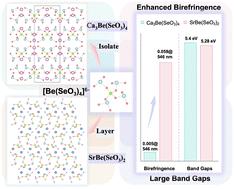
Beryllium-based selenites have rarely been reported. Herein, the first two alkaline earth metal beryllium-based selenites, Ca3Be(SeO3)4 and SrBe(SeO3)2, have been synthesized using a mild hydrothermal method. In both crystals, Be is connected to four [SeO3]2− groups. Due to the different arrangements of [SeO3]2− groups, these two crystals exhibit significantly different optical anisotropy. From Ca3Be(SeO3)4 to SrBe(SeO3)2, the birefringence ranges from 0.005@546 nm to 0.058@546 nm. Theoretical calculations confirmed the dominant role of [SeO3]2− in the optical anisotropy of these two crystals. In addition, both of them exhibited large band gaps (5.40 and 5.28 eV) and high thermal stability (596 and 570 °C). This work demonstrates that the introduction of beryllium can effectively increase the band gap of selenites to over 5 eV and offers new ideas for the development of large-bandgap selenites.



 京公网安备 11010802042870号
京ICP备2023020795号-1
京公网安备 11010802042870号
京ICP备2023020795号-1

 分享
分享
 求助内容:
求助内容: 应助结果提醒方式:
 扫码关注我们
