{"title":"Internal cap-initiated translation for efficient protein production from circular mRNA","authors":"Kosuke Fukuchi, Yuko Nakashima, Naoko Abe, Seigo Kimura, Fumitaka Hashiya, Yuichi Shichino, Yiwei Liu, Ryoko Ogisu, Satomi Sugiyama, Daisuke Kawaguchi, Masahito Inagaki, Zheyu Meng, Shiryu Kajihara, Mizuki Tada, Satoshi Uchida, Ting-Ting Li, Ramkrishna Maity, Tairin Kawasaki, Yasuaki Kimura, Shintaro Iwasaki, Hiroshi Abe","doi":"10.1038/s41587-025-02561-8","DOIUrl":null,"url":null,"abstract":"Circular mRNA faces challenges in enhancing its translation potential as an RNA therapeutic. Here we introduce two molecular designs that bolster circular mRNA translation through an internal cap-initiated mechanism. The first consists of a circular mRNA with a covalently attached N7-methylguanosine (m7G) cap through a branching structure (cap-circ mRNA). This modification allows circular mRNA to recruit translation machinery and produce proteins more efficiently than internal ribosome entry site (IRES)-containing circular mRNAs. Combining with an N1-methylpseudouridine (m1Ψ) modification, cap-circ mRNA exhibits a lower acute immunostimulatory effect, maintaining high translation in mice. The second design features the non-covalent attachment of an m7G cap to a circular mRNA through hybridization with an m7G cap-containing oligonucleotide, enhancing translation by more than 50-fold. This setup allows circular mRNAs to synthesize reporter proteins upon hybridizing with capped mRNAs or long non-coding RNAs and to undergo rolling circle-type translation. These advancements broaden the therapeutic applications of circular mRNAs by minimizing their molecular size, elevating translation efficiency and facilitating cell-type-selective translation. Placement of an m7G cap internally on circular RNAs promotes their translation in vivo.","PeriodicalId":19084,"journal":{"name":"Nature biotechnology","volume":"44 1","pages":"120-132"},"PeriodicalIF":41.7000,"publicationDate":"2025-02-19","publicationTypes":"Journal Article","fieldsOfStudy":null,"isOpenAccess":false,"openAccessPdf":"","citationCount":"0","resultStr":null,"platform":"Semanticscholar","paperid":null,"PeriodicalName":"Nature biotechnology","FirstCategoryId":"5","ListUrlMain":"https://www.nature.com/articles/s41587-025-02561-8","RegionNum":1,"RegionCategory":"生物学","ArticlePicture":[],"TitleCN":null,"AbstractTextCN":null,"PMCID":null,"EPubDate":"","PubModel":"","JCR":"Q1","JCRName":"BIOTECHNOLOGY & APPLIED MICROBIOLOGY","Score":null,"Total":0}
引用次数: 0
Abstract
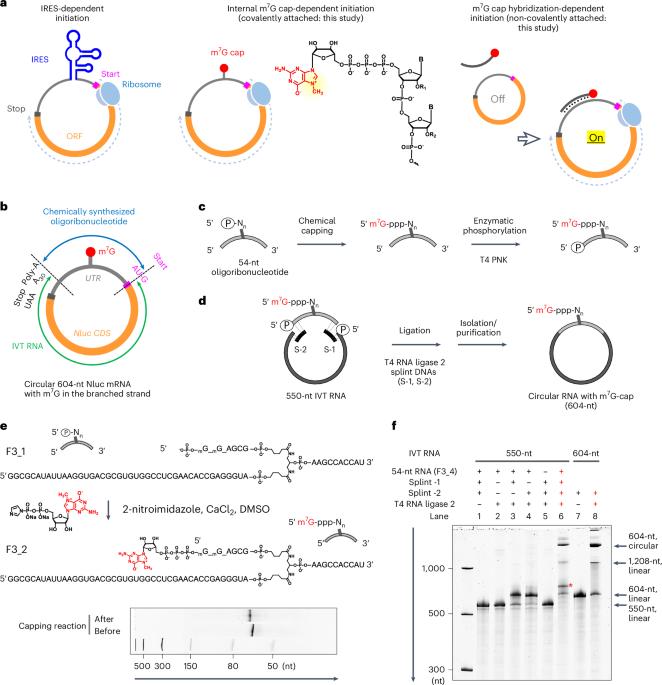
Circular mRNA faces challenges in enhancing its translation potential as an RNA therapeutic. Here we introduce two molecular designs that bolster circular mRNA translation through an internal cap-initiated mechanism. The first consists of a circular mRNA with a covalently attached N7-methylguanosine (m7G) cap through a branching structure (cap-circ mRNA). This modification allows circular mRNA to recruit translation machinery and produce proteins more efficiently than internal ribosome entry site (IRES)-containing circular mRNAs. Combining with an N1-methylpseudouridine (m1Ψ) modification, cap-circ mRNA exhibits a lower acute immunostimulatory effect, maintaining high translation in mice. The second design features the non-covalent attachment of an m7G cap to a circular mRNA through hybridization with an m7G cap-containing oligonucleotide, enhancing translation by more than 50-fold. This setup allows circular mRNAs to synthesize reporter proteins upon hybridizing with capped mRNAs or long non-coding RNAs and to undergo rolling circle-type translation. These advancements broaden the therapeutic applications of circular mRNAs by minimizing their molecular size, elevating translation efficiency and facilitating cell-type-selective translation. Placement of an m7G cap internally on circular RNAs promotes their translation in vivo.
期刊介绍:
Nature Biotechnology is a monthly journal that focuses on the science and business of biotechnology. It covers a wide range of topics including technology/methodology advancements in the biological, biomedical, agricultural, and environmental sciences. The journal also explores the commercial, political, ethical, legal, and societal aspects of this research.
The journal serves researchers by providing peer-reviewed research papers in the field of biotechnology. It also serves the business community by delivering news about research developments. This approach ensures that both the scientific and business communities are well-informed and able to stay up-to-date on the latest advancements and opportunities in the field.
Some key areas of interest in which the journal actively seeks research papers include molecular engineering of nucleic acids and proteins, molecular therapy, large-scale biology, computational biology, regenerative medicine, imaging technology, analytical biotechnology, applied immunology, food and agricultural biotechnology, and environmental biotechnology.
In summary, Nature Biotechnology is a comprehensive journal that covers both the scientific and business aspects of biotechnology. It strives to provide researchers with valuable research papers and news while also delivering important scientific advancements to the business community.



 京公网安备 11010802042870号
京ICP备2023020795号-1
京公网安备 11010802042870号
京ICP备2023020795号-1

 分享
分享
 求助内容:
求助内容: 应助结果提醒方式:
 扫码关注我们
