{"title":"Tailoring Lewis Acidity of Metal Oxides on Nickel to Boost Electrocatalytic Hydrogen Evolution in Neutral Electrolyte.","authors":"Lin-Lin Wang, Xiao-Ran Wang, Hong-Juan Wang, Chong Zhang, Jing-Jing Li, Guo-Jin Feng, Xuan-Xuan Cheng, Xue-Rong Qin, Zi-You Yu, Tong-Bu Lu","doi":"10.1021/jacs.4c16596","DOIUrl":null,"url":null,"abstract":"<p><p>Neutral-pH water splitting for hydrogen production features a benign environment that could alleviate catalyst and electrolyzer corrosion but calls for the corresponding high-efficiency and earth-abundant hydrogen evolution reaction (HER) catalysts. Herein, we first designed a series of metal oxides decorated on Ni as the model catalysts and found a volcano-shaped relationship between the Lewis acidity of Ni/metal oxides and HER activity in neutral media. The Ni/ZnO with the optimum Lewis acidity could balance water dissociation and hydroxyl desorption, thereby greatly boosting the HER. On the basis of this finding, we further in situ grew the Ni/ZnO heterostructure on a three-dimensional conductive support. The resulting catalyst requires overpotentials of merely 34 and 194 mV to deliver the current densities of 10 and 200 mA cm<sup>-2</sup>, respectively, and can stably operate at these current densities for 2000 h in 1 M phosphate buffer solution (pH 7), representing the most active and durable HER catalyst in neutral electrolyte reported thus far. Our work provides an effective design scheme for low-cost and high-performance neutral HER catalysts.</p>","PeriodicalId":49,"journal":{"name":"Journal of the American Chemical Society","volume":" ","pages":"7555-7563"},"PeriodicalIF":15.6000,"publicationDate":"2025-03-05","publicationTypes":"Journal Article","fieldsOfStudy":null,"isOpenAccess":false,"openAccessPdf":"","citationCount":"0","resultStr":null,"platform":"Semanticscholar","paperid":null,"PeriodicalName":"Journal of the American Chemical Society","FirstCategoryId":"92","ListUrlMain":"https://doi.org/10.1021/jacs.4c16596","RegionNum":1,"RegionCategory":"化学","ArticlePicture":[],"TitleCN":null,"AbstractTextCN":null,"PMCID":null,"EPubDate":"2025/2/18 0:00:00","PubModel":"Epub","JCR":"Q1","JCRName":"CHEMISTRY, MULTIDISCIPLINARY","Score":null,"Total":0}
引用次数: 0
Abstract
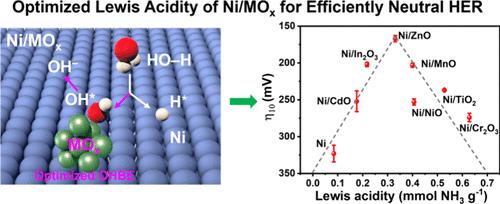
Neutral-pH water splitting for hydrogen production features a benign environment that could alleviate catalyst and electrolyzer corrosion but calls for the corresponding high-efficiency and earth-abundant hydrogen evolution reaction (HER) catalysts. Herein, we first designed a series of metal oxides decorated on Ni as the model catalysts and found a volcano-shaped relationship between the Lewis acidity of Ni/metal oxides and HER activity in neutral media. The Ni/ZnO with the optimum Lewis acidity could balance water dissociation and hydroxyl desorption, thereby greatly boosting the HER. On the basis of this finding, we further in situ grew the Ni/ZnO heterostructure on a three-dimensional conductive support. The resulting catalyst requires overpotentials of merely 34 and 194 mV to deliver the current densities of 10 and 200 mA cm-2, respectively, and can stably operate at these current densities for 2000 h in 1 M phosphate buffer solution (pH 7), representing the most active and durable HER catalyst in neutral electrolyte reported thus far. Our work provides an effective design scheme for low-cost and high-performance neutral HER catalysts.
中性ph水裂解制氢具有良好的环境,可以减轻催化剂和电解槽的腐蚀,但需要相应的高效和地球丰富的析氢反应(HER)催化剂。在此,我们首先设计了一系列以Ni为装饰材料的金属氧化物作为模型催化剂,并发现Ni/金属氧化物的刘易斯酸度与中性介质中HER活性之间存在火山状关系。具有最佳Lewis酸度的Ni/ZnO可以平衡水解离和羟基脱附,从而大大提高HER。在此基础上,我们进一步在三维导电支架上原位生长了Ni/ZnO异质结构。所得到的催化剂只需要34和194 mV的过电位就可以分别提供10和200 mA cm-2的电流密度,并且可以在1m磷酸盐缓冲溶液(pH 7)中以这些电流密度稳定工作2000小时,代表了迄今为止报道的中性电解质中最活跃和耐用的HER催化剂。我们的工作为低成本、高性能的中性HER催化剂提供了有效的设计方案。
期刊介绍:
The flagship journal of the American Chemical Society, known as the Journal of the American Chemical Society (JACS), has been a prestigious publication since its establishment in 1879. It holds a preeminent position in the field of chemistry and related interdisciplinary sciences. JACS is committed to disseminating cutting-edge research papers, covering a wide range of topics, and encompasses approximately 19,000 pages of Articles, Communications, and Perspectives annually. With a weekly publication frequency, JACS plays a vital role in advancing the field of chemistry by providing essential research.



 京公网安备 11010802042870号
京ICP备2023020795号-1
京公网安备 11010802042870号
京ICP备2023020795号-1

 分享
分享
 求助内容:
求助内容: 应助结果提醒方式:
 扫码关注我们
