Kwang-Won Park, Christina H Yu, Shuaicheng Fu and Rong Yang
{"title":"Ion-conducting polymer thin films via chemical vapor deposition polymerization","authors":"Kwang-Won Park, Christina H Yu, Shuaicheng Fu and Rong Yang","doi":"10.1039/D4SM01346H","DOIUrl":null,"url":null,"abstract":"<p >Ion-conducting polymers (ICPs), benefiting from the movement of ions instead of electrons, have attracted significant interest in various scientific and technological fields, including drug delivery, water purification, and electrochemical devices. This review aims to highlight recent advances in the synthesis of ICP thin films, with a particular focus on chemical vapor deposition (CVD) technologies. Traditional solution-based methods for ICP thin film deposition face challenges, including non-uniformity, low-throughput manufacturing, and the generation of hazardous wastes. In comparison, CVD eliminates the drawbacks associated with solution-based processes. They offer precise control film properties, including high purity, conformal coating, delicate control over thickness, <em>etc.</em> This review organizes the latest developments in CVD-based ICP synthesis, based on material properties and the synthesis strategy, into direct deposition and post-polymerization modification, ionogels, hydrogels, and ultrathin siloxane or silazane-based polymer films. By providing an up-to-date review of the materials and synthesis, we aim to position CVD polymerization as an effective strategy for future materials development/production and device fabrication in energy, sustainability, and healthcare where ion conductivity is desired.</p>","PeriodicalId":103,"journal":{"name":"Soft Matter","volume":" 10","pages":" 1813-1834"},"PeriodicalIF":2.8000,"publicationDate":"2025-02-07","publicationTypes":"Journal Article","fieldsOfStudy":null,"isOpenAccess":false,"openAccessPdf":"https://pubs.rsc.org/en/content/articlepdf/2025/sm/d4sm01346h?page=search","citationCount":"0","resultStr":null,"platform":"Semanticscholar","paperid":null,"PeriodicalName":"Soft Matter","FirstCategoryId":"92","ListUrlMain":"https://pubs.rsc.org/en/content/articlelanding/2025/sm/d4sm01346h","RegionNum":3,"RegionCategory":"化学","ArticlePicture":[],"TitleCN":null,"AbstractTextCN":null,"PMCID":null,"EPubDate":"","PubModel":"","JCR":"Q3","JCRName":"CHEMISTRY, PHYSICAL","Score":null,"Total":0}
引用次数: 0
Abstract
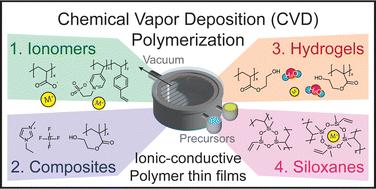
Ion-conducting polymers (ICPs), benefiting from the movement of ions instead of electrons, have attracted significant interest in various scientific and technological fields, including drug delivery, water purification, and electrochemical devices. This review aims to highlight recent advances in the synthesis of ICP thin films, with a particular focus on chemical vapor deposition (CVD) technologies. Traditional solution-based methods for ICP thin film deposition face challenges, including non-uniformity, low-throughput manufacturing, and the generation of hazardous wastes. In comparison, CVD eliminates the drawbacks associated with solution-based processes. They offer precise control film properties, including high purity, conformal coating, delicate control over thickness, etc. This review organizes the latest developments in CVD-based ICP synthesis, based on material properties and the synthesis strategy, into direct deposition and post-polymerization modification, ionogels, hydrogels, and ultrathin siloxane or silazane-based polymer films. By providing an up-to-date review of the materials and synthesis, we aim to position CVD polymerization as an effective strategy for future materials development/production and device fabrication in energy, sustainability, and healthcare where ion conductivity is desired.
期刊介绍:
Soft Matter is an international journal published by the Royal Society of Chemistry using Engineering-Materials Science: A Synthesis as its research focus. It publishes original research articles, review articles, and synthesis articles related to this field, reporting the latest discoveries in the relevant theoretical, practical, and applied disciplines in a timely manner, and aims to promote the rapid exchange of scientific information in this subject area. The journal is an open access journal. The journal is an open access journal and has not been placed on the alert list in the last three years.



 京公网安备 11010802042870号
京ICP备2023020795号-1
京公网安备 11010802042870号
京ICP备2023020795号-1

 分享
分享
 求助内容:
求助内容: 应助结果提醒方式:
 扫码关注我们
