Targeting autophagy in platinum-sensitive relapsed ovarian cancer: randomized phase II trial of hydroxychloroquine with chemotherapy with biomarker correlation.
{"title":"Targeting autophagy in platinum-sensitive relapsed ovarian cancer: randomized phase II trial of hydroxychloroquine with chemotherapy with biomarker correlation.","authors":"Luxitaa Goenka, Biswajit Dubashi, Smita Kayal, Medha Rajappa, Prabhu Manivannan, Sunitha Vellathussery Chakkalakkoombil, Debasis Gochhait, Latha Chaturvedula, S Pradeep, Annuja Anandaradje, Alladi Charanraj Goud, Prasanth Ganesan","doi":"10.1007/s12672-025-01904-w","DOIUrl":null,"url":null,"abstract":"<p><strong>Background: </strong>Autophagy activation contributes to chemotherapy resistance in several cancers, including ovarian cancer. Hydroxychloroquine (HCQ) is an autophagy inhibitor inhibiting the fusion of the autophagosome with the lysosome and has been repurposed as an anti-cancer agent. In this randomized phase II study, we used HCQ in combination with standard chemotherapy in platinum sensitive relapsed ovarian cancer (PSROC) patients.</p><p><strong>Methods: </strong>Patients were randomized in a 1:1 ratio to receive standard chemotherapy (carboplatin with paclitaxel/gemcitabine) with or without HCQ. Those randomized to receive HCQ received additional HCQ 200mg orally twice daily. The primary endpoint was the overall response rate (ORR). Other endpoints included survival outcomes, changes in autophagy biomarkers, toxicity, and quality of life.</p><p><strong>Results: </strong>A total of 59 patients were enrolled- chemotherapy + HCQ (N = 28), chemotherapy alone (N = 31), and 56 were evaluable ( received ≥ 3 cycles treatment). The ORR was not superior with the addition of HCQ [85% (22/26) in the experimental arm as compared to 80% (24/30) in the control arm, chi-square test, P = 0.65]. The median progression-free survival was 12 (95% CI, 9.75-14.24) months for the experimental arm and 11 (95% CI, 5.25-16.74) months for the control arm (P = 0.56) , and the median overall survival was 16 (95% CI, 8.54-23.45) months vs. 21 (95% CI, 11.70-30.59 ) months (P = 0.49) respectively. HCQ was well tolerated, with no excess adverse events [21 (75%) in the experimental arm vs. 22 (71%) in the control arm]. There were no substantial differences in the reduction of autophagy biomarker levels and QOL between the control and experimental arms.</p><p><strong>Conclusion: </strong>Adding HCQ to chemotherapy failed to improve response rates or survival in patients with PSROC. Conducting biomarker-stratified clinical trials might show the potential benefit of HCQ. Trial registration number (TRN): The trial was registered in the Clinical Trial Registry of India ( www.ctri.nic.in ; CTRI/2020/06/025790) on 17th June 2020.</p>","PeriodicalId":11148,"journal":{"name":"Discover. Oncology","volume":"16 1","pages":"203"},"PeriodicalIF":2.9000,"publicationDate":"2025-02-19","publicationTypes":"Journal Article","fieldsOfStudy":null,"isOpenAccess":false,"openAccessPdf":"https://www.ncbi.nlm.nih.gov/pmc/articles/PMC11839959/pdf/","citationCount":"0","resultStr":null,"platform":"Semanticscholar","paperid":null,"PeriodicalName":"Discover. Oncology","FirstCategoryId":"3","ListUrlMain":"https://doi.org/10.1007/s12672-025-01904-w","RegionNum":4,"RegionCategory":"医学","ArticlePicture":[],"TitleCN":null,"AbstractTextCN":null,"PMCID":null,"EPubDate":"","PubModel":"","JCR":"Q3","JCRName":"ENDOCRINOLOGY & METABOLISM","Score":null,"Total":0}
引用次数: 0
Abstract
Background: Autophagy activation contributes to chemotherapy resistance in several cancers, including ovarian cancer. Hydroxychloroquine (HCQ) is an autophagy inhibitor inhibiting the fusion of the autophagosome with the lysosome and has been repurposed as an anti-cancer agent. In this randomized phase II study, we used HCQ in combination with standard chemotherapy in platinum sensitive relapsed ovarian cancer (PSROC) patients.
Methods: Patients were randomized in a 1:1 ratio to receive standard chemotherapy (carboplatin with paclitaxel/gemcitabine) with or without HCQ. Those randomized to receive HCQ received additional HCQ 200mg orally twice daily. The primary endpoint was the overall response rate (ORR). Other endpoints included survival outcomes, changes in autophagy biomarkers, toxicity, and quality of life.
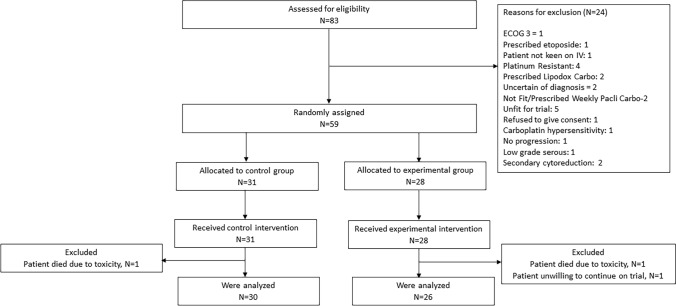
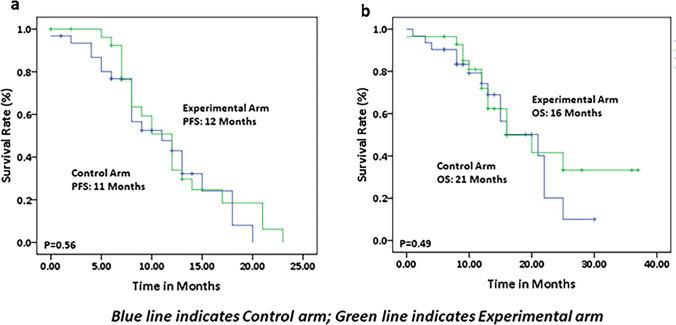
Results: A total of 59 patients were enrolled- chemotherapy + HCQ (N = 28), chemotherapy alone (N = 31), and 56 were evaluable ( received ≥ 3 cycles treatment). The ORR was not superior with the addition of HCQ [85% (22/26) in the experimental arm as compared to 80% (24/30) in the control arm, chi-square test, P = 0.65]. The median progression-free survival was 12 (95% CI, 9.75-14.24) months for the experimental arm and 11 (95% CI, 5.25-16.74) months for the control arm (P = 0.56) , and the median overall survival was 16 (95% CI, 8.54-23.45) months vs. 21 (95% CI, 11.70-30.59 ) months (P = 0.49) respectively. HCQ was well tolerated, with no excess adverse events [21 (75%) in the experimental arm vs. 22 (71%) in the control arm]. There were no substantial differences in the reduction of autophagy biomarker levels and QOL between the control and experimental arms.
Conclusion: Adding HCQ to chemotherapy failed to improve response rates or survival in patients with PSROC. Conducting biomarker-stratified clinical trials might show the potential benefit of HCQ. Trial registration number (TRN): The trial was registered in the Clinical Trial Registry of India ( www.ctri.nic.in ; CTRI/2020/06/025790) on 17th June 2020.




 京公网安备 11010802042870号
京ICP备2023020795号-1
京公网安备 11010802042870号
京ICP备2023020795号-1

 分享
分享
 求助内容:
求助内容: 应助结果提醒方式:
 扫码关注我们
