Mohamed S. Abdel-Hamid, Sherif F. Abdel-Ghafar, Inas S. M. Sayed, Maha S. Zaki, Ghada M. H. Abdel-Salam
{"title":"Delineating the Clinical and Brain Imaging Characteristics of the Neonatal Form of CSTB-Related Neurodevelopmental Disorders","authors":"Mohamed S. Abdel-Hamid, Sherif F. Abdel-Ghafar, Inas S. M. Sayed, Maha S. Zaki, Ghada M. H. Abdel-Salam","doi":"10.1111/cge.14720","DOIUrl":null,"url":null,"abstract":"<div>\n \n <p>Cystatin B gene (<i>CSTB</i>) is responsible for the most common childhood onset type of progressive myoclonic epilepsy (EPM1A). More recently, biallelic <i>CSTB</i> variants were described in four patients with a neonatal onset phenotype of microcephaly, diffuse hypomyelination, brain atrophic changes, and dyskinesia. Herein, we describe the clinical and molecular characterization of five additional patients in whom exome sequencing detected a splice variant (c.67-1G>C) in Family I and II and a missense variant (c.10G>C, p.Gly4Arg) in Family III and IV. Interestingly, these variants were described before in patients with EPM1A. However, all our patients had progressive microcephaly, developmental delay, and dyskinesia. In addition, only one patient developed seizures. Brain imaging showed mainly diffuse hypomyelination and progressive cerebral and cerebellar atrophy of variable severity. Interestingly, one patient showed intracranial calcification and another showed congenital distal arthrogryposis. Our findings support the association between <i>CSTB</i> variants and the neonatal form as a distinct neurodevelopmental phenotype. This newly characterized neonatal onset of the <i>CSTB</i> shares many overlapping features with genetic disorders encompassing microcephaly and hypomyelination.</p>\n </div>","PeriodicalId":10354,"journal":{"name":"Clinical Genetics","volume":"108 2","pages":"184-193"},"PeriodicalIF":2.3000,"publicationDate":"2025-02-18","publicationTypes":"Journal Article","fieldsOfStudy":null,"isOpenAccess":false,"openAccessPdf":"","citationCount":"0","resultStr":null,"platform":"Semanticscholar","paperid":null,"PeriodicalName":"Clinical Genetics","FirstCategoryId":"3","ListUrlMain":"https://onlinelibrary.wiley.com/doi/10.1111/cge.14720","RegionNum":3,"RegionCategory":"医学","ArticlePicture":[],"TitleCN":null,"AbstractTextCN":null,"PMCID":null,"EPubDate":"","PubModel":"","JCR":"Q2","JCRName":"GENETICS & HEREDITY","Score":null,"Total":0}
引用次数: 0
Abstract
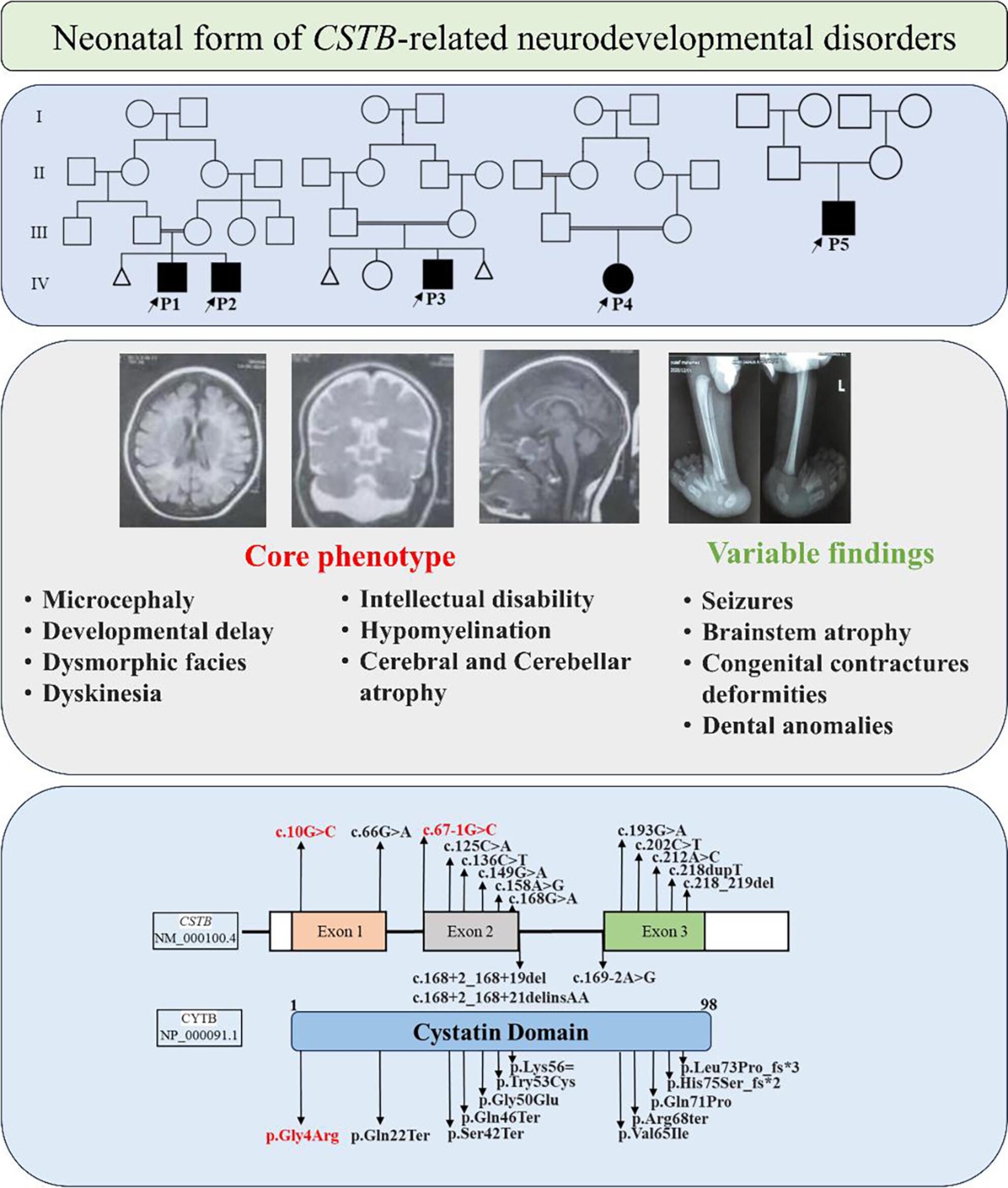
Cystatin B gene (CSTB) is responsible for the most common childhood onset type of progressive myoclonic epilepsy (EPM1A). More recently, biallelic CSTB variants were described in four patients with a neonatal onset phenotype of microcephaly, diffuse hypomyelination, brain atrophic changes, and dyskinesia. Herein, we describe the clinical and molecular characterization of five additional patients in whom exome sequencing detected a splice variant (c.67-1G>C) in Family I and II and a missense variant (c.10G>C, p.Gly4Arg) in Family III and IV. Interestingly, these variants were described before in patients with EPM1A. However, all our patients had progressive microcephaly, developmental delay, and dyskinesia. In addition, only one patient developed seizures. Brain imaging showed mainly diffuse hypomyelination and progressive cerebral and cerebellar atrophy of variable severity. Interestingly, one patient showed intracranial calcification and another showed congenital distal arthrogryposis. Our findings support the association between CSTB variants and the neonatal form as a distinct neurodevelopmental phenotype. This newly characterized neonatal onset of the CSTB shares many overlapping features with genetic disorders encompassing microcephaly and hypomyelination.
期刊介绍:
Clinical Genetics links research to the clinic, translating advances in our understanding of the molecular basis of genetic disease for the practising clinical geneticist. The journal publishes high quality research papers, short reports, reviews and mini-reviews that connect medical genetics research with clinical practice.
Topics of particular interest are:
• Linking genetic variations to disease
• Genome rearrangements and disease
• Epigenetics and disease
• The translation of genotype to phenotype
• Genetics of complex disease
• Management/intervention of genetic diseases
• Novel therapies for genetic diseases
• Developmental biology, as it relates to clinical genetics
• Social science research on the psychological and behavioural aspects of living with or being at risk of genetic disease



 京公网安备 11010802042870号
京ICP备2023020795号-1
京公网安备 11010802042870号
京ICP备2023020795号-1

 分享
分享
 求助内容:
求助内容: 应助结果提醒方式:
 扫码关注我们
