{"title":"Indirect Spinal Decompression in Thoracolumbar Burst Fractures: Efficacy of Combined Modified Percutaneous Posterior Short-segment Fixation and Intraoperative CT Assistance.","authors":"Hou-Tsung Chen, Re-Wen Wu, Fu-Shine Yang, Cheh-Yung Chang, Chieh-Cheng Hsu, Sung-Hsiung Chen, Meng-Ling Lu","doi":"10.1097/BSD.0000000000001772","DOIUrl":null,"url":null,"abstract":"<p><strong>Study design: </strong>This is a retrospective cohort study.</p><p><strong>Objective: </strong>To evaluate the combined modified percutaneous short-segment posterior instrumentation technique by reducing and fixating the thoracolumbar burst fracture and checking the efficacy of indirect spinal decompression using intraoperative CT. This study aims to (1) demonstrate that using modified percutaneous short-segment posterior instrumentation is enough to rebuild spinal stability and decompress the spinal stenosis for thoracolumbar burst fracture and (2) prove the effects of spinal canal decompression by intraoperative portable CT with the surgical technique.</p><p><strong>Summary of background data: </strong>Various posterior instrumentation methods have been used to treat thoracolumbar burst fractures and decompress retropulsed bony fragments through ligamentotaxis, but no studies have assessed the efficacy of combining percutaneous short-segment posterior instrumentation with intraoperative CT.</p><p><strong>Methods: </strong>Using modified percutaneous short-segment posterior instrumentation to rebuild the spinal stability and ligamentotaxis effect to indirect decompression of the spinal stenosis without laminectomy and check parameters immediately after surgery by real-time intraoperative portable CT.</p><p><strong>Results: </strong>Fifty-seven patients with thoracolumbar burst fractures underwent modified percutaneous short-segment posterior instrumentation from 2018 to 2023 at a single medical center. Mean injured vertebral canal dimension increased from 90.8±26.3 to 122.1±30.3 mm 2 ( P <0.05) and mean canal encroachment index decreased from 44.8±9.5% to 25.6±4.8% ( P <0.05), the anterior body height increased from 13.9±3.8 to 25.9±3.9 mm ( P <0.01) and kyphotic angle decreased from 27.3±3.2 to 8.6±2.1 degrees ( P <0.01). Neurological function was improved by at least 1 Frankel grade in neurological deficit patients. No significant difference in kyphotic angle between post-op and 6-month follow-up.</p><p><strong>Conclusions: </strong>Indirect decompression of the spinal canal with modified percutaneous short-segment fixation without laminectomy was an effective treatment for thoracolumbar burst fracture, even in selected incomplete neurological deficits patients.</p>","PeriodicalId":10457,"journal":{"name":"Clinical Spine Surgery","volume":" ","pages":"513-519"},"PeriodicalIF":1.7000,"publicationDate":"2025-12-01","publicationTypes":"Journal Article","fieldsOfStudy":null,"isOpenAccess":false,"openAccessPdf":"https://www.ncbi.nlm.nih.gov/pmc/articles/PMC12655886/pdf/","citationCount":"0","resultStr":null,"platform":"Semanticscholar","paperid":null,"PeriodicalName":"Clinical Spine Surgery","FirstCategoryId":"3","ListUrlMain":"https://doi.org/10.1097/BSD.0000000000001772","RegionNum":4,"RegionCategory":"医学","ArticlePicture":[],"TitleCN":null,"AbstractTextCN":null,"PMCID":null,"EPubDate":"2025/2/19 0:00:00","PubModel":"Epub","JCR":"Q3","JCRName":"CLINICAL NEUROLOGY","Score":null,"Total":0}
引用次数: 0
Abstract
Study design: This is a retrospective cohort study.
Objective: To evaluate the combined modified percutaneous short-segment posterior instrumentation technique by reducing and fixating the thoracolumbar burst fracture and checking the efficacy of indirect spinal decompression using intraoperative CT. This study aims to (1) demonstrate that using modified percutaneous short-segment posterior instrumentation is enough to rebuild spinal stability and decompress the spinal stenosis for thoracolumbar burst fracture and (2) prove the effects of spinal canal decompression by intraoperative portable CT with the surgical technique.
Summary of background data: Various posterior instrumentation methods have been used to treat thoracolumbar burst fractures and decompress retropulsed bony fragments through ligamentotaxis, but no studies have assessed the efficacy of combining percutaneous short-segment posterior instrumentation with intraoperative CT.
Methods: Using modified percutaneous short-segment posterior instrumentation to rebuild the spinal stability and ligamentotaxis effect to indirect decompression of the spinal stenosis without laminectomy and check parameters immediately after surgery by real-time intraoperative portable CT.
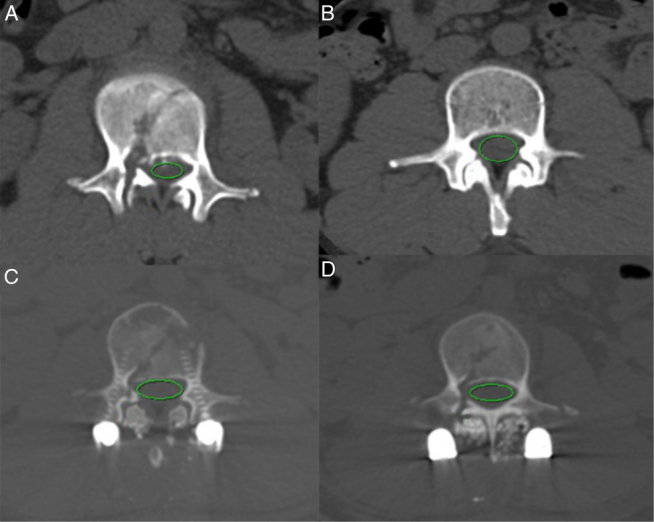
Results: Fifty-seven patients with thoracolumbar burst fractures underwent modified percutaneous short-segment posterior instrumentation from 2018 to 2023 at a single medical center. Mean injured vertebral canal dimension increased from 90.8±26.3 to 122.1±30.3 mm 2 ( P <0.05) and mean canal encroachment index decreased from 44.8±9.5% to 25.6±4.8% ( P <0.05), the anterior body height increased from 13.9±3.8 to 25.9±3.9 mm ( P <0.01) and kyphotic angle decreased from 27.3±3.2 to 8.6±2.1 degrees ( P <0.01). Neurological function was improved by at least 1 Frankel grade in neurological deficit patients. No significant difference in kyphotic angle between post-op and 6-month follow-up.
Conclusions: Indirect decompression of the spinal canal with modified percutaneous short-segment fixation without laminectomy was an effective treatment for thoracolumbar burst fracture, even in selected incomplete neurological deficits patients.
期刊介绍:
Clinical Spine Surgery is the ideal journal for the busy practicing spine surgeon or trainee, as it is the only journal necessary to keep up to date with new clinical research and surgical techniques. Readers get to watch leaders in the field debate controversial topics in a new controversies section, and gain access to evidence-based reviews of important pathologies in the systematic reviews section. The journal features a surgical technique complete with a video, and a tips and tricks section that allows surgeons to review the important steps prior to a complex procedure.
Clinical Spine Surgery provides readers with primary research studies, specifically level 1, 2 and 3 studies, ensuring that articles that may actually change a surgeon’s practice will be read and published. Each issue includes a brief article that will help a surgeon better understand the business of healthcare, as well as an article that will help a surgeon understand how to interpret increasingly complex research methodology. Clinical Spine Surgery is your single source for up-to-date, evidence-based recommendations for spine care.





 京公网安备 11010802042870号
京ICP备2023020795号-1
京公网安备 11010802042870号
京ICP备2023020795号-1

 分享
分享
 求助内容:
求助内容: 应助结果提醒方式:
 扫码关注我们
