Wentao Yang, Ke Xu, Xi Fu, Weifeng Zhang, Ziyong Hao, Zhenchi Sang, Lisheng Jiang, Xingbiao Qiu, Shengxian Tu, Linghong Shen, Ben He
{"title":"Lesion-specific coronary artery calcium score to predict stent underexpansion.","authors":"Wentao Yang, Ke Xu, Xi Fu, Weifeng Zhang, Ziyong Hao, Zhenchi Sang, Lisheng Jiang, Xingbiao Qiu, Shengxian Tu, Linghong Shen, Ben He","doi":"10.3389/fcvm.2025.1524390","DOIUrl":null,"url":null,"abstract":"<p><strong>Background: </strong>Previous intracoronary imaging studies have shown that coronary artery calcium (CAC) is an independent risk factor of stent underexpansion; however, limited preintervention assessments of CAC have been performed using noninvasive methods. We aimed to determine the association between lesion-specific CAC score and stent underexpansion.</p><p><strong>Methods: </strong>In this retrospective observational study, we included 416 lesions from 359 patients who underwent intravascular ultrasound (IVUS)-guided stent implantation. CAC of each lesion was quantified using the Agatston method derived from either nongated noncontrast chest CT (NCCT) or electrocardiogram-gated coronary CT angiography (CCTA). The primary endpoint was stent underexpansion defined as minimum stent area of <80% of the average reference lumen area.</p><p><strong>Results: </strong>Overall, stent underexpansion occurred in 144 (34.6%) of 416 lesions. Lesion-specific CAC score was significantly negatively correlated with the stent expansion rate (in NCCT cohort, <i>r</i> = 0.8113, <i>P</i> < 0.05; in CCTA cohort, <i>r</i> = 0.8024, <i>P</i> < 0.05). The optimal cutoff values of lesion-specific CAC score to predict stent underexpansion were >200 in both NCCT (sensitivity, 91.4%; specificity, 66.8%) and CCTA (sensitivity, 84.6%; specificity, 64.3%) cohort, which were associated with 24.94-fold increased risk of stent underexpansion in NCCT cohort and 13.56-fold increased risk of stent underexpansion in CCTA cohort.</p><p><strong>Conclusions: </strong>In this study, we found that lesion-specific CAC scores in both NCCT and CCTA cohorts were significantly independently associated with an increased risk of stent underexpansion, and the cutoff value to predict stent underexpansion was >200.</p>","PeriodicalId":12414,"journal":{"name":"Frontiers in Cardiovascular Medicine","volume":"12 ","pages":"1524390"},"PeriodicalIF":2.8000,"publicationDate":"2025-02-04","publicationTypes":"Journal Article","fieldsOfStudy":null,"isOpenAccess":false,"openAccessPdf":"https://www.ncbi.nlm.nih.gov/pmc/articles/PMC11832659/pdf/","citationCount":"0","resultStr":null,"platform":"Semanticscholar","paperid":null,"PeriodicalName":"Frontiers in Cardiovascular Medicine","FirstCategoryId":"3","ListUrlMain":"https://doi.org/10.3389/fcvm.2025.1524390","RegionNum":3,"RegionCategory":"医学","ArticlePicture":[],"TitleCN":null,"AbstractTextCN":null,"PMCID":null,"EPubDate":"2025/1/1 0:00:00","PubModel":"eCollection","JCR":"Q2","JCRName":"CARDIAC & CARDIOVASCULAR SYSTEMS","Score":null,"Total":0}
引用次数: 0
Abstract
Background: Previous intracoronary imaging studies have shown that coronary artery calcium (CAC) is an independent risk factor of stent underexpansion; however, limited preintervention assessments of CAC have been performed using noninvasive methods. We aimed to determine the association between lesion-specific CAC score and stent underexpansion.
Methods: In this retrospective observational study, we included 416 lesions from 359 patients who underwent intravascular ultrasound (IVUS)-guided stent implantation. CAC of each lesion was quantified using the Agatston method derived from either nongated noncontrast chest CT (NCCT) or electrocardiogram-gated coronary CT angiography (CCTA). The primary endpoint was stent underexpansion defined as minimum stent area of <80% of the average reference lumen area.
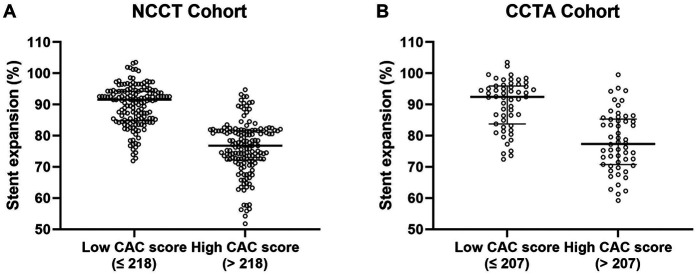
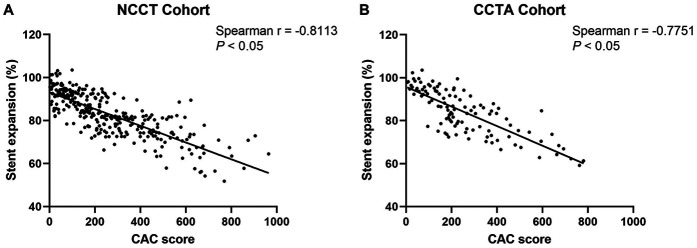
Results: Overall, stent underexpansion occurred in 144 (34.6%) of 416 lesions. Lesion-specific CAC score was significantly negatively correlated with the stent expansion rate (in NCCT cohort, r = 0.8113, P < 0.05; in CCTA cohort, r = 0.8024, P < 0.05). The optimal cutoff values of lesion-specific CAC score to predict stent underexpansion were >200 in both NCCT (sensitivity, 91.4%; specificity, 66.8%) and CCTA (sensitivity, 84.6%; specificity, 64.3%) cohort, which were associated with 24.94-fold increased risk of stent underexpansion in NCCT cohort and 13.56-fold increased risk of stent underexpansion in CCTA cohort.
Conclusions: In this study, we found that lesion-specific CAC scores in both NCCT and CCTA cohorts were significantly independently associated with an increased risk of stent underexpansion, and the cutoff value to predict stent underexpansion was >200.
背景:以往的冠状动脉内成像研究表明,冠状动脉钙化(CAC)是支架扩张不足的独立危险因素;然而,使用非侵入性方法对CAC进行了有限的干预前评估。我们的目的是确定病变特异性CAC评分与支架扩张不足之间的关系。方法:在这项回顾性观察性研究中,我们纳入了359例接受血管内超声(IVUS)引导下支架植入术的患者的416个病变。每个病变的CAC使用Agatston方法进行量化,该方法来源于非对比胸部CT (NCCT)或心电图门控冠状动脉CT血管造影(CCTA)。结果:总体而言,416个病变中有144个(34.6%)发生了支架扩张不足。病变特异性CAC评分与支架扩张率呈显著负相关(在NCCT队列中,r = 0.8113, P r = 0.8024,两种NCCT中P 200)(敏感性,91.4%;特异性,66.8%)和CCTA(敏感性,84.6%;特异性为64.3%),NCCT组支架扩张不足风险增加24.94倍,CCTA组支架扩张不足风险增加13.56倍。结论:在本研究中,我们发现NCCT和CCTA队列中病变特异性CAC评分与支架扩张不足风险增加有显著的独立相关性,预测支架扩张不足的临界值为bbb200。
期刊介绍:
Frontiers? Which frontiers? Where exactly are the frontiers of cardiovascular medicine? And who should be defining these frontiers?
At Frontiers in Cardiovascular Medicine we believe it is worth being curious to foresee and explore beyond the current frontiers. In other words, we would like, through the articles published by our community journal Frontiers in Cardiovascular Medicine, to anticipate the future of cardiovascular medicine, and thus better prevent cardiovascular disorders and improve therapeutic options and outcomes of our patients.




 京公网安备 11010802042870号
京ICP备2023020795号-1
京公网安备 11010802042870号
京ICP备2023020795号-1

 分享
分享
 求助内容:
求助内容: 应助结果提醒方式:
 扫码关注我们
