Xiaoyue Wang, Sophie Bouton, Nada Kojovic, Anne-Lise Giraud, Marie Schaer
{"title":"Atypical audio-visual neural synchrony and speech processing in early autism.","authors":"Xiaoyue Wang, Sophie Bouton, Nada Kojovic, Anne-Lise Giraud, Marie Schaer","doi":"10.1186/s11689-025-09593-w","DOIUrl":null,"url":null,"abstract":"<p><strong>Background: </strong>Children with Autism Spectrum disorder (ASD) often exhibit communication difficulties that may stem from basic auditory temporal integration impairment but also be aggravated by an audio-visual integration deficit, resulting in a lack of interest in face-to-face communication. This study addresses whether speech processing anomalies in young autistic children (mean age 3.09-year-old) are associated with alterations of audio-visual temporal integration.</p><p><strong>Methods: </strong>We used high-density electroencephalography (HD-EEG) and eye tracking to record brain activity and gaze patterns in 31 children with ASD (6 females) and 33 typically developing (TD) children (11 females), while they watched cartoon videos. Neural responses to temporal audio-visual stimuli were analyzed using Temporal Response Functions model and phase analyses for audiovisual temporal coordination.</p><p><strong>Results: </strong>The reconstructability of speech signals from auditory responses was reduced in children with ASD compared to TD, but despite more restricted gaze patterns in ASD it was similar for visual responses in both groups. Speech reception was most strongly affected when visual speech information was also present, an interference that was not seen in TD children. These differences were associated with a broader phase angle distribution (exceeding pi/2) in the EEG theta range in children with ASD, signaling reduced reliability of audio-visual temporal alignment.</p><p><strong>Conclusion: </strong>These findings show that speech processing anomalies in ASD do not stand alone and that they are associated already at a very early development stage with audio-visual imbalance with poor auditory response encoding and disrupted audio-visual temporal coordination.</p>","PeriodicalId":16530,"journal":{"name":"Journal of Neurodevelopmental Disorders","volume":"17 1","pages":"9"},"PeriodicalIF":4.0000,"publicationDate":"2025-02-18","publicationTypes":"Journal Article","fieldsOfStudy":null,"isOpenAccess":false,"openAccessPdf":"https://www.ncbi.nlm.nih.gov/pmc/articles/PMC11837391/pdf/","citationCount":"0","resultStr":null,"platform":"Semanticscholar","paperid":null,"PeriodicalName":"Journal of Neurodevelopmental Disorders","FirstCategoryId":"3","ListUrlMain":"https://doi.org/10.1186/s11689-025-09593-w","RegionNum":2,"RegionCategory":"医学","ArticlePicture":[],"TitleCN":null,"AbstractTextCN":null,"PMCID":null,"EPubDate":"","PubModel":"","JCR":"Q1","JCRName":"CLINICAL NEUROLOGY","Score":null,"Total":0}
引用次数: 0
Abstract
Background: Children with Autism Spectrum disorder (ASD) often exhibit communication difficulties that may stem from basic auditory temporal integration impairment but also be aggravated by an audio-visual integration deficit, resulting in a lack of interest in face-to-face communication. This study addresses whether speech processing anomalies in young autistic children (mean age 3.09-year-old) are associated with alterations of audio-visual temporal integration.
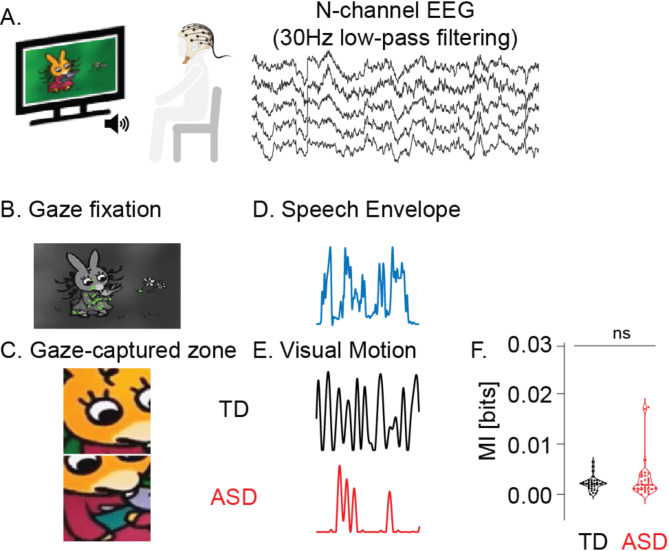
Methods: We used high-density electroencephalography (HD-EEG) and eye tracking to record brain activity and gaze patterns in 31 children with ASD (6 females) and 33 typically developing (TD) children (11 females), while they watched cartoon videos. Neural responses to temporal audio-visual stimuli were analyzed using Temporal Response Functions model and phase analyses for audiovisual temporal coordination.
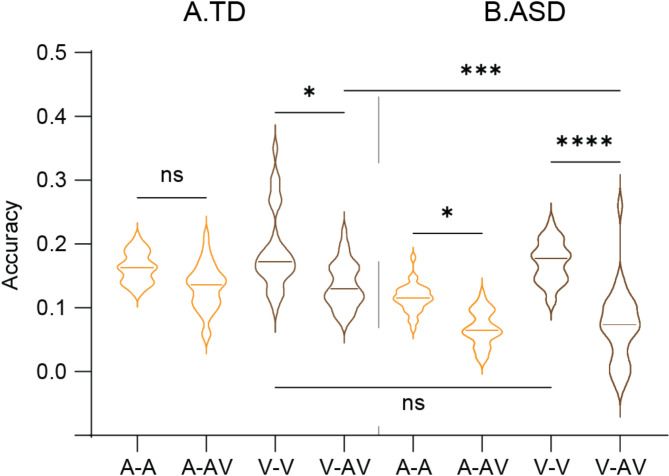
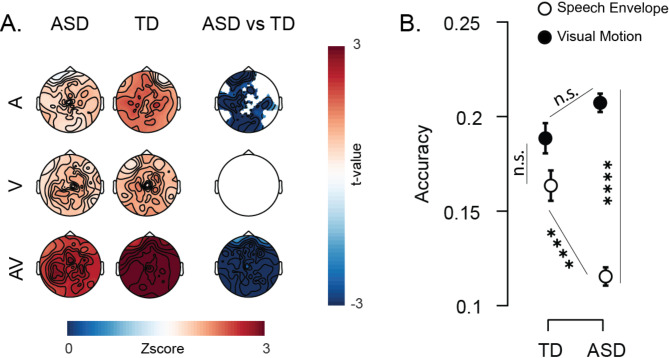
Results: The reconstructability of speech signals from auditory responses was reduced in children with ASD compared to TD, but despite more restricted gaze patterns in ASD it was similar for visual responses in both groups. Speech reception was most strongly affected when visual speech information was also present, an interference that was not seen in TD children. These differences were associated with a broader phase angle distribution (exceeding pi/2) in the EEG theta range in children with ASD, signaling reduced reliability of audio-visual temporal alignment.
Conclusion: These findings show that speech processing anomalies in ASD do not stand alone and that they are associated already at a very early development stage with audio-visual imbalance with poor auditory response encoding and disrupted audio-visual temporal coordination.
期刊介绍:
Journal of Neurodevelopmental Disorders is an open access journal that integrates current, cutting-edge research across a number of disciplines, including neurobiology, genetics, cognitive neuroscience, psychiatry and psychology. The journal’s primary focus is on the pathogenesis of neurodevelopmental disorders including autism, fragile X syndrome, tuberous sclerosis, Turner Syndrome, 22q Deletion Syndrome, Prader-Willi and Angelman Syndrome, Williams syndrome, lysosomal storage diseases, dyslexia, specific language impairment and fetal alcohol syndrome. With the discovery of specific genes underlying neurodevelopmental syndromes, the emergence of powerful tools for studying neural circuitry, and the development of new approaches for exploring molecular mechanisms, interdisciplinary research on the pathogenesis of neurodevelopmental disorders is now increasingly common. Journal of Neurodevelopmental Disorders provides a unique venue for researchers interested in comparing and contrasting mechanisms and characteristics related to the pathogenesis of the full range of neurodevelopmental disorders, sharpening our understanding of the etiology and relevant phenotypes of each condition.



 京公网安备 11010802042870号
京ICP备2023020795号-1
京公网安备 11010802042870号
京ICP备2023020795号-1

 分享
分享
 求助内容:
求助内容: 应助结果提醒方式:
 扫码关注我们
