Shoyo Sato, Cecilie Appeldorff, Owen S Wangensteen, Sandra Garcés-Pastor, Christopher E Laumer, María Herranz, Gonzalo Giribet, David Renault, Peter Rask Møller, Katrine Worsaae
{"title":"Phylogenomics of the rarest animals: a second species of Micrognathozoa identified by machine learning.","authors":"Shoyo Sato, Cecilie Appeldorff, Owen S Wangensteen, Sandra Garcés-Pastor, Christopher E Laumer, María Herranz, Gonzalo Giribet, David Renault, Peter Rask Møller, Katrine Worsaae","doi":"10.1098/rspb.2024.2867","DOIUrl":null,"url":null,"abstract":"<p><p>The latest animal phylum to be discovered, Micrognathozoa, constitutes a rare group of limnic meiofauna. These microscopic 'jaw animals' are among the smallest metazoans yet possess highly complex jaw structures. The single species of Micrognathozoa, <i>Limnognathia maerski</i> Kristensen and Funch, 2000, was first described from Greenland, later reported from a remote Subantarctic island and more recently discovered in the Pyrenees on the European continent. Successful collections of these three known populations facilitated investigations of the intraphylum relationships and species limits within <i>Limnognathia</i> for the first time. Through detailed anatomical comparisons, we substantiate the lack of morphological differences between the three geographically disjunct populations. With transcriptomic data from single specimens, we conducted the first intraphylum phylogenetic analyses and extensively tested species hypotheses using standard approaches and novel machine learning methods. Analyses clearly delimited the Subantarctic population, here described as <i>Limnognathia desmeti</i> sp. nov., the second species of Micrognathozoa, but did not definitively split the Greenland and Pyrenees populations as separate species. Divergence dating analysis suggests the disjunct distribution of Micrognathozoa is not human mediated but the result of long-distance dispersal raising questions about their dispersal capabilities and potential undiscovered populations.</p>","PeriodicalId":20589,"journal":{"name":"Proceedings of the Royal Society B: Biological Sciences","volume":"292 2041","pages":"20242867"},"PeriodicalIF":3.5000,"publicationDate":"2025-02-01","publicationTypes":"Journal Article","fieldsOfStudy":null,"isOpenAccess":false,"openAccessPdf":"https://www.ncbi.nlm.nih.gov/pmc/articles/PMC11836703/pdf/","citationCount":"0","resultStr":null,"platform":"Semanticscholar","paperid":null,"PeriodicalName":"Proceedings of the Royal Society B: Biological Sciences","FirstCategoryId":"99","ListUrlMain":"https://doi.org/10.1098/rspb.2024.2867","RegionNum":1,"RegionCategory":"生物学","ArticlePicture":[],"TitleCN":null,"AbstractTextCN":null,"PMCID":null,"EPubDate":"2025/2/19 0:00:00","PubModel":"Epub","JCR":"Q1","JCRName":"BIOLOGY","Score":null,"Total":0}
引用次数: 0
Abstract
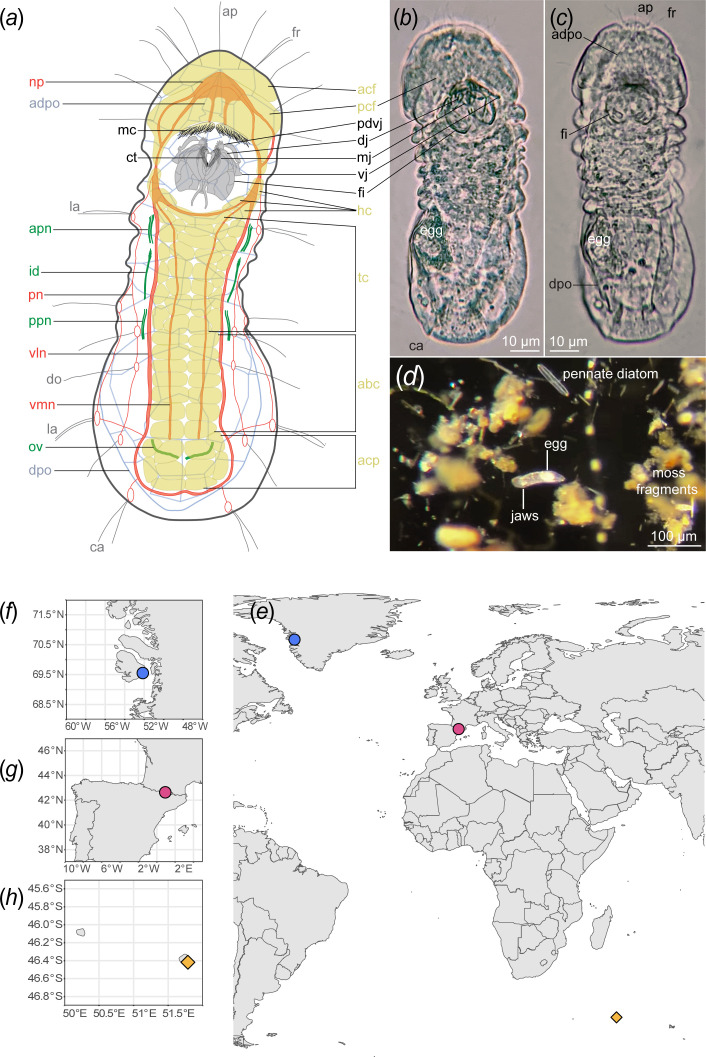
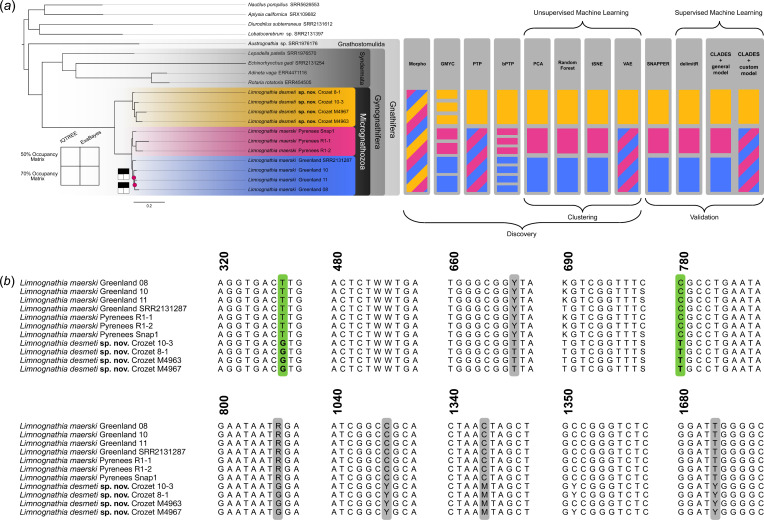
The latest animal phylum to be discovered, Micrognathozoa, constitutes a rare group of limnic meiofauna. These microscopic 'jaw animals' are among the smallest metazoans yet possess highly complex jaw structures. The single species of Micrognathozoa, Limnognathia maerski Kristensen and Funch, 2000, was first described from Greenland, later reported from a remote Subantarctic island and more recently discovered in the Pyrenees on the European continent. Successful collections of these three known populations facilitated investigations of the intraphylum relationships and species limits within Limnognathia for the first time. Through detailed anatomical comparisons, we substantiate the lack of morphological differences between the three geographically disjunct populations. With transcriptomic data from single specimens, we conducted the first intraphylum phylogenetic analyses and extensively tested species hypotheses using standard approaches and novel machine learning methods. Analyses clearly delimited the Subantarctic population, here described as Limnognathia desmeti sp. nov., the second species of Micrognathozoa, but did not definitively split the Greenland and Pyrenees populations as separate species. Divergence dating analysis suggests the disjunct distribution of Micrognathozoa is not human mediated but the result of long-distance dispersal raising questions about their dispersal capabilities and potential undiscovered populations.
期刊介绍:
Proceedings B is the Royal Society’s flagship biological research journal, accepting original articles and reviews of outstanding scientific importance and broad general interest. The main criteria for acceptance are that a study is novel, and has general significance to biologists. Articles published cover a wide range of areas within the biological sciences, many have relevance to organisms and the environments in which they live. The scope includes, but is not limited to, ecology, evolution, behavior, health and disease epidemiology, neuroscience and cognition, behavioral genetics, development, biomechanics, paleontology, comparative biology, molecular ecology and evolution, and global change biology.




 京公网安备 11010802042870号
京ICP备2023020795号-1
京公网安备 11010802042870号
京ICP备2023020795号-1

 分享
分享
 求助内容:
求助内容: 应助结果提醒方式:
 扫码关注我们
