Beibei Li, Wenting Li, Junwei Guo, Hongbo Wang, Ran Wan, Yu Liu, Meijuan Fan, Cong Wang, Song Yang, Le Zhao, Cong Nie
{"title":"Outlier Removal with Weight Penalization and Aggregation: A Robust Variable Selection Method for Enhancing Near-Infrared Spectral Analysis Performance","authors":"Beibei Li, Wenting Li, Junwei Guo, Hongbo Wang, Ran Wan, Yu Liu, Meijuan Fan, Cong Wang, Song Yang, Le Zhao, Cong Nie","doi":"10.1021/acs.analchem.4c07007","DOIUrl":null,"url":null,"abstract":"Full-wavelength near-infrared (NIR) spectroscopy faces significant challenges due to the strong collinearity among spectral variables and the presence of variables that are highly sensitive to sample fluctuations. Additionally, not all spectral variables contribute equally to the NIR model. Weakly influential variables, although not important on their own, can provide substantial improvement when combined with stronger variables, thus increasing both model stability and prediction accuracy. Therefore, this study proposes a new variable selection method called outlier removal with weight penalization and aggregation (OR-WPA). The method begins by removing outlier spectral variables with high coefficient of variation, which enhances model stability. During the variable selection process, multiple submodels are constructed based on variable subsets, with variable weights assigned according to the absolute values of regression coefficients. A moving window is applied to average the weights, and variables with excessively high weights are penalized, promoting the selection of weakly influential variables that positively contribute to model accuracy. The variable space is iteratively reduced, and the subset of variables associated with the highest predictive accuracy is selected as the final characteristic variable combination. The OR-WPA method was evaluated on three NIR spectral data sets, involving corn, heated tobacco substrate, and flue-cured tobacco. The results were compared with three advanced variable selection methods: Monte Carlo uninformative variable elimination, competitive adaptive reweighted sampling, and bootstrapping soft shrinkage. The results indicate that OR-WPA demonstrates better predictive performance, particularly in predicting low-content components, where it significantly enhances both the accuracy and stability of the NIR model.","PeriodicalId":27,"journal":{"name":"Analytical Chemistry","volume":"8 1","pages":""},"PeriodicalIF":6.7000,"publicationDate":"2025-02-19","publicationTypes":"Journal Article","fieldsOfStudy":null,"isOpenAccess":false,"openAccessPdf":"","citationCount":"0","resultStr":null,"platform":"Semanticscholar","paperid":null,"PeriodicalName":"Analytical Chemistry","FirstCategoryId":"92","ListUrlMain":"https://doi.org/10.1021/acs.analchem.4c07007","RegionNum":1,"RegionCategory":"化学","ArticlePicture":[],"TitleCN":null,"AbstractTextCN":null,"PMCID":null,"EPubDate":"","PubModel":"","JCR":"Q1","JCRName":"CHEMISTRY, ANALYTICAL","Score":null,"Total":0}
引用次数: 0
Abstract
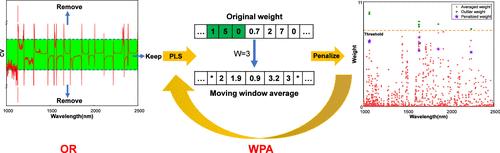
Full-wavelength near-infrared (NIR) spectroscopy faces significant challenges due to the strong collinearity among spectral variables and the presence of variables that are highly sensitive to sample fluctuations. Additionally, not all spectral variables contribute equally to the NIR model. Weakly influential variables, although not important on their own, can provide substantial improvement when combined with stronger variables, thus increasing both model stability and prediction accuracy. Therefore, this study proposes a new variable selection method called outlier removal with weight penalization and aggregation (OR-WPA). The method begins by removing outlier spectral variables with high coefficient of variation, which enhances model stability. During the variable selection process, multiple submodels are constructed based on variable subsets, with variable weights assigned according to the absolute values of regression coefficients. A moving window is applied to average the weights, and variables with excessively high weights are penalized, promoting the selection of weakly influential variables that positively contribute to model accuracy. The variable space is iteratively reduced, and the subset of variables associated with the highest predictive accuracy is selected as the final characteristic variable combination. The OR-WPA method was evaluated on three NIR spectral data sets, involving corn, heated tobacco substrate, and flue-cured tobacco. The results were compared with three advanced variable selection methods: Monte Carlo uninformative variable elimination, competitive adaptive reweighted sampling, and bootstrapping soft shrinkage. The results indicate that OR-WPA demonstrates better predictive performance, particularly in predicting low-content components, where it significantly enhances both the accuracy and stability of the NIR model.
期刊介绍:
Analytical Chemistry, a peer-reviewed research journal, focuses on disseminating new and original knowledge across all branches of analytical chemistry. Fundamental articles may explore general principles of chemical measurement science and need not directly address existing or potential analytical methodology. They can be entirely theoretical or report experimental results. Contributions may cover various phases of analytical operations, including sampling, bioanalysis, electrochemistry, mass spectrometry, microscale and nanoscale systems, environmental analysis, separations, spectroscopy, chemical reactions and selectivity, instrumentation, imaging, surface analysis, and data processing. Papers discussing known analytical methods should present a significant, original application of the method, a notable improvement, or results on an important analyte.



 京公网安备 11010802042870号
京ICP备2023020795号-1
京公网安备 11010802042870号
京ICP备2023020795号-1

 分享
分享
 求助内容:
求助内容: 应助结果提醒方式:
 扫码关注我们
