Gaolei Zhan, Brecht Koek, Yijia Yuan, Yikuan Liu, Vipin Mishra, Veniero Lenzi, Karol Strutyński, Chunxiao Li, Rongrong Zhang, Xin Zhou, Hwa Seob Choi, Zhen-Feng Cai, Joaquín Almarza, Kunal S. Mali, Aurelio Mateo-Alonso, Manuel Melle Franco, Yihan Zhu, Steven De Feyter, Kian Ping Loh
{"title":"Moiré two-dimensional covalent organic framework superlattices","authors":"Gaolei Zhan, Brecht Koek, Yijia Yuan, Yikuan Liu, Vipin Mishra, Veniero Lenzi, Karol Strutyński, Chunxiao Li, Rongrong Zhang, Xin Zhou, Hwa Seob Choi, Zhen-Feng Cai, Joaquín Almarza, Kunal S. Mali, Aurelio Mateo-Alonso, Manuel Melle Franco, Yihan Zhu, Steven De Feyter, Kian Ping Loh","doi":"10.1038/s41557-025-01748-5","DOIUrl":null,"url":null,"abstract":"The on-surface synthesis of two-dimensional (2D) polymers from monomers represents a useful strategy for designing lattice, orbital and spin symmetries. Like other 2D materials, the ordered stacking of 2D polymers into bilayers may allow developing unique optoelectronic, charge transport and magnetic properties not found in the individual layers. However, controlling layer stacking of 2D polymers remains challenging. Here we describe a method for synthesizing 2D polymer bilayers or bilayer 2D covalent organic frameworks at the liquid–substrate interface through the direct condensation of monomers. More importantly, we also show how factors such as monomer structure and solvent mixture influence the bilayer stacking modes and how, under certain conditions, large-area moiré superlattices emerge from the twisted bilayer stacking. This finding offers new opportunities for the design of bilayer stacked framework materials with tunable electronic and structural properties. On-surface synthesis of two-dimensional polymers is a useful strategy for designing the lattice, orbital and spin symmetries of materials, but controlling their layer stacking remains challenging. Now, a method to synthesize bilayer two-dimensional covalent organic frameworks at a liquid–substrate interface through monomer condensation has been developed; large-area moiré superlattices emerge from the twisted bilayer stacking.","PeriodicalId":18909,"journal":{"name":"Nature chemistry","volume":"17 4","pages":"518-524"},"PeriodicalIF":20.2000,"publicationDate":"2025-02-20","publicationTypes":"Journal Article","fieldsOfStudy":null,"isOpenAccess":false,"openAccessPdf":"","citationCount":"0","resultStr":null,"platform":"Semanticscholar","paperid":null,"PeriodicalName":"Nature chemistry","FirstCategoryId":"92","ListUrlMain":"https://www.nature.com/articles/s41557-025-01748-5","RegionNum":1,"RegionCategory":"化学","ArticlePicture":[],"TitleCN":null,"AbstractTextCN":null,"PMCID":null,"EPubDate":"","PubModel":"","JCR":"Q1","JCRName":"CHEMISTRY, MULTIDISCIPLINARY","Score":null,"Total":0}
引用次数: 0
Abstract
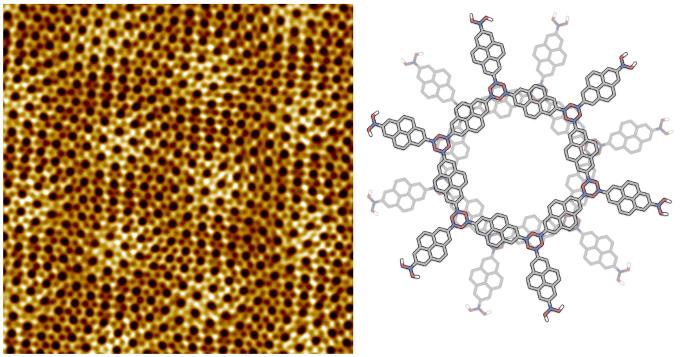
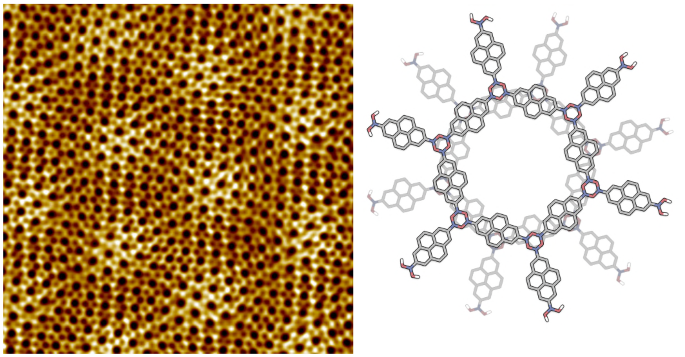
The on-surface synthesis of two-dimensional (2D) polymers from monomers represents a useful strategy for designing lattice, orbital and spin symmetries. Like other 2D materials, the ordered stacking of 2D polymers into bilayers may allow developing unique optoelectronic, charge transport and magnetic properties not found in the individual layers. However, controlling layer stacking of 2D polymers remains challenging. Here we describe a method for synthesizing 2D polymer bilayers or bilayer 2D covalent organic frameworks at the liquid–substrate interface through the direct condensation of monomers. More importantly, we also show how factors such as monomer structure and solvent mixture influence the bilayer stacking modes and how, under certain conditions, large-area moiré superlattices emerge from the twisted bilayer stacking. This finding offers new opportunities for the design of bilayer stacked framework materials with tunable electronic and structural properties. On-surface synthesis of two-dimensional polymers is a useful strategy for designing the lattice, orbital and spin symmetries of materials, but controlling their layer stacking remains challenging. Now, a method to synthesize bilayer two-dimensional covalent organic frameworks at a liquid–substrate interface through monomer condensation has been developed; large-area moiré superlattices emerge from the twisted bilayer stacking.
期刊介绍:
Nature Chemistry is a monthly journal that publishes groundbreaking and significant research in all areas of chemistry. It covers traditional subjects such as analytical, inorganic, organic, and physical chemistry, as well as a wide range of other topics including catalysis, computational and theoretical chemistry, and environmental chemistry.
The journal also features interdisciplinary research at the interface of chemistry with biology, materials science, nanotechnology, and physics. Manuscripts detailing such multidisciplinary work are encouraged, as long as the central theme pertains to chemistry.
Aside from primary research, Nature Chemistry publishes review articles, news and views, research highlights from other journals, commentaries, book reviews, correspondence, and analysis of the broader chemical landscape. It also addresses crucial issues related to education, funding, policy, intellectual property, and the societal impact of chemistry.
Nature Chemistry is dedicated to ensuring the highest standards of original research through a fair and rigorous review process. It offers authors maximum visibility for their papers, access to a broad readership, exceptional copy editing and production standards, rapid publication, and independence from academic societies and other vested interests.
Overall, Nature Chemistry aims to be the authoritative voice of the global chemical community.




 京公网安备 11010802042870号
京ICP备2023020795号-1
京公网安备 11010802042870号
京ICP备2023020795号-1

 分享
分享
 求助内容:
求助内容: 应助结果提醒方式:
 扫码关注我们
