Mohsina Faria Mou, Mim Khatun, Debashis Roy, Abdullah Al Roman and Mohammad Tanvir Ahmed*,
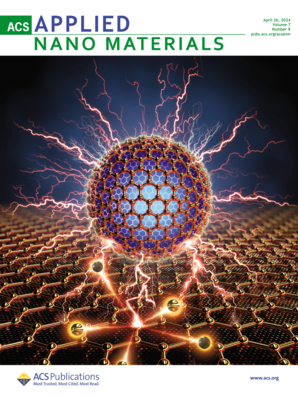
{"title":"Density Functional Theory Calculations of Tetragonal Graphene Nanobowls for Toxic Heavy Metal Ion Removal from Wastewater","authors":"Mohsina Faria Mou, Mim Khatun, Debashis Roy, Abdullah Al Roman and Mohammad Tanvir Ahmed*, ","doi":"10.1021/acsanm.4c06715","DOIUrl":null,"url":null,"abstract":"<p >The removal of heavy metal ions (HMIs) from polluted environments is crucial for safeguarding public health and improving water quality. This study investigates the HMI adsorption capabilities of a tetragonal graphene nanobowl (TGNB), an sp<sup>2</sup>-hybridized carbon-based nanomaterial, in wastewater. The negative cohesive energy of −6.75 eV and real vibrational frequencies confirm that the TGNB structure is stable and can occur naturally. The nanobowl exhibited an energy gap of 1.148 eV, revealing its semiconducting nature. Using density functional theory calculations, the adsorption behavior of TGNB for Ni(ii) and As(iii) ions was explored in an aqueous medium. The optimized TGNB structure showed adsorption energies of −3.07 eV for Ni(ii) and −13.10 eV for As(iii), causing significant structural deformation. The interaction of HMIs with TGNB resulted in substantial changes in the energy gap and work function, suggesting its applicability in HMI detection and monitoring in wastewater. The negative entropy change confirms the thermodynamic stability of all the complexes. Strong, partially covalent, as well as van der Waals interactions were observed between TGNB and HMIs. The adsorption process was exothermic and spontaneous, with strong interactions confirmed for most complexes. These findings demonstrate the potential of TGNB as an efficient stable nanomaterial for HMI detection and removal from wastewater.</p>","PeriodicalId":6,"journal":{"name":"ACS Applied Nano Materials","volume":"8 7","pages":"3497–3510 3497–3510"},"PeriodicalIF":5.5000,"publicationDate":"2025-02-13","publicationTypes":"Journal Article","fieldsOfStudy":null,"isOpenAccess":false,"openAccessPdf":"","citationCount":"0","resultStr":null,"platform":"Semanticscholar","paperid":null,"PeriodicalName":"ACS Applied Nano Materials","FirstCategoryId":"88","ListUrlMain":"https://pubs.acs.org/doi/10.1021/acsanm.4c06715","RegionNum":2,"RegionCategory":"材料科学","ArticlePicture":[],"TitleCN":null,"AbstractTextCN":null,"PMCID":null,"EPubDate":"","PubModel":"","JCR":"Q2","JCRName":"MATERIALS SCIENCE, MULTIDISCIPLINARY","Score":null,"Total":0}
引用次数: 0
Abstract
The removal of heavy metal ions (HMIs) from polluted environments is crucial for safeguarding public health and improving water quality. This study investigates the HMI adsorption capabilities of a tetragonal graphene nanobowl (TGNB), an sp2-hybridized carbon-based nanomaterial, in wastewater. The negative cohesive energy of −6.75 eV and real vibrational frequencies confirm that the TGNB structure is stable and can occur naturally. The nanobowl exhibited an energy gap of 1.148 eV, revealing its semiconducting nature. Using density functional theory calculations, the adsorption behavior of TGNB for Ni(ii) and As(iii) ions was explored in an aqueous medium. The optimized TGNB structure showed adsorption energies of −3.07 eV for Ni(ii) and −13.10 eV for As(iii), causing significant structural deformation. The interaction of HMIs with TGNB resulted in substantial changes in the energy gap and work function, suggesting its applicability in HMI detection and monitoring in wastewater. The negative entropy change confirms the thermodynamic stability of all the complexes. Strong, partially covalent, as well as van der Waals interactions were observed between TGNB and HMIs. The adsorption process was exothermic and spontaneous, with strong interactions confirmed for most complexes. These findings demonstrate the potential of TGNB as an efficient stable nanomaterial for HMI detection and removal from wastewater.
期刊介绍:
ACS Applied Nano Materials is an interdisciplinary journal publishing original research covering all aspects of engineering, chemistry, physics and biology relevant to applications of nanomaterials. The journal is devoted to reports of new and original experimental and theoretical research of an applied nature that integrate knowledge in the areas of materials, engineering, physics, bioscience, and chemistry into important applications of nanomaterials.




 京公网安备 11010802042870号
京ICP备2023020795号-1
京公网安备 11010802042870号
京ICP备2023020795号-1

 分享
分享
 求助内容:
求助内容: 应助结果提醒方式:
 扫码关注我们
