{"title":"Rapid alternative of the post-harvest process to enhance the irones content in Iris germanica L","authors":"Ghader Ghasemi , Mahdi Ayyari , Mohammad-Hossein Azimi , Mohammad-Taghi Ebadi","doi":"10.1016/j.jafr.2025.101748","DOIUrl":null,"url":null,"abstract":"<div><div>Postharvest has vital impact on production of desired compounds in some medicinal plants. <em>Iris germanica</em> L. rhizome with the trade name of orris root, should be kept for 3–5 years, to produce irones from triterpene iridals. Irones have an important role in food, pharmaceutical and perfumery industries. Here, we evaluated the effect of rhizome type (whole and sliced) and drying methods including infrared, microwave, oven, vacuum-oven, shade and sun drying on volatile constituents of orris root, especially on irone content. The effect of these treatments on drying time (DT), phytochemical and antioxidant capacity of orris root has been also investigated. Rhizome type and drying methods significantly affect on DT (<em>P</em> < 0.01). Lowest DT was in Microwave and whole rhizome with 1:4 <span><math><mrow><mover><mn>1</mn><mo>´</mo></mover></mrow></math></span>:4 <span><math><mrow><msup><mn>5</mn><mo>″</mo></msup></mrow></math></span> and the highest DT was observed in shade and whole rhizome with 4704:0 <span><math><mrow><mover><mn>0</mn><mo>´</mo></mover></mrow></math></span>:0 <span><math><mrow><msup><mn>0</mn><mo>″</mo></msup></mrow></math></span>. Interestingly, microwave drying not only reduced the time of drying but also, increased the irones content compared to the fresh samples. The negligible amount of <em>cis</em>-α-irone and <em>cis</em>-γ-irone in fresh sample (0.2 %), reached to more than 90 % in whole rhizome by microwave drying. In almost all methods, irone content was significantly higher in whole rhizome rather than the sliced rhizomes. However, the highest TPC (110.29 mg GAE/g DWP), TFC (70.344 mg QUE/g DWP) and antioxidant activity (DPPH: 104.988 mg TBHQ/g DWP) was observed in sun dried whole sample. In conclusion, microwave is the best method for producing irone compounds and sun drying could be the best method to keep the phenolic and antioxidant compounds in <em>I. germanica</em>.</div></div>","PeriodicalId":34393,"journal":{"name":"Journal of Agriculture and Food Research","volume":"20 ","pages":"Article 101748"},"PeriodicalIF":6.2000,"publicationDate":"2025-04-01","publicationTypes":"Journal Article","fieldsOfStudy":null,"isOpenAccess":false,"openAccessPdf":"","citationCount":"0","resultStr":null,"platform":"Semanticscholar","paperid":null,"PeriodicalName":"Journal of Agriculture and Food Research","FirstCategoryId":"1085","ListUrlMain":"https://www.sciencedirect.com/science/article/pii/S266615432500119X","RegionNum":0,"RegionCategory":null,"ArticlePicture":[],"TitleCN":null,"AbstractTextCN":null,"PMCID":null,"EPubDate":"2025/2/18 0:00:00","PubModel":"Epub","JCR":"Q1","JCRName":"AGRICULTURE, MULTIDISCIPLINARY","Score":null,"Total":0}
引用次数: 0
Abstract
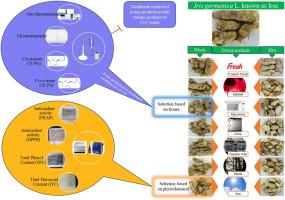
Postharvest has vital impact on production of desired compounds in some medicinal plants. Iris germanica L. rhizome with the trade name of orris root, should be kept for 3–5 years, to produce irones from triterpene iridals. Irones have an important role in food, pharmaceutical and perfumery industries. Here, we evaluated the effect of rhizome type (whole and sliced) and drying methods including infrared, microwave, oven, vacuum-oven, shade and sun drying on volatile constituents of orris root, especially on irone content. The effect of these treatments on drying time (DT), phytochemical and antioxidant capacity of orris root has been also investigated. Rhizome type and drying methods significantly affect on DT (P < 0.01). Lowest DT was in Microwave and whole rhizome with 1:4 :4 and the highest DT was observed in shade and whole rhizome with 4704:0 :0 . Interestingly, microwave drying not only reduced the time of drying but also, increased the irones content compared to the fresh samples. The negligible amount of cis-α-irone and cis-γ-irone in fresh sample (0.2 %), reached to more than 90 % in whole rhizome by microwave drying. In almost all methods, irone content was significantly higher in whole rhizome rather than the sliced rhizomes. However, the highest TPC (110.29 mg GAE/g DWP), TFC (70.344 mg QUE/g DWP) and antioxidant activity (DPPH: 104.988 mg TBHQ/g DWP) was observed in sun dried whole sample. In conclusion, microwave is the best method for producing irone compounds and sun drying could be the best method to keep the phenolic and antioxidant compounds in I. germanica.




 京公网安备 11010802042870号
京ICP备2023020795号-1
京公网安备 11010802042870号
京ICP备2023020795号-1

 分享
分享
 求助内容:
求助内容: 应助结果提醒方式:
 扫码关注我们
