No evidence of increased hypoglycaemia attributed to physical activity with once-weekly insulin icodec versus once-daily basal insulin degludec in type 1 diabetes: A post hoc analysis of ONWARDS 6
Harald Sourij MD, Richard M. Bracken PhD, Lisbeth Carstensen PhD, Thaís M. Pagliaro Rocha PhD, Sara Kehlet Watt PhD, Athena Philis-Tsimikas MD
{"title":"No evidence of increased hypoglycaemia attributed to physical activity with once-weekly insulin icodec versus once-daily basal insulin degludec in type 1 diabetes: A post hoc analysis of ONWARDS 6","authors":"Harald Sourij MD, Richard M. Bracken PhD, Lisbeth Carstensen PhD, Thaís M. Pagliaro Rocha PhD, Sara Kehlet Watt PhD, Athena Philis-Tsimikas MD","doi":"10.1111/dom.16265","DOIUrl":null,"url":null,"abstract":"<p>Regular physical activity should be recommended as part of a diabetes management plan in people with diabetes mellitus.<span><sup>1, 2</sup></span> However, physical activity increases glucose utilization rates and sensitivity to insulin, potentially increasing hypoglycaemia risk in individuals receiving insulin therapy.<span><sup>3</sup></span> Clinicians may advise people with diabetes mellitus who are receiving insulin to adjust their insulin dose or to consume additional carbohydrates to reduce the risk of hypoglycaemia during and after acute physical exercise.<span><sup>4-6</sup></span> Once-weekly basal insulins can reduce treatment burden and improve adherence to insulin therapy compared with once-daily basal insulin.<span><sup>7, 8</sup></span> However, once-weekly insulin doses cannot be reduced ahead of increased physical activity, possibly increasing the risk of hypoglycaemia attributed to physical activity compared with once-daily basal insulin.</p><p>ONWARDS 6 (NCT04848480) evaluated once-weekly basal insulin icodec (icodec) compared with once-daily basal insulin degludec (degludec) in adults with type 1 diabetes (T1D), in combination with bolus insulin.<span><sup>9</sup></span> In ONWARDS 6, icodec was non-inferior to degludec in reducing glycated haemoglobin (HbA<sub>1c</sub>) but was associated with statistically significantly higher hypoglycaemia rates. This post hoc analysis of data from ONWARDS 6 investigated whether the odds of hypoglycaemia attributed to physical activity in adults with T1D were higher with icodec than with degludec and whether baseline physical activity level affected hypoglycaemia rates.</p><p>ONWARDS 6 was a randomized, open-label, treat-to-target phase 3a multinational trial comprising a 2-week screening period, a 52-week treatment phase (26-week main phase and 26-week safety extension phase) and a 5-week follow-up period.<span><sup>9</sup></span> Eligible participants were aged ≥18 years with T1D who had received multiple daily insulin injections for at least 1 year. Participants were randomly assigned (1:1) to receive once-weekly icodec or once-daily degludec, in combination with at least two daily injections of insulin aspart. An open continuous glucose monitoring (CGM) device (Dexcom G6®) was worn throughout the trial. Suspected hypoglycaemia symptoms triggered additional self-measured blood glucose measurements; values indicative of hypoglycaemia were recorded as hypoglycaemic episodes in a digital diary. Participants who reported hypoglycaemic episodes were asked to indicate any relationship to physical activity.</p><p>Participants were asked to report their baseline level of physical activity using the International Physical Activity Questionnaire (IPAQ)<span><sup>10</sup></span>; IPAQ results were used to categorize physical activity levels as ‘low’, ‘moderate’ or ‘high’. There were no restrictions on level of physical activity or exercise during the trial.</p><p>Descriptive statistics were based on the safety analysis set (all randomized participants who received one or more doses of icodec or degludec). Statistical analyses were based on the full analysis set (all randomized participants). For the ONWARDS 6 trial, all randomized participants received one or more doses of icodec or degludec, so the safety and full analysis sets are the same. The present analysis investigated the proportion of self-reported hypoglycaemic episodes that were attributed to physical activity and the overall hypoglycaemia rates by baseline physical activity level. Hypoglycaemia alert value (level 1) was defined as a blood glucose value of 3.0–<3.9 mmol/L, confirmed by blood glucose meter. Clinically significant hypoglycaemia (level 2) was defined as a blood glucose value of <3.0 mmol/L, confirmed by blood glucose meter. Severe hypoglycaemia (level 3) was defined as hypoglycaemia associated with severe cognitive impairment requiring external assistance for recovery. Hypoglycaemic episodes were assessed during the on-treatment period (onset date on or after the first dose of trial product and no later than the first date of the follow-up visit, the last dose of trial product +5 weeks for degludec and +6 weeks for icodec, or the end date for the in-trial period). The proportion of time below range (TBR) <3.0 mmol/L was assessed at two pre-specified time points in the ONWARDS 6 trial (weeks 22–26 and 48–52).</p><p>Clinically significant or severe hypoglycaemia rates were calculated as the number of episodes per patient-year of exposure (PYE; 1 PYE = 365.25 days). The odds ratio (OR) (icodec/degludec) of experiencing a clinically significant or severe hypoglycaemic episode attributed to physical activity (binary incidence) was estimated using a binary logistic regression model (logit link) with treatment, region, pretrial basal regimen and HbA<sub>1c</sub> group (<8.0% or ≥8.0% at screening) as fixed factors. Missing data were imputed using multiple imputation. Each imputed dataset was analysed separately; estimates were combined using Rubin's rules. Descriptive statistical analyses were performed using R, version 4.0.4; all other statistical analyses were performed using SAS software, version 9.4 (SAS Institute Inc., Cary, NC, USA).</p><p>ONWARDS 6 included 582 adults with T1D (58% male; mean [standard deviation]: age, 44.2 [14.1] years; diabetes duration, 19.5 [13.0] years; body mass index, 26.5 [4.8] kg/m<sup>2</sup>).<span><sup>9</sup></span> Based on aggregated data, the proportion of hypoglycaemic episodes attributed to physical activity, relative to the total number of hypoglycaemic episodes with icodec versus degludec, respectively, was 18.2% versus 25.4% for hypoglycaemia alert value, 19.2% versus 27.3% for clinically significant hypoglycaemia, and 21.4% versus 20.0% for severe hypoglycaemia (Figure 1A); individual-level data were largely in agreement with this (Table S1). Most hypoglycaemic episodes attributed to physical activity were hypoglycaemia alert values or clinically significant hypoglycaemia. The proportion of hypoglycaemia alert values or clinically significant hypoglycaemia attributed to physical activity relative to the overall number of episodes at each level of hypoglycaemia was numerically lower with icodec than with degludec. The proportions of severe hypoglycaemic episodes attributed to physical activity were similar across treatment groups. The odds of having clinically significant or severe hypoglycaemia attributed to physical activity were similar between the treatment groups (OR [95% confidence interval], icodec/degludec: 1.06 [0.76; 1.47]; <i>p</i> = 0.7515). The proportion of clinically significant or severe hypoglycaemic episodes attributed to physical activity that were followed by additional hypoglycaemic episodes in the subsequent 24 h were also similar between treatment groups (Figure 1B).</p><p>Clinically significant or severe hypoglycaemia rates (including those not attributed to physical activity) were similar across baseline physical activity level subgroups within each treatment group (Table S2). Severe hypoglycaemia rates were very low (<0.4 episodes/PYE), regardless of baseline physical activity level. The proportion of hypoglycaemic episodes attributed to physical activity relative to the overall number of hypoglycaemic episodes increased as baseline physical activity level intensified, as could be expected; the results between arms were largely comparable to those shown in Figure 1 (Table S3).</p><p>The proportion of TBR <3.0 mmol/L was similar across baseline physical activity level subgroups and between treatment groups during weeks 48–52 (Table 1). In the icodec group, TBR <3.0 mmol/L was below or close to the internationally recommended target of <1%<span><sup>11, 12</sup></span> for all baseline physical activity level subgroups during weeks 22–26, and below this target for all physical activity level subgroups during weeks 48–52 (Table 1).<span><sup>11, 12</sup></span></p><p>Although the rates of combined clinically significant or severe hypoglycaemia were statistically significantly higher with icodec than with degludec in the overall trial population, this post hoc analysis of ONWARDS 6 found no evidence of an increased odds of having clinically significant or severe hypoglycaemia attributed to physical activity with once-weekly icodec compared with once-daily degludec in adults with T1D. Most hypoglycaemic episodes attributed to physical activity were hypoglycaemia alert values or clinically significant hypoglycaemia, with few severe hypoglycaemic episodes attributed to physical activity with either treatment. Recurrent hypoglycaemic episodes in the 24 h after a clinically significant or severe hypoglycaemic episode attributed to physical activity were infrequent and similar in both treatment groups. Baseline physical activity levels did not affect the rate of clinically significant or severe hypoglycaemic episodes in either treatment group. In the icodec group, baseline physical activity levels minimally affected the proportion of TBR <3.0 mmol/L during weeks 22–26 or 48–52.</p><p>However, this analysis has limitations. No specific definitions or criteria for ‘physical activity’ were provided to participants; consequently, a broad range of activities that varied in intensity, duration and type may have been grouped and analysed together. Furthermore, data on physical activity levels were available at baseline only with any changes during the trial not captured. Any changes in physical activity during the trial may have impacted the number of hypoglycaemic episodes; any such changes are not accounted for in the current analysis. The lack of information regarding the intensity or type of physical activity, or how it may have changed during the trial, or whether the association of hypoglycaemic episodes with physical activity had been underreported, limits the robustness of the conclusions that can be drawn. No data are available on how participants prevented hypoglycaemic episodes, and the use of open CGM could have influenced participants' behaviour or actions, such as prompting a change in food consumption or an adjustment to doses of bolus insulin, which could have affected the risk of hypoglycaemia. Confirmatory prospective studies that consider these limitations would be required to validate the current findings. It should also be noted that the nature of this trial population may preclude generalizability to the wider population of people with type 1 diabetes, as noted previously.<span><sup>9</sup></span> In addition, physical activity-attributed hypoglycaemia has also been assessed in T2D using data from ONWARDS 1–5 and there is an ongoing study investigating icodec use during and after exercise in T2D (NCT06288412), which will hopefully provide more insights into this phenomenon. However, future trials dedicated to investigating physical activity during treatment with icodec that include a broader population of individuals with T1D may be beneficial.</p><p>Nonetheless, the findings from this study are encouraging because they demonstrate no increases in hypoglycaemia attributed to physical activity with icodec compared with degludec in adults with type 1 diabetes.</p><p>Lisbeth Carstensen, Thaís M. Pagliaro Rocha and Sara Kehlet Watt were involved in the study design and data analysis. Harald Sourij, Richard M. Bracken and Athena Philis-Tsimikas were involved in study conduct, data collection and review of data analysis. All authors were involved in developing the manuscript and approved the final draft.</p><p>This study was funded by Novo Nordisk A/S.</p><p>Harald Sourij serves on advisory boards for and is on the speaker's bureau of Amarin, Amgen, Bayer, Boehringer Ingelheim, Daiichi Sankyo, Eli Lilly, Novartis and Novo Nordisk. Richard M. Bracken has received funding for scientific dissemination and research from Beneo, Boehringer Ingelheim, Medtronic, Novo Nordisk and Sanofi. Lisbeth Carstensen, Thaís M. P. Rocha and Sara Kehlet Watt are employees of Novo Nordisk and hold stock options in Novo Nordisk. Athena Philis-Tsimikas performs research and serves on advisory committees for Eli Lilly, Dexcom, Medtronic and Novo Nordisk.</p>","PeriodicalId":158,"journal":{"name":"Diabetes, Obesity & Metabolism","volume":"27 5","pages":"2882-2886"},"PeriodicalIF":5.7000,"publicationDate":"2025-02-19","publicationTypes":"Journal Article","fieldsOfStudy":null,"isOpenAccess":false,"openAccessPdf":"https://onlinelibrary.wiley.com/doi/epdf/10.1111/dom.16265","citationCount":"0","resultStr":null,"platform":"Semanticscholar","paperid":null,"PeriodicalName":"Diabetes, Obesity & Metabolism","FirstCategoryId":"3","ListUrlMain":"https://dom-pubs.onlinelibrary.wiley.com/doi/10.1111/dom.16265","RegionNum":2,"RegionCategory":"医学","ArticlePicture":[],"TitleCN":null,"AbstractTextCN":null,"PMCID":null,"EPubDate":"","PubModel":"","JCR":"Q1","JCRName":"ENDOCRINOLOGY & METABOLISM","Score":null,"Total":0}
引用次数: 0
Abstract
Regular physical activity should be recommended as part of a diabetes management plan in people with diabetes mellitus.1, 2 However, physical activity increases glucose utilization rates and sensitivity to insulin, potentially increasing hypoglycaemia risk in individuals receiving insulin therapy.3 Clinicians may advise people with diabetes mellitus who are receiving insulin to adjust their insulin dose or to consume additional carbohydrates to reduce the risk of hypoglycaemia during and after acute physical exercise.4-6 Once-weekly basal insulins can reduce treatment burden and improve adherence to insulin therapy compared with once-daily basal insulin.7, 8 However, once-weekly insulin doses cannot be reduced ahead of increased physical activity, possibly increasing the risk of hypoglycaemia attributed to physical activity compared with once-daily basal insulin.
ONWARDS 6 (NCT04848480) evaluated once-weekly basal insulin icodec (icodec) compared with once-daily basal insulin degludec (degludec) in adults with type 1 diabetes (T1D), in combination with bolus insulin.9 In ONWARDS 6, icodec was non-inferior to degludec in reducing glycated haemoglobin (HbA1c) but was associated with statistically significantly higher hypoglycaemia rates. This post hoc analysis of data from ONWARDS 6 investigated whether the odds of hypoglycaemia attributed to physical activity in adults with T1D were higher with icodec than with degludec and whether baseline physical activity level affected hypoglycaemia rates.
ONWARDS 6 was a randomized, open-label, treat-to-target phase 3a multinational trial comprising a 2-week screening period, a 52-week treatment phase (26-week main phase and 26-week safety extension phase) and a 5-week follow-up period.9 Eligible participants were aged ≥18 years with T1D who had received multiple daily insulin injections for at least 1 year. Participants were randomly assigned (1:1) to receive once-weekly icodec or once-daily degludec, in combination with at least two daily injections of insulin aspart. An open continuous glucose monitoring (CGM) device (Dexcom G6®) was worn throughout the trial. Suspected hypoglycaemia symptoms triggered additional self-measured blood glucose measurements; values indicative of hypoglycaemia were recorded as hypoglycaemic episodes in a digital diary. Participants who reported hypoglycaemic episodes were asked to indicate any relationship to physical activity.
Participants were asked to report their baseline level of physical activity using the International Physical Activity Questionnaire (IPAQ)10; IPAQ results were used to categorize physical activity levels as ‘low’, ‘moderate’ or ‘high’. There were no restrictions on level of physical activity or exercise during the trial.
Descriptive statistics were based on the safety analysis set (all randomized participants who received one or more doses of icodec or degludec). Statistical analyses were based on the full analysis set (all randomized participants). For the ONWARDS 6 trial, all randomized participants received one or more doses of icodec or degludec, so the safety and full analysis sets are the same. The present analysis investigated the proportion of self-reported hypoglycaemic episodes that were attributed to physical activity and the overall hypoglycaemia rates by baseline physical activity level. Hypoglycaemia alert value (level 1) was defined as a blood glucose value of 3.0–<3.9 mmol/L, confirmed by blood glucose meter. Clinically significant hypoglycaemia (level 2) was defined as a blood glucose value of <3.0 mmol/L, confirmed by blood glucose meter. Severe hypoglycaemia (level 3) was defined as hypoglycaemia associated with severe cognitive impairment requiring external assistance for recovery. Hypoglycaemic episodes were assessed during the on-treatment period (onset date on or after the first dose of trial product and no later than the first date of the follow-up visit, the last dose of trial product +5 weeks for degludec and +6 weeks for icodec, or the end date for the in-trial period). The proportion of time below range (TBR) <3.0 mmol/L was assessed at two pre-specified time points in the ONWARDS 6 trial (weeks 22–26 and 48–52).
Clinically significant or severe hypoglycaemia rates were calculated as the number of episodes per patient-year of exposure (PYE; 1 PYE = 365.25 days). The odds ratio (OR) (icodec/degludec) of experiencing a clinically significant or severe hypoglycaemic episode attributed to physical activity (binary incidence) was estimated using a binary logistic regression model (logit link) with treatment, region, pretrial basal regimen and HbA1c group (<8.0% or ≥8.0% at screening) as fixed factors. Missing data were imputed using multiple imputation. Each imputed dataset was analysed separately; estimates were combined using Rubin's rules. Descriptive statistical analyses were performed using R, version 4.0.4; all other statistical analyses were performed using SAS software, version 9.4 (SAS Institute Inc., Cary, NC, USA).
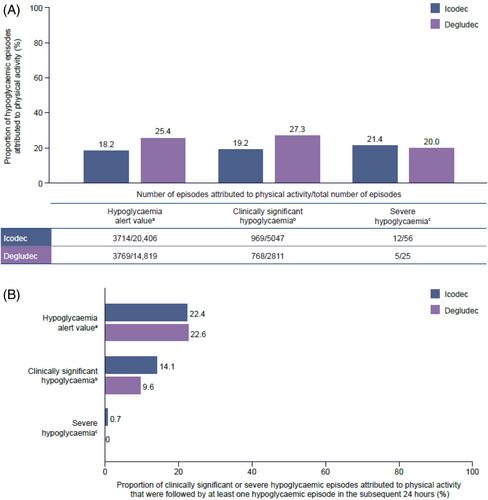
ONWARDS 6 included 582 adults with T1D (58% male; mean [standard deviation]: age, 44.2 [14.1] years; diabetes duration, 19.5 [13.0] years; body mass index, 26.5 [4.8] kg/m2).9 Based on aggregated data, the proportion of hypoglycaemic episodes attributed to physical activity, relative to the total number of hypoglycaemic episodes with icodec versus degludec, respectively, was 18.2% versus 25.4% for hypoglycaemia alert value, 19.2% versus 27.3% for clinically significant hypoglycaemia, and 21.4% versus 20.0% for severe hypoglycaemia (Figure 1A); individual-level data were largely in agreement with this (Table S1). Most hypoglycaemic episodes attributed to physical activity were hypoglycaemia alert values or clinically significant hypoglycaemia. The proportion of hypoglycaemia alert values or clinically significant hypoglycaemia attributed to physical activity relative to the overall number of episodes at each level of hypoglycaemia was numerically lower with icodec than with degludec. The proportions of severe hypoglycaemic episodes attributed to physical activity were similar across treatment groups. The odds of having clinically significant or severe hypoglycaemia attributed to physical activity were similar between the treatment groups (OR [95% confidence interval], icodec/degludec: 1.06 [0.76; 1.47]; p = 0.7515). The proportion of clinically significant or severe hypoglycaemic episodes attributed to physical activity that were followed by additional hypoglycaemic episodes in the subsequent 24 h were also similar between treatment groups (Figure 1B).
Clinically significant or severe hypoglycaemia rates (including those not attributed to physical activity) were similar across baseline physical activity level subgroups within each treatment group (Table S2). Severe hypoglycaemia rates were very low (<0.4 episodes/PYE), regardless of baseline physical activity level. The proportion of hypoglycaemic episodes attributed to physical activity relative to the overall number of hypoglycaemic episodes increased as baseline physical activity level intensified, as could be expected; the results between arms were largely comparable to those shown in Figure 1 (Table S3).
The proportion of TBR <3.0 mmol/L was similar across baseline physical activity level subgroups and between treatment groups during weeks 48–52 (Table 1). In the icodec group, TBR <3.0 mmol/L was below or close to the internationally recommended target of <1%11, 12 for all baseline physical activity level subgroups during weeks 22–26, and below this target for all physical activity level subgroups during weeks 48–52 (Table 1).11, 12
Although the rates of combined clinically significant or severe hypoglycaemia were statistically significantly higher with icodec than with degludec in the overall trial population, this post hoc analysis of ONWARDS 6 found no evidence of an increased odds of having clinically significant or severe hypoglycaemia attributed to physical activity with once-weekly icodec compared with once-daily degludec in adults with T1D. Most hypoglycaemic episodes attributed to physical activity were hypoglycaemia alert values or clinically significant hypoglycaemia, with few severe hypoglycaemic episodes attributed to physical activity with either treatment. Recurrent hypoglycaemic episodes in the 24 h after a clinically significant or severe hypoglycaemic episode attributed to physical activity were infrequent and similar in both treatment groups. Baseline physical activity levels did not affect the rate of clinically significant or severe hypoglycaemic episodes in either treatment group. In the icodec group, baseline physical activity levels minimally affected the proportion of TBR <3.0 mmol/L during weeks 22–26 or 48–52.
However, this analysis has limitations. No specific definitions or criteria for ‘physical activity’ were provided to participants; consequently, a broad range of activities that varied in intensity, duration and type may have been grouped and analysed together. Furthermore, data on physical activity levels were available at baseline only with any changes during the trial not captured. Any changes in physical activity during the trial may have impacted the number of hypoglycaemic episodes; any such changes are not accounted for in the current analysis. The lack of information regarding the intensity or type of physical activity, or how it may have changed during the trial, or whether the association of hypoglycaemic episodes with physical activity had been underreported, limits the robustness of the conclusions that can be drawn. No data are available on how participants prevented hypoglycaemic episodes, and the use of open CGM could have influenced participants' behaviour or actions, such as prompting a change in food consumption or an adjustment to doses of bolus insulin, which could have affected the risk of hypoglycaemia. Confirmatory prospective studies that consider these limitations would be required to validate the current findings. It should also be noted that the nature of this trial population may preclude generalizability to the wider population of people with type 1 diabetes, as noted previously.9 In addition, physical activity-attributed hypoglycaemia has also been assessed in T2D using data from ONWARDS 1–5 and there is an ongoing study investigating icodec use during and after exercise in T2D (NCT06288412), which will hopefully provide more insights into this phenomenon. However, future trials dedicated to investigating physical activity during treatment with icodec that include a broader population of individuals with T1D may be beneficial.
Nonetheless, the findings from this study are encouraging because they demonstrate no increases in hypoglycaemia attributed to physical activity with icodec compared with degludec in adults with type 1 diabetes.
Lisbeth Carstensen, Thaís M. Pagliaro Rocha and Sara Kehlet Watt were involved in the study design and data analysis. Harald Sourij, Richard M. Bracken and Athena Philis-Tsimikas were involved in study conduct, data collection and review of data analysis. All authors were involved in developing the manuscript and approved the final draft.
This study was funded by Novo Nordisk A/S.
Harald Sourij serves on advisory boards for and is on the speaker's bureau of Amarin, Amgen, Bayer, Boehringer Ingelheim, Daiichi Sankyo, Eli Lilly, Novartis and Novo Nordisk. Richard M. Bracken has received funding for scientific dissemination and research from Beneo, Boehringer Ingelheim, Medtronic, Novo Nordisk and Sanofi. Lisbeth Carstensen, Thaís M. P. Rocha and Sara Kehlet Watt are employees of Novo Nordisk and hold stock options in Novo Nordisk. Athena Philis-Tsimikas performs research and serves on advisory committees for Eli Lilly, Dexcom, Medtronic and Novo Nordisk.
期刊介绍:
Diabetes, Obesity and Metabolism is primarily a journal of clinical and experimental pharmacology and therapeutics covering the interrelated areas of diabetes, obesity and metabolism. The journal prioritises high-quality original research that reports on the effects of new or existing therapies, including dietary, exercise and lifestyle (non-pharmacological) interventions, in any aspect of metabolic and endocrine disease, either in humans or animal and cellular systems. ‘Metabolism’ may relate to lipids, bone and drug metabolism, or broader aspects of endocrine dysfunction. Preclinical pharmacology, pharmacokinetic studies, meta-analyses and those addressing drug safety and tolerability are also highly suitable for publication in this journal. Original research may be published as a main paper or as a research letter.






 京公网安备 11010802042870号
京ICP备2023020795号-1
京公网安备 11010802042870号
京ICP备2023020795号-1

 分享
分享
 求助内容:
求助内容: 应助结果提醒方式:
 扫码关注我们
