Yuhao Zou, Dongfeng Li, Virgili Gianni, Nathan Congdon, Prabhath Piyasena, S Grace Prakalapakorn, Ruifan Zhang, Zixiang Zhao, Ving Fai Chan, Man Yu
{"title":"Prevalence of dry eye disease among children: a systematic review and meta-analysis.","authors":"Yuhao Zou, Dongfeng Li, Virgili Gianni, Nathan Congdon, Prabhath Piyasena, S Grace Prakalapakorn, Ruifan Zhang, Zixiang Zhao, Ving Fai Chan, Man Yu","doi":"10.1136/bmjophth-2024-002014","DOIUrl":null,"url":null,"abstract":"<p><strong>Background: </strong>Dry eye disease (DED) is a multifactorial disorder of the tear film and ocular surface instability that causes ocular discomfort and visual impairment. The increasing use of digital devices and changing lifestyle patterns have raised concerns about a potential rise in DED among children. Understanding the prevalence of paediatric DED is crucial for developing effective diagnostic and management strategies tailored to this vulnerable population.</p><p><strong>Method: </strong>An exhaustive literature search was performed on several databases covering the period from 1 January 2001 to 1 April 2024. Prevalence estimates of DED were combined using random effects models, and heterogeneity sources were explored through subgroup and regression analyses.</p><p><strong>Results: </strong>Our literature search identified 7309 articles, of which 41 articles, representing 42 study cohorts (48 479 participants) included in the systematic review. The estimated prevalence of DED among children was 23.7% (95% CI 18.5% to 28.9%). The prevalence of DED by different diagnostic criteria (clinical signs vs reported symptoms by questionnaire) was 16.6% (95% CI 13.7% to 19.5%; 26 studies; 27 107 children) vs 34.6% (95% CI 23.7% to 45.6%; 16 studies; 21 372 children; p<0.01), respectively. The prevalence of DED after the COVID-19 pandemic outbreak was 44.1% (95% CI 25.5% to 62.7%; 8 studies; 9163 children), which was significantly higher than the 18.7% (95% CI 15.6% to 21.9%; 34studies, 39 316 children; p=0.01) before the COVID-19 outbreak. High between-study heterogeneity was noted (I<sup>2</sup>>92%). In meta-regression analysis, the prevalence of DED among children increased by 7.1% with each 10° decrease in latitude (p=0.015), and by 10.2% with each 10° increase in mean annual temperature (p=0.024).</p><p><strong>Conclusions: </strong>DED is common in children up to 18 years of age and poses a significant disease burden. Standardisation of the diagnosis of DED in children and further study of other risk factors are needed to fully explain the epidemiology of DED in children.</p>","PeriodicalId":9286,"journal":{"name":"BMJ Open Ophthalmology","volume":"10 1","pages":""},"PeriodicalIF":2.2000,"publicationDate":"2025-02-19","publicationTypes":"Journal Article","fieldsOfStudy":null,"isOpenAccess":false,"openAccessPdf":"https://www.ncbi.nlm.nih.gov/pmc/articles/PMC11840909/pdf/","citationCount":"0","resultStr":null,"platform":"Semanticscholar","paperid":null,"PeriodicalName":"BMJ Open Ophthalmology","FirstCategoryId":"1085","ListUrlMain":"https://doi.org/10.1136/bmjophth-2024-002014","RegionNum":0,"RegionCategory":null,"ArticlePicture":[],"TitleCN":null,"AbstractTextCN":null,"PMCID":null,"EPubDate":"","PubModel":"","JCR":"Q2","JCRName":"OPHTHALMOLOGY","Score":null,"Total":0}
引用次数: 0
Abstract
Background: Dry eye disease (DED) is a multifactorial disorder of the tear film and ocular surface instability that causes ocular discomfort and visual impairment. The increasing use of digital devices and changing lifestyle patterns have raised concerns about a potential rise in DED among children. Understanding the prevalence of paediatric DED is crucial for developing effective diagnostic and management strategies tailored to this vulnerable population.
Method: An exhaustive literature search was performed on several databases covering the period from 1 January 2001 to 1 April 2024. Prevalence estimates of DED were combined using random effects models, and heterogeneity sources were explored through subgroup and regression analyses.
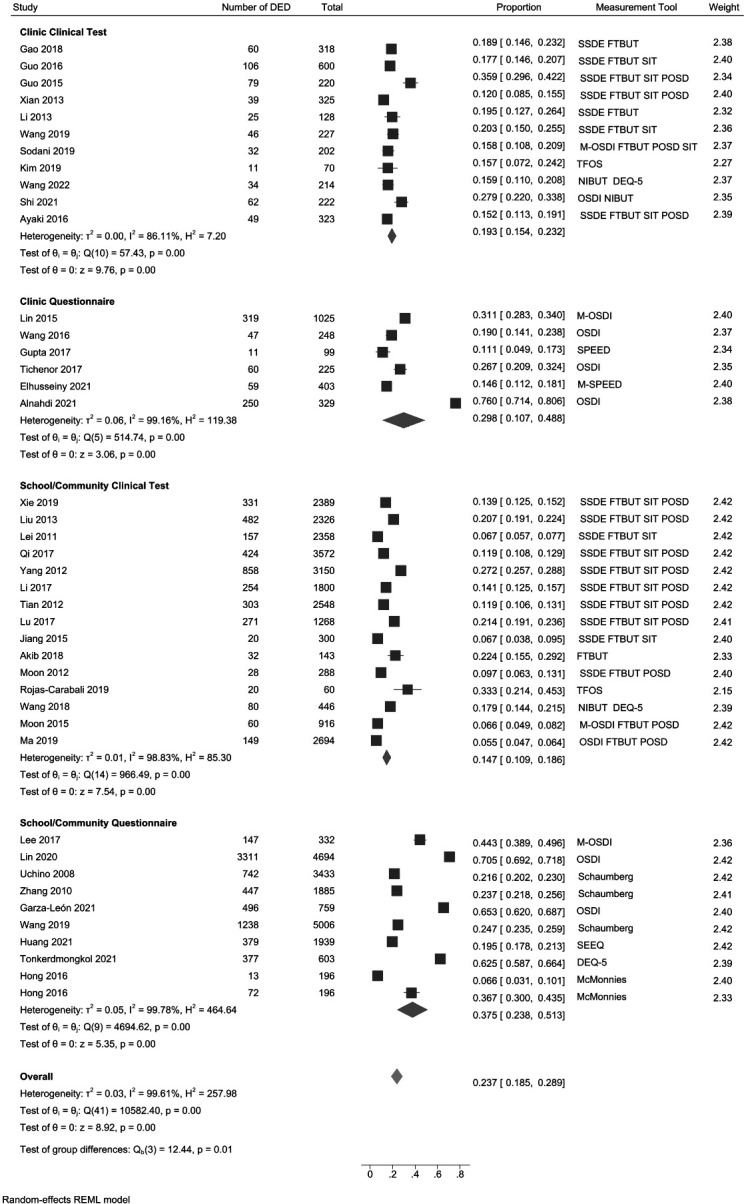
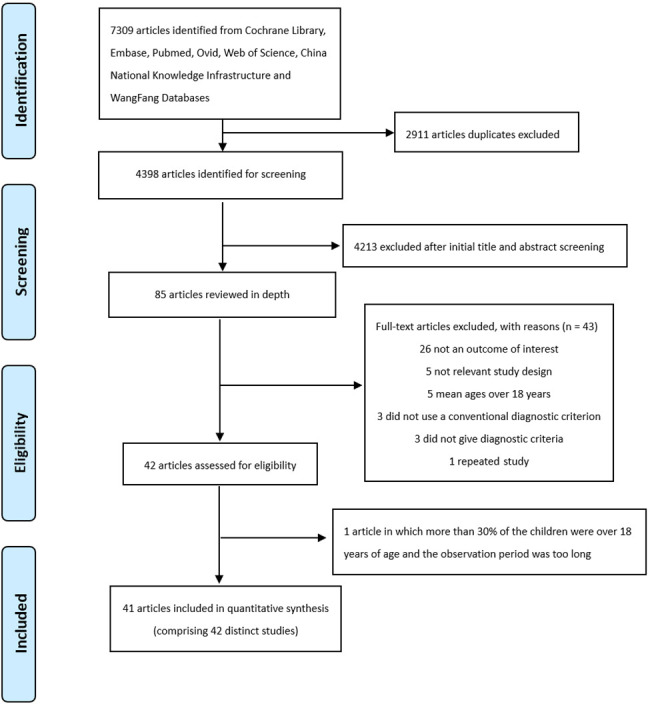
Results: Our literature search identified 7309 articles, of which 41 articles, representing 42 study cohorts (48 479 participants) included in the systematic review. The estimated prevalence of DED among children was 23.7% (95% CI 18.5% to 28.9%). The prevalence of DED by different diagnostic criteria (clinical signs vs reported symptoms by questionnaire) was 16.6% (95% CI 13.7% to 19.5%; 26 studies; 27 107 children) vs 34.6% (95% CI 23.7% to 45.6%; 16 studies; 21 372 children; p<0.01), respectively. The prevalence of DED after the COVID-19 pandemic outbreak was 44.1% (95% CI 25.5% to 62.7%; 8 studies; 9163 children), which was significantly higher than the 18.7% (95% CI 15.6% to 21.9%; 34studies, 39 316 children; p=0.01) before the COVID-19 outbreak. High between-study heterogeneity was noted (I2>92%). In meta-regression analysis, the prevalence of DED among children increased by 7.1% with each 10° decrease in latitude (p=0.015), and by 10.2% with each 10° increase in mean annual temperature (p=0.024).
Conclusions: DED is common in children up to 18 years of age and poses a significant disease burden. Standardisation of the diagnosis of DED in children and further study of other risk factors are needed to fully explain the epidemiology of DED in children.




 京公网安备 11010802042870号
京ICP备2023020795号-1
京公网安备 11010802042870号
京ICP备2023020795号-1

 分享
分享
 求助内容:
求助内容: 应助结果提醒方式:
 扫码关注我们
