Ilia Valentin, Pilar Caro, Christine Fischer, Heiko Brennenstuhl, Christian P. Schaaf
{"title":"The Natural Course of Bosch-Boonstra-Schaaf Optic Atrophy Syndrome","authors":"Ilia Valentin, Pilar Caro, Christine Fischer, Heiko Brennenstuhl, Christian P. Schaaf","doi":"10.1111/cge.14731","DOIUrl":null,"url":null,"abstract":"<p>(Likely) pathogenic variants in <i>NR2F1</i> are associated with Bosch-Boonstra-Schaaf optic atrophy syndrome (BBSOAS, OMIM #615722), a rare neurodevelopmental disorder. Patients present with a variety of symptoms, including intellectual disability, developmental delay, visual impairment, muscular hypotonia, seizures, and/or autistic features. Since it was first described in 2014, the phenotype has steadily expanded. However, there is limited information regarding the natural course of the disorder. Here, we present data on genetic variants and phenotype development of 47 individuals who responded to our questionnaire. A questionnaire was developed to assess the phenotype more comprehensively and to better understand the course of symptoms. In addition, families sent medical documents and photographs. To investigate the genotype-phenotype correlation in our cohort, we compared clinical features of two genotypically distinct groups (variants in the DNA-binding domain (DBD, <i>n</i> = 17) versus variants elsewhere in the gene (<i>n</i> = 30)). We observed a range of common symptoms including developmental delay, muscular hypotonia, optic atrophy, nystagmus, strabismus, autistic features, and thin corpus callosum on brain MRI. Overall, more improvement than worsening was reported. Individuals with variants in the DBD showed a higher prevalence of severe clinical features, such as infantile spasms (46.7% vs. 3.8%, <i>p</i> = 0.002) or nonverbality (50% vs. 3.4%, <i>p</i> = 0.0004), age at diagnosis was statistically significantly different between the two genotypic groups (mean 4.7 years vs. 8.9 years, <i>p</i> = 0.048). Our study confirms characteristic clinical features of BBSOAS. Variants in the DBD are associated with a more severe clinical phenotype. We found no evidence that the disease progresses; rather, several symptoms are reported to improve over time. However, prospective longitudinal studies are needed to further investigate disease progression.</p>","PeriodicalId":10354,"journal":{"name":"Clinical Genetics","volume":"108 2","pages":"168-178"},"PeriodicalIF":2.3000,"publicationDate":"2025-02-19","publicationTypes":"Journal Article","fieldsOfStudy":null,"isOpenAccess":false,"openAccessPdf":"https://onlinelibrary.wiley.com/doi/epdf/10.1111/cge.14731","citationCount":"0","resultStr":null,"platform":"Semanticscholar","paperid":null,"PeriodicalName":"Clinical Genetics","FirstCategoryId":"3","ListUrlMain":"https://onlinelibrary.wiley.com/doi/10.1111/cge.14731","RegionNum":3,"RegionCategory":"医学","ArticlePicture":[],"TitleCN":null,"AbstractTextCN":null,"PMCID":null,"EPubDate":"","PubModel":"","JCR":"Q2","JCRName":"GENETICS & HEREDITY","Score":null,"Total":0}
引用次数: 0
Abstract
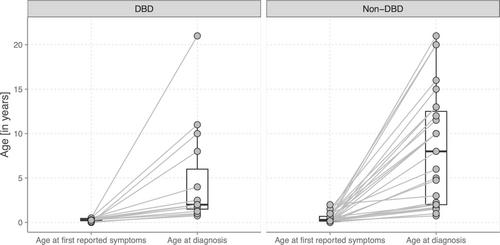
(Likely) pathogenic variants in NR2F1 are associated with Bosch-Boonstra-Schaaf optic atrophy syndrome (BBSOAS, OMIM #615722), a rare neurodevelopmental disorder. Patients present with a variety of symptoms, including intellectual disability, developmental delay, visual impairment, muscular hypotonia, seizures, and/or autistic features. Since it was first described in 2014, the phenotype has steadily expanded. However, there is limited information regarding the natural course of the disorder. Here, we present data on genetic variants and phenotype development of 47 individuals who responded to our questionnaire. A questionnaire was developed to assess the phenotype more comprehensively and to better understand the course of symptoms. In addition, families sent medical documents and photographs. To investigate the genotype-phenotype correlation in our cohort, we compared clinical features of two genotypically distinct groups (variants in the DNA-binding domain (DBD, n = 17) versus variants elsewhere in the gene (n = 30)). We observed a range of common symptoms including developmental delay, muscular hypotonia, optic atrophy, nystagmus, strabismus, autistic features, and thin corpus callosum on brain MRI. Overall, more improvement than worsening was reported. Individuals with variants in the DBD showed a higher prevalence of severe clinical features, such as infantile spasms (46.7% vs. 3.8%, p = 0.002) or nonverbality (50% vs. 3.4%, p = 0.0004), age at diagnosis was statistically significantly different between the two genotypic groups (mean 4.7 years vs. 8.9 years, p = 0.048). Our study confirms characteristic clinical features of BBSOAS. Variants in the DBD are associated with a more severe clinical phenotype. We found no evidence that the disease progresses; rather, several symptoms are reported to improve over time. However, prospective longitudinal studies are needed to further investigate disease progression.
期刊介绍:
Clinical Genetics links research to the clinic, translating advances in our understanding of the molecular basis of genetic disease for the practising clinical geneticist. The journal publishes high quality research papers, short reports, reviews and mini-reviews that connect medical genetics research with clinical practice.
Topics of particular interest are:
• Linking genetic variations to disease
• Genome rearrangements and disease
• Epigenetics and disease
• The translation of genotype to phenotype
• Genetics of complex disease
• Management/intervention of genetic diseases
• Novel therapies for genetic diseases
• Developmental biology, as it relates to clinical genetics
• Social science research on the psychological and behavioural aspects of living with or being at risk of genetic disease



 京公网安备 11010802042870号
京ICP备2023020795号-1
京公网安备 11010802042870号
京ICP备2023020795号-1

 分享
分享
 求助内容:
求助内容: 应助结果提醒方式:
 扫码关注我们
