Impact of age and sex on survival outcomes in patients aged 1-45 years with acute lymphoblastic leukemia treated according to the stratification used in the NOPHO ALL2008 trial.
Tuomas Lahteenmaki Taalas, Trausti Oskarsson, Mats Heyman, Bendik Lund, Kristi Lepik, Goda Vaitkevičiene, Olafur Gisli Jonsson, Julia Eriksson, Nina Toft, Laimonas Griškevičius, Helene Hallbook, Katrin Palk, Ulla Wartiovaara-Kautto, Petter Quist-Paulsen, Ulrika Noren-Nystrom, Kim Vettenranta, Jonas Abrahamsson, Kjeld Schmiegelow, Paivi M Lahteenmaki
{"title":"Impact of age and sex on survival outcomes in patients aged 1-45 years with acute lymphoblastic leukemia treated according to the stratification used in the NOPHO ALL2008 trial.","authors":"Tuomas Lahteenmaki Taalas, Trausti Oskarsson, Mats Heyman, Bendik Lund, Kristi Lepik, Goda Vaitkevičiene, Olafur Gisli Jonsson, Julia Eriksson, Nina Toft, Laimonas Griškevičius, Helene Hallbook, Katrin Palk, Ulla Wartiovaara-Kautto, Petter Quist-Paulsen, Ulrika Noren-Nystrom, Kim Vettenranta, Jonas Abrahamsson, Kjeld Schmiegelow, Paivi M Lahteenmaki","doi":"10.3324/haematol.2024.286043","DOIUrl":null,"url":null,"abstract":"<p><p>Age and sex have historically been associated with differences in the survival of patients with acute lymphoblastic leukemia (ALL). The NOPHO ALL2008 trial included patients aged 1-45 years with BCR::ABL1-negative B-precursor and T-cell ALL, but neither sex nor age was integrated into risk group allocation. Among 1,771 trial patients stratified into protocol- appropriate risk groups, we estimated the impact of age and sex on survival (even after relapse) and toxicities prospectively registered at 3-month intervals. In multivariate Cox regression analysis adjusted by sex, age group, and risk group, age but not sex was an independent risk factor for reduced 5-year event-free survival (EFS): hazard ratio=1.57 (95% confidence interval: 1.15-2.14) for patients 10-17.9 years, and 2.70 (95% confidence interval: 2.03-3.58) for patients 18-45 years, compared to patients <10 years old at diagnosis. The overall 5-year pEFS was 0.83. For standard-risk patients (B-lineage, white cell count <100x109/L, no risk genetics, minimal residual disease day 29 <0.1%), an inferior 5-year EFS was observed among patients 18-45 years (pEFS 0.78, P<0.001) and 10-17.9 years (pEFS 0.86, P=0.002) compared to patients <10 years at diagnosis (pEFS 0.93). For the intermediate-risk and high-risk groups, EFS was worse for patients 18-45 years compared to patients <10 years: pEFS 0.69 versus 0.89 (P<0.001) and pEFS 0.55 versus 0.71 (P=0.005), respectively. Osteonecrosis and veno-occlusive disease were associated with female sex in the standard-risk group, and age ≥10 years was associated with osteonecrosis, thrombosis, and pancreatitis in sex- and treatment-group-adjusted analyses. In conclusion, this study indicates that risk-grouping and/or treatment-intensity criteria should differ across age groups and that age-adapted strategies to mitigate toxicities are needed.</p>","PeriodicalId":12964,"journal":{"name":"Haematologica","volume":" ","pages":"1723-1735"},"PeriodicalIF":7.9000,"publicationDate":"2025-08-01","publicationTypes":"Journal Article","fieldsOfStudy":null,"isOpenAccess":false,"openAccessPdf":"https://www.ncbi.nlm.nih.gov/pmc/articles/PMC12358788/pdf/","citationCount":"0","resultStr":null,"platform":"Semanticscholar","paperid":null,"PeriodicalName":"Haematologica","FirstCategoryId":"3","ListUrlMain":"https://doi.org/10.3324/haematol.2024.286043","RegionNum":1,"RegionCategory":"医学","ArticlePicture":[],"TitleCN":null,"AbstractTextCN":null,"PMCID":null,"EPubDate":"2025/2/20 0:00:00","PubModel":"Epub","JCR":"Q1","JCRName":"HEMATOLOGY","Score":null,"Total":0}
引用次数: 0
Abstract
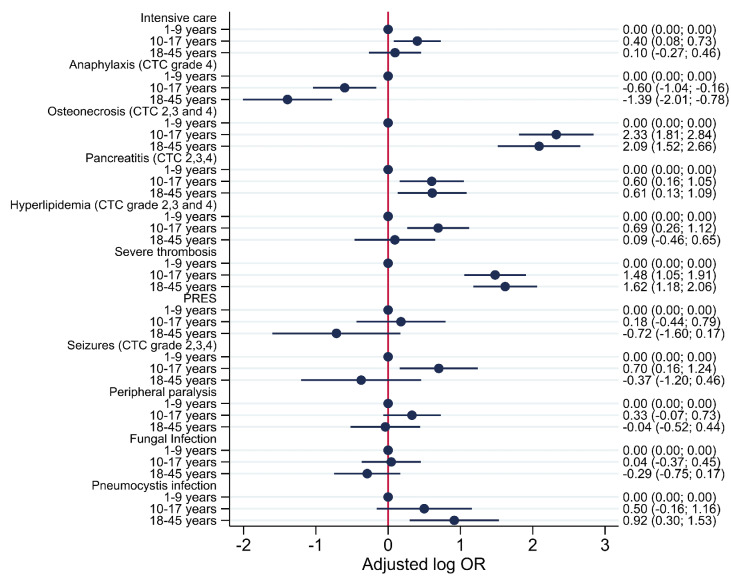
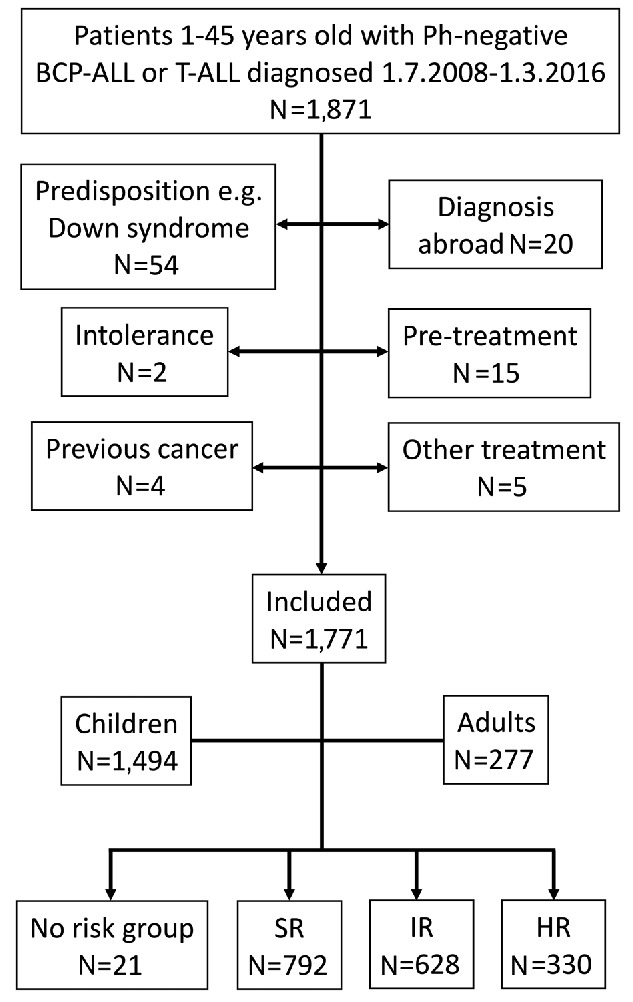
Age and sex have historically been associated with differences in the survival of patients with acute lymphoblastic leukemia (ALL). The NOPHO ALL2008 trial included patients aged 1-45 years with BCR::ABL1-negative B-precursor and T-cell ALL, but neither sex nor age was integrated into risk group allocation. Among 1,771 trial patients stratified into protocol- appropriate risk groups, we estimated the impact of age and sex on survival (even after relapse) and toxicities prospectively registered at 3-month intervals. In multivariate Cox regression analysis adjusted by sex, age group, and risk group, age but not sex was an independent risk factor for reduced 5-year event-free survival (EFS): hazard ratio=1.57 (95% confidence interval: 1.15-2.14) for patients 10-17.9 years, and 2.70 (95% confidence interval: 2.03-3.58) for patients 18-45 years, compared to patients <10 years old at diagnosis. The overall 5-year pEFS was 0.83. For standard-risk patients (B-lineage, white cell count <100x109/L, no risk genetics, minimal residual disease day 29 <0.1%), an inferior 5-year EFS was observed among patients 18-45 years (pEFS 0.78, P<0.001) and 10-17.9 years (pEFS 0.86, P=0.002) compared to patients <10 years at diagnosis (pEFS 0.93). For the intermediate-risk and high-risk groups, EFS was worse for patients 18-45 years compared to patients <10 years: pEFS 0.69 versus 0.89 (P<0.001) and pEFS 0.55 versus 0.71 (P=0.005), respectively. Osteonecrosis and veno-occlusive disease were associated with female sex in the standard-risk group, and age ≥10 years was associated with osteonecrosis, thrombosis, and pancreatitis in sex- and treatment-group-adjusted analyses. In conclusion, this study indicates that risk-grouping and/or treatment-intensity criteria should differ across age groups and that age-adapted strategies to mitigate toxicities are needed.
期刊介绍:
Haematologica is a journal that publishes articles within the broad field of hematology. It reports on novel findings in basic, clinical, and translational research.
Scope:
The scope of the journal includes reporting novel research results that:
Have a significant impact on understanding normal hematology or the development of hematological diseases.
Are likely to bring important changes to the diagnosis or treatment of hematological diseases.




 京公网安备 11010802042870号
京ICP备2023020795号-1
京公网安备 11010802042870号
京ICP备2023020795号-1

 分享
分享
 求助内容:
求助内容: 应助结果提醒方式:
 扫码关注我们
