Roxanne S Beltran, A Marm Kilpatrick, Stephanie K Adamczak, Larissa T Beumer, Max F Czapanskiy, Sarah C Davidson, Bryan S McLean, Thomas Mueller, Allison R Payne, Carmen D Soria, Brian C Weeks, Terrie M Williams, Roberto Salguero-Gómez
{"title":"Integrating animal tracking and trait data to facilitate global ecological discoveries.","authors":"Roxanne S Beltran, A Marm Kilpatrick, Stephanie K Adamczak, Larissa T Beumer, Max F Czapanskiy, Sarah C Davidson, Bryan S McLean, Thomas Mueller, Allison R Payne, Carmen D Soria, Brian C Weeks, Terrie M Williams, Roberto Salguero-Gómez","doi":"10.1242/jeb.247981","DOIUrl":null,"url":null,"abstract":"<p><p>Understanding animal movement is at the core of ecology, evolution and conservation science. Big data approaches for animal tracking have facilitated impactful synthesis research on spatial biology and behavior in ecologically important and human-impacted regions. Similarly, databases of animal traits (e.g. body size, limb length, locomotion method, lifespan) have been used for a wide range of comparative questions, with emerging data being shared at the level of individuals and populations. Here, we argue that the proliferation of both types of publicly available data creates exciting opportunities to unlock new avenues of research, such as spatial planning and ecological forecasting. We assessed the feasibility of combining animal tracking and trait databases to develop and test hypotheses across geographic, temporal and biological allometric scales. We identified multiple research questions addressing performance and distribution constraints that could be answered by integrating trait and tracking data. For example, how do physiological (e.g. metabolic rates) and biomechanical traits (e.g. limb length, locomotion form) influence migration distances? We illustrate the potential of our framework with three case studies that effectively integrate trait and tracking data for comparative research. An important challenge ahead is the lack of taxonomic and spatial overlap in trait and tracking databases. We identify critical next steps for future integration of tracking and trait databases, with the most impactful being open and interlinked individual-level data. Coordinated efforts to combine trait and tracking databases will accelerate global ecological and evolutionary insights and inform conservation and management decisions in our changing world.</p>","PeriodicalId":15786,"journal":{"name":"Journal of Experimental Biology","volume":"228 Suppl_1","pages":""},"PeriodicalIF":2.6000,"publicationDate":"2025-02-15","publicationTypes":"Journal Article","fieldsOfStudy":null,"isOpenAccess":false,"openAccessPdf":"https://www.ncbi.nlm.nih.gov/pmc/articles/PMC11883293/pdf/","citationCount":"0","resultStr":null,"platform":"Semanticscholar","paperid":null,"PeriodicalName":"Journal of Experimental Biology","FirstCategoryId":"99","ListUrlMain":"https://doi.org/10.1242/jeb.247981","RegionNum":2,"RegionCategory":"生物学","ArticlePicture":[],"TitleCN":null,"AbstractTextCN":null,"PMCID":null,"EPubDate":"2025/2/20 0:00:00","PubModel":"Epub","JCR":"Q2","JCRName":"BIOLOGY","Score":null,"Total":0}
引用次数: 0
Abstract
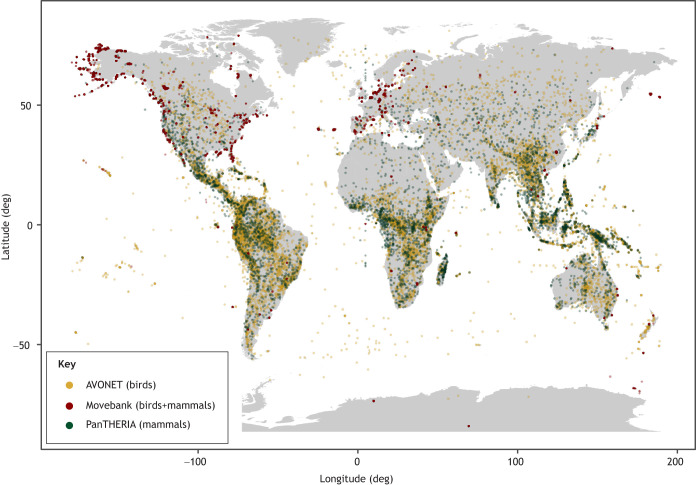
Understanding animal movement is at the core of ecology, evolution and conservation science. Big data approaches for animal tracking have facilitated impactful synthesis research on spatial biology and behavior in ecologically important and human-impacted regions. Similarly, databases of animal traits (e.g. body size, limb length, locomotion method, lifespan) have been used for a wide range of comparative questions, with emerging data being shared at the level of individuals and populations. Here, we argue that the proliferation of both types of publicly available data creates exciting opportunities to unlock new avenues of research, such as spatial planning and ecological forecasting. We assessed the feasibility of combining animal tracking and trait databases to develop and test hypotheses across geographic, temporal and biological allometric scales. We identified multiple research questions addressing performance and distribution constraints that could be answered by integrating trait and tracking data. For example, how do physiological (e.g. metabolic rates) and biomechanical traits (e.g. limb length, locomotion form) influence migration distances? We illustrate the potential of our framework with three case studies that effectively integrate trait and tracking data for comparative research. An important challenge ahead is the lack of taxonomic and spatial overlap in trait and tracking databases. We identify critical next steps for future integration of tracking and trait databases, with the most impactful being open and interlinked individual-level data. Coordinated efforts to combine trait and tracking databases will accelerate global ecological and evolutionary insights and inform conservation and management decisions in our changing world.
期刊介绍:
Journal of Experimental Biology is the leading primary research journal in comparative physiology and publishes papers on the form and function of living organisms at all levels of biological organisation, from the molecular and subcellular to the integrated whole animal.





 京公网安备 11010802042870号
京ICP备2023020795号-1
京公网安备 11010802042870号
京ICP备2023020795号-1

 分享
分享
 求助内容:
求助内容: 应助结果提醒方式:
 扫码关注我们
