{"title":"A LASSO-derived model for the prediction of coagulation disorders after coronary artery bypass grafting.","authors":"Honglei Zhao, Xiaonan Li, Haiyang Li, Wenxing Peng","doi":"10.21037/jtd-24-1321","DOIUrl":null,"url":null,"abstract":"<p><strong>Background: </strong>Postoperative coagulation dysfunction is one of the common complications after coronary artery bypass grafting (CABG), especially in elderly patients. The aim of this study was to establish a risk prediction model for coagulation disorders in elderly patients after CABG, effectively identify high-risk patients who are prone to coagulation disorders, and strengthen postoperative treatment monitoring for these patients.</p><p><strong>Methods: </strong>Patients who underwent CABG were retrospectively included between February 2019 and December 2020, and were randomly divided into a derivation set and a validation set at a ratio of 7:3. The disseminated intravascular coagulation (DIC) score of ≥2 was defined as coagulation disorder. The least absolute shrinkage and selection operator (LASSO) regression was used for variable selection and the establishment of a regression model. The confusion matrix and receiver operating characteristic (ROC) curve were used to evaluate the model prediction effect.</p><p><strong>Results: </strong>The risk factors associated with postoperative coagulation dysfunction, selected by LASSO regression, including patient weight, preoperative baseline estimated glomerular filtration rate (eGFR), B-type natriuretic peptide (BNP), platelet count (PLT), preoperative use of heparin and angiotensin receptor-neprilysin inhibitor (ARNI), as well as intraoperative utilization of epinephrine, norepinephrine, dopamine, cephalosporins, cardiopulmonary bypass (CPB), intra-aortic balloon pump (IABP), extracorporeal membrane oxygenation (ECMO), operation duration, and total intraoperative fluid input. The area under curve (AUC) of the derivation set was 0.818 [95% confidence interval (CI): 0.775-0.862], while the AUC of the validation set was 0.827 (95% CI: 0.755-0.898). The sensitivity and specificity of the model in the derivation set were 80.0% and 70.0%. In the validation set, the sensitivity was 76.6% and the specificity was 81.7%, indicating that the model has good predictive performance.</p><p><strong>Conclusions: </strong>The LASSO regression model for predicting coagulation disorders after CABG showed a good predictive performance in both the derivation set and the validation set, which is helpful for early identification of high-risk patients with coagulation disorders after CABG.</p>","PeriodicalId":17542,"journal":{"name":"Journal of thoracic disease","volume":"17 1","pages":"231-242"},"PeriodicalIF":1.9000,"publicationDate":"2025-01-24","publicationTypes":"Journal Article","fieldsOfStudy":null,"isOpenAccess":false,"openAccessPdf":"https://www.ncbi.nlm.nih.gov/pmc/articles/PMC11833571/pdf/","citationCount":"0","resultStr":null,"platform":"Semanticscholar","paperid":null,"PeriodicalName":"Journal of thoracic disease","FirstCategoryId":"3","ListUrlMain":"https://doi.org/10.21037/jtd-24-1321","RegionNum":3,"RegionCategory":"医学","ArticlePicture":[],"TitleCN":null,"AbstractTextCN":null,"PMCID":null,"EPubDate":"2025/1/22 0:00:00","PubModel":"Epub","JCR":"Q3","JCRName":"RESPIRATORY SYSTEM","Score":null,"Total":0}
引用次数: 0
Abstract
Background: Postoperative coagulation dysfunction is one of the common complications after coronary artery bypass grafting (CABG), especially in elderly patients. The aim of this study was to establish a risk prediction model for coagulation disorders in elderly patients after CABG, effectively identify high-risk patients who are prone to coagulation disorders, and strengthen postoperative treatment monitoring for these patients.
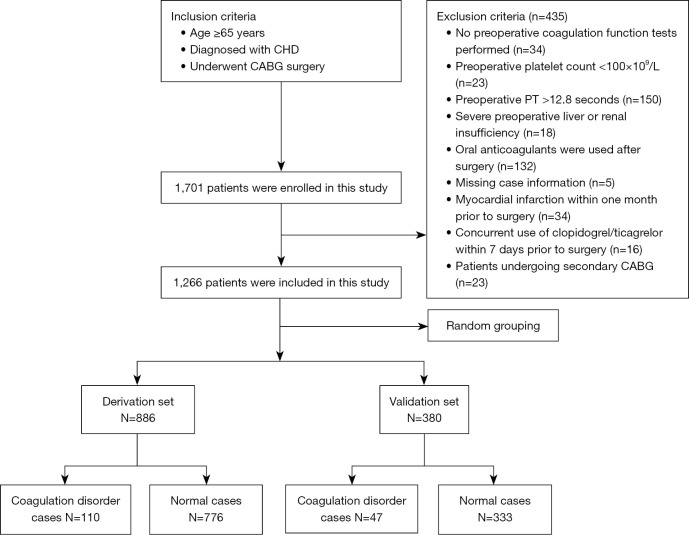
Methods: Patients who underwent CABG were retrospectively included between February 2019 and December 2020, and were randomly divided into a derivation set and a validation set at a ratio of 7:3. The disseminated intravascular coagulation (DIC) score of ≥2 was defined as coagulation disorder. The least absolute shrinkage and selection operator (LASSO) regression was used for variable selection and the establishment of a regression model. The confusion matrix and receiver operating characteristic (ROC) curve were used to evaluate the model prediction effect.
Results: The risk factors associated with postoperative coagulation dysfunction, selected by LASSO regression, including patient weight, preoperative baseline estimated glomerular filtration rate (eGFR), B-type natriuretic peptide (BNP), platelet count (PLT), preoperative use of heparin and angiotensin receptor-neprilysin inhibitor (ARNI), as well as intraoperative utilization of epinephrine, norepinephrine, dopamine, cephalosporins, cardiopulmonary bypass (CPB), intra-aortic balloon pump (IABP), extracorporeal membrane oxygenation (ECMO), operation duration, and total intraoperative fluid input. The area under curve (AUC) of the derivation set was 0.818 [95% confidence interval (CI): 0.775-0.862], while the AUC of the validation set was 0.827 (95% CI: 0.755-0.898). The sensitivity and specificity of the model in the derivation set were 80.0% and 70.0%. In the validation set, the sensitivity was 76.6% and the specificity was 81.7%, indicating that the model has good predictive performance.
Conclusions: The LASSO regression model for predicting coagulation disorders after CABG showed a good predictive performance in both the derivation set and the validation set, which is helpful for early identification of high-risk patients with coagulation disorders after CABG.
期刊介绍:
The Journal of Thoracic Disease (JTD, J Thorac Dis, pISSN: 2072-1439; eISSN: 2077-6624) was founded in Dec 2009, and indexed in PubMed in Dec 2011 and Science Citation Index SCI in Feb 2013. It is published quarterly (Dec 2009- Dec 2011), bimonthly (Jan 2012 - Dec 2013), monthly (Jan. 2014-) and openly distributed worldwide. JTD received its impact factor of 2.365 for the year 2016. JTD publishes manuscripts that describe new findings and provide current, practical information on the diagnosis and treatment of conditions related to thoracic disease. All the submission and reviewing are conducted electronically so that rapid review is assured.





 京公网安备 11010802042870号
京ICP备2023020795号-1
京公网安备 11010802042870号
京ICP备2023020795号-1

 分享
分享
 求助内容:
求助内容: 应助结果提醒方式:
 扫码关注我们
