Zejun Liu, Ying Yu, Rui Hu, Tengteng Jian, Kai Yu, Ji Lu
{"title":"Effect of prostate volume on the predictive value of prostate-specific antigen density for prostate cancer.","authors":"Zejun Liu, Ying Yu, Rui Hu, Tengteng Jian, Kai Yu, Ji Lu","doi":"10.21037/tau-24-490","DOIUrl":null,"url":null,"abstract":"<p><strong>Background: </strong>In clinical practice, we observed that some patients with larger prostate volume (PV) and prostate-specific antigen (PSA) values below 20 ng/mL still yielded negative biopsy results. We aim to establish a more precise volume range for guiding biopsies in patients with enlarged prostate glands.</p><p><strong>Methods: </strong>We conducted a retrospective analysis of 424 cases involving patients who underwent prostate biopsy. The patients were categorized into three groups based on their body mass index: small (PV <45 cm<sup>3</sup>), medium (45 cm<sup>3</sup>≤ PV <70 cm<sup>3</sup>), and large (PV ≥70 cm<sup>3</sup>). Logistic regression, receiver operating characteristic (ROC) curves, restricted cubic spline (RCS) curves, and decision trees were employed for comparison purposes.</p><p><strong>Results: </strong>In the multivariate logistic regression analysis, a statistically significant association was observed between prostate-specific antigen density (PSAD) ≥0.15 ng/mL/cm<sup>3</sup> and the need for biopsy to confirm prostate cancer diagnosis when the volume was less than 45 cm<sup>3</sup> [odds ratio (OR) =4.587; 95% confidence intervals (CI): 1.667-15.091; P=0.006]. The point of intersection between the RCS curve and the reference line occurred at PV =45 cm<sup>3</sup>, indicating a higher risk of prostate cancer (PCa) increased with decreasing PV size. After constructing a decision tree model, it was found that when the volume was less than approximately 26 cm<sup>3</sup>, there was a significantly increased probability (approximately 69%) of having prostate cancer after biopsy.</p><p><strong>Conclusions: </strong>The likelihood of developing prostate cancer is higher in patients with small PVs (PV <45 cm<sup>3</sup>), especially those with (PV <26 cm<sup>3</sup>), when PSAD exceeds 0.15 ng/mL/cm<sup>3</sup>. Patients with larger volumes (PV ≥70 cm<sup>3</sup>) can be regularly monitored and followed up.</p>","PeriodicalId":23270,"journal":{"name":"Translational andrology and urology","volume":"14 1","pages":"70-80"},"PeriodicalIF":1.7000,"publicationDate":"2025-01-31","publicationTypes":"Journal Article","fieldsOfStudy":null,"isOpenAccess":false,"openAccessPdf":"https://www.ncbi.nlm.nih.gov/pmc/articles/PMC11833531/pdf/","citationCount":"0","resultStr":null,"platform":"Semanticscholar","paperid":null,"PeriodicalName":"Translational andrology and urology","FirstCategoryId":"3","ListUrlMain":"https://doi.org/10.21037/tau-24-490","RegionNum":3,"RegionCategory":"医学","ArticlePicture":[],"TitleCN":null,"AbstractTextCN":null,"PMCID":null,"EPubDate":"2025/1/22 0:00:00","PubModel":"Epub","JCR":"Q4","JCRName":"ANDROLOGY","Score":null,"Total":0}
引用次数: 0
Abstract
Background: In clinical practice, we observed that some patients with larger prostate volume (PV) and prostate-specific antigen (PSA) values below 20 ng/mL still yielded negative biopsy results. We aim to establish a more precise volume range for guiding biopsies in patients with enlarged prostate glands.
Methods: We conducted a retrospective analysis of 424 cases involving patients who underwent prostate biopsy. The patients were categorized into three groups based on their body mass index: small (PV <45 cm3), medium (45 cm3≤ PV <70 cm3), and large (PV ≥70 cm3). Logistic regression, receiver operating characteristic (ROC) curves, restricted cubic spline (RCS) curves, and decision trees were employed for comparison purposes.
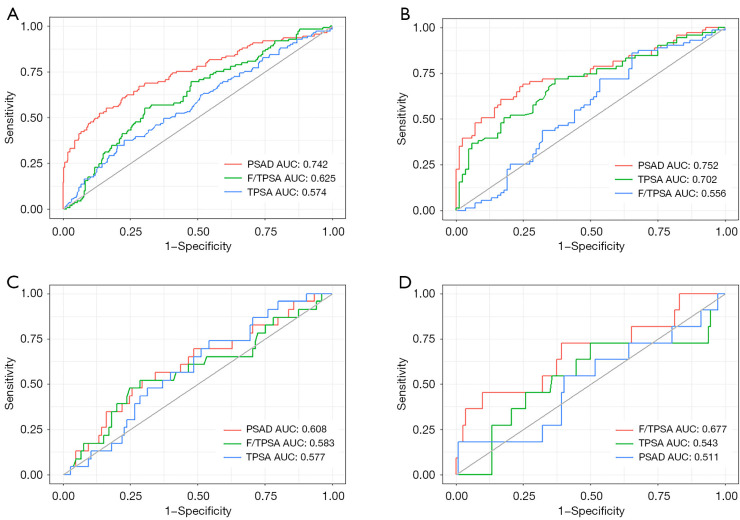
Results: In the multivariate logistic regression analysis, a statistically significant association was observed between prostate-specific antigen density (PSAD) ≥0.15 ng/mL/cm3 and the need for biopsy to confirm prostate cancer diagnosis when the volume was less than 45 cm3 [odds ratio (OR) =4.587; 95% confidence intervals (CI): 1.667-15.091; P=0.006]. The point of intersection between the RCS curve and the reference line occurred at PV =45 cm3, indicating a higher risk of prostate cancer (PCa) increased with decreasing PV size. After constructing a decision tree model, it was found that when the volume was less than approximately 26 cm3, there was a significantly increased probability (approximately 69%) of having prostate cancer after biopsy.
Conclusions: The likelihood of developing prostate cancer is higher in patients with small PVs (PV <45 cm3), especially those with (PV <26 cm3), when PSAD exceeds 0.15 ng/mL/cm3. Patients with larger volumes (PV ≥70 cm3) can be regularly monitored and followed up.
期刊介绍:
ranslational Andrology and Urology (Print ISSN 2223-4683; Online ISSN 2223-4691; Transl Androl Urol; TAU) is an open access, peer-reviewed, bi-monthly journal (quarterly published from Mar.2012 - Dec. 2014). The main focus of the journal is to describe new findings in the field of translational research of Andrology and Urology, provides current and practical information on basic research and clinical investigations of Andrology and Urology. Specific areas of interest include, but not limited to, molecular study, pathology, biology and technical advances related to andrology and urology. Topics cover range from evaluation, prevention, diagnosis, therapy, prognosis, rehabilitation and future challenges to urology and andrology. Contributions pertinent to urology and andrology are also included from related fields such as public health, basic sciences, education, sociology, and nursing.





 京公网安备 11010802042870号
京ICP备2023020795号-1
京公网安备 11010802042870号
京ICP备2023020795号-1

 分享
分享
 求助内容:
求助内容: 应助结果提醒方式:
 扫码关注我们
