Braxton W Porter, Robert B Sowby, Gustavious P Williams, Braden J Limb, Jason C Quinn, Alex Johnson, Evan A Thomas
{"title":"Mitigating Wildfire Impact on Water Quality through Climate-Based Financing: A Case Study of the Provo River Watershed.","authors":"Braxton W Porter, Robert B Sowby, Gustavious P Williams, Braden J Limb, Jason C Quinn, Alex Johnson, Evan A Thomas","doi":"10.1021/acsestwater.4c00727","DOIUrl":null,"url":null,"abstract":"<p><p>Following wildfires, riverine water quality in forested watersheds is prone to degradation, impacting drinking water treatment and potentially causing increased carbon emissions because of additional electricity consumption during treatment. We explore the potential for climate-based financing to support wildfire mitigation and watershed restoration by reducing potential water treatment energy demand following a fire within the Provo River watershed, Utah, USA. We model pre- and post-wildfire erosion and water quality in the Provo River using GeoWEPP. We use energy data from a water treatment plant in the watershed and literature data to estimate the increase in energy use for treating degraded water. We find that most watershed areas are not subject to large treatment demand changes, but a few hotspots are prone to increased sediment loads. In the Provo River watershed, on average, a fire in a single 12-digit hydrologic unit code (HUC) subwatershed corresponds to an additional 350 metric tonnes of carbon-dioxide-equivalent (CO<sub>2</sub>e) emissions for one year following a wildfire event due to increased energy required by the water treatment plant. If wildfire risk is reduced, the avoided emissions can generate a potential of $88,500 annually in carbon credit revenue (at $10/CO<sub>2</sub>e credit) for the contributing HUC8 sub-basin.</p>","PeriodicalId":93847,"journal":{"name":"ACS ES&T water","volume":"5 2","pages":"649-658"},"PeriodicalIF":4.3000,"publicationDate":"2025-02-05","publicationTypes":"Journal Article","fieldsOfStudy":null,"isOpenAccess":false,"openAccessPdf":"https://www.ncbi.nlm.nih.gov/pmc/articles/PMC11833860/pdf/","citationCount":"0","resultStr":null,"platform":"Semanticscholar","paperid":null,"PeriodicalName":"ACS ES&T water","FirstCategoryId":"1085","ListUrlMain":"https://doi.org/10.1021/acsestwater.4c00727","RegionNum":0,"RegionCategory":null,"ArticlePicture":[],"TitleCN":null,"AbstractTextCN":null,"PMCID":null,"EPubDate":"2025/2/14 0:00:00","PubModel":"eCollection","JCR":"Q1","JCRName":"ENVIRONMENTAL SCIENCES","Score":null,"Total":0}
引用次数: 0
Abstract
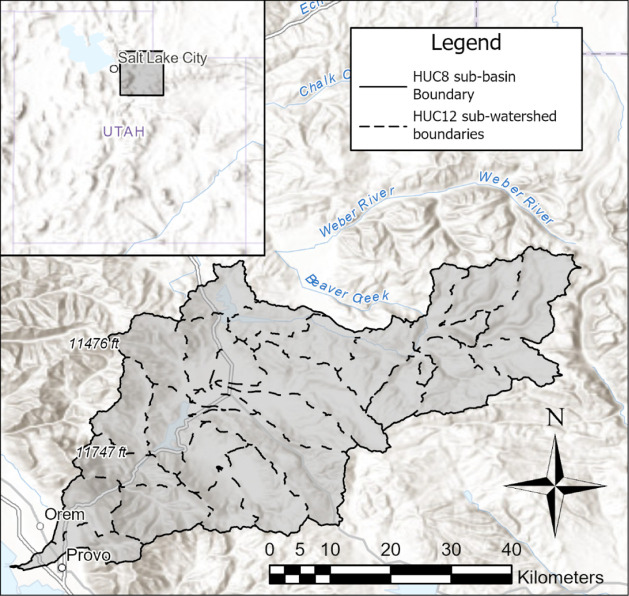
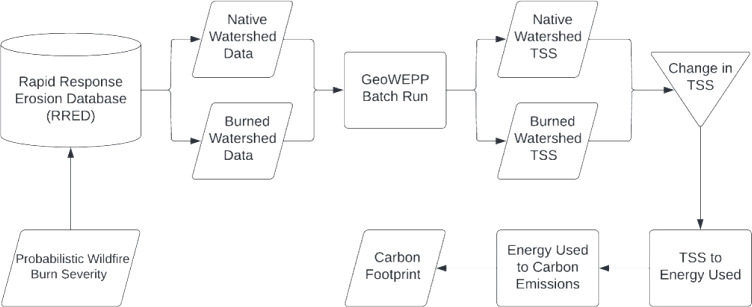
Following wildfires, riverine water quality in forested watersheds is prone to degradation, impacting drinking water treatment and potentially causing increased carbon emissions because of additional electricity consumption during treatment. We explore the potential for climate-based financing to support wildfire mitigation and watershed restoration by reducing potential water treatment energy demand following a fire within the Provo River watershed, Utah, USA. We model pre- and post-wildfire erosion and water quality in the Provo River using GeoWEPP. We use energy data from a water treatment plant in the watershed and literature data to estimate the increase in energy use for treating degraded water. We find that most watershed areas are not subject to large treatment demand changes, but a few hotspots are prone to increased sediment loads. In the Provo River watershed, on average, a fire in a single 12-digit hydrologic unit code (HUC) subwatershed corresponds to an additional 350 metric tonnes of carbon-dioxide-equivalent (CO2e) emissions for one year following a wildfire event due to increased energy required by the water treatment plant. If wildfire risk is reduced, the avoided emissions can generate a potential of $88,500 annually in carbon credit revenue (at $10/CO2e credit) for the contributing HUC8 sub-basin.




 京公网安备 11010802042870号
京ICP备2023020795号-1
京公网安备 11010802042870号
京ICP备2023020795号-1

 分享
分享

 求助内容:
求助内容: 应助结果提醒方式:
 扫码关注我们
