Luyanduthando Mqadi, Gillian J Bedwell, Ncumisa Msolo, Gwendoline Arendse, Maia Lesosky, Peter R Kamerman, Mark R Hutchinson, Andrew Schrepf, Robert R Edwards, John A Joska, Romy Parker, Victoria J Madden
{"title":"Distress is positively associated with induced secondary hyperalgesia in people with suppressed HIV.","authors":"Luyanduthando Mqadi, Gillian J Bedwell, Ncumisa Msolo, Gwendoline Arendse, Maia Lesosky, Peter R Kamerman, Mark R Hutchinson, Andrew Schrepf, Robert R Edwards, John A Joska, Romy Parker, Victoria J Madden","doi":"10.1101/2025.01.27.25321015","DOIUrl":null,"url":null,"abstract":"<p><p>Pain and symptoms of depression and anxiety (here, 'psychological distress') are frequently reported by people with HIV. Although pain is widely acknowledged to contribute to distress, distress may also contribute to pain and its persistence. Facilitation of nociceptive signalling is one pathway by which distress could exacerbate pain. The current study investigated the relationships between symptoms of depression and anxiety, secondary hyperalgesia (SH), and persistent pain in people with HIV, reporting pain (n=19) or no pain (n=26). We hypothesised that self-reported distress would be positively associated with the surface area (primary measure) and magnitude (secondary measure) of induced SH, and that participants reporting persistent pain would display greater induced SH than those reporting no pain. We found that distress was positively associated with the surface area (p=0.02) and the magnitude (p=0.01) of induced SH. However, participants with persistent pain showed no difference in the surface area of SH compared to pain-free participants (p=0.87), and those with pain displayed a marginally lower magnitude of SH (p=0.05). These findings position SH as a potentially useful mechanistic outcome for interventions that aim to address pain by reducing symptoms of depression and anxiety.</p><p><strong>Perspective: </strong>Symptoms of depression and anxiety were positively associated with induced secondary hyperalgesia in people with suppressed HIV.</p>","PeriodicalId":94281,"journal":{"name":"medRxiv : the preprint server for health sciences","volume":" ","pages":""},"PeriodicalIF":0.0000,"publicationDate":"2025-11-24","publicationTypes":"Journal Article","fieldsOfStudy":null,"isOpenAccess":false,"openAccessPdf":"https://www.ncbi.nlm.nih.gov/pmc/articles/PMC11838949/pdf/","citationCount":"0","resultStr":null,"platform":"Semanticscholar","paperid":null,"PeriodicalName":"medRxiv : the preprint server for health sciences","FirstCategoryId":"1085","ListUrlMain":"https://doi.org/10.1101/2025.01.27.25321015","RegionNum":0,"RegionCategory":null,"ArticlePicture":[],"TitleCN":null,"AbstractTextCN":null,"PMCID":null,"EPubDate":"","PubModel":"","JCR":"","JCRName":"","Score":null,"Total":0}
引用次数: 0
Abstract
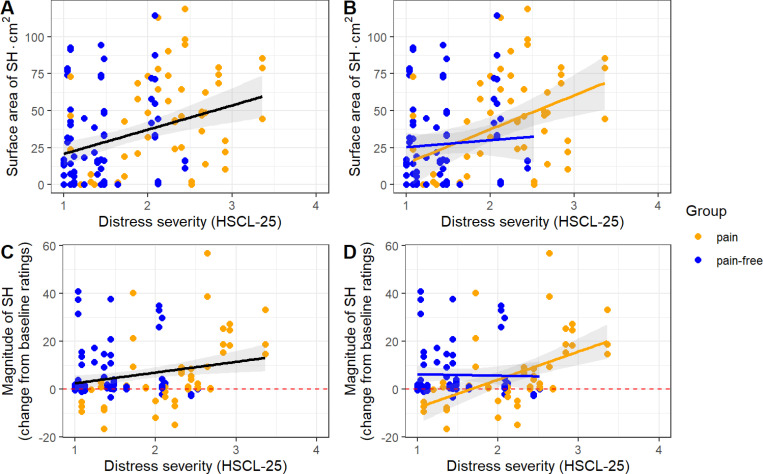
Pain and symptoms of depression and anxiety (here, 'psychological distress') are frequently reported by people with HIV. Although pain is widely acknowledged to contribute to distress, distress may also contribute to pain and its persistence. Facilitation of nociceptive signalling is one pathway by which distress could exacerbate pain. The current study investigated the relationships between symptoms of depression and anxiety, secondary hyperalgesia (SH), and persistent pain in people with HIV, reporting pain (n=19) or no pain (n=26). We hypothesised that self-reported distress would be positively associated with the surface area (primary measure) and magnitude (secondary measure) of induced SH, and that participants reporting persistent pain would display greater induced SH than those reporting no pain. We found that distress was positively associated with the surface area (p=0.02) and the magnitude (p=0.01) of induced SH. However, participants with persistent pain showed no difference in the surface area of SH compared to pain-free participants (p=0.87), and those with pain displayed a marginally lower magnitude of SH (p=0.05). These findings position SH as a potentially useful mechanistic outcome for interventions that aim to address pain by reducing symptoms of depression and anxiety.
Perspective: Symptoms of depression and anxiety were positively associated with induced secondary hyperalgesia in people with suppressed HIV.




 京公网安备 11010802042870号
京ICP备2023020795号-1
京公网安备 11010802042870号
京ICP备2023020795号-1

 分享
分享

 求助内容:
求助内容: 应助结果提醒方式:
 扫码关注我们
