Multiblock NIR and MIR spectralprint through AComDim to evaluate the effects of growing site, harvest season, and clone on yerba mate leaves composition
Natalia Saudade de Aguiar , Gustavo Galo Marcheafave , Elis Daiane Pauli , Manoela Mendes Duarte , Ieda Spacino Scarminio , Roy Edward Bruns , Romà Tauler , Marcelo Lazzarotto , Ivar Wendling
{"title":"Multiblock NIR and MIR spectralprint through AComDim to evaluate the effects of growing site, harvest season, and clone on yerba mate leaves composition","authors":"Natalia Saudade de Aguiar , Gustavo Galo Marcheafave , Elis Daiane Pauli , Manoela Mendes Duarte , Ieda Spacino Scarminio , Roy Edward Bruns , Romà Tauler , Marcelo Lazzarotto , Ivar Wendling","doi":"10.1016/j.foodchem.2025.143459","DOIUrl":null,"url":null,"abstract":"<div><div>The composition of yerba mate implies significant potential in the food, pharmaceutical, and cosmetic industries, which requires standardization of the raw material. This study explores the simultaneous influence of growing sites, harvest seasons, and clones on the spectralprint of leaves through near-infrared (NIR) and mid-infrared (MIR) spectroscopy coupled with ANOVA Common Dimensions (AComDim) multivariate analysis. MIR spectroscopy identifies only the main effects of growing site and harvesting season, and the interaction between these factors. The NIR spectralprint identifies all main effects and interactions. Growing site and harvesting season individually account for approximately 7 % of the variance in the chemical composition of yerba mate, with their interaction contributing with 5.7 %. Clonal variation significantly affects the spectral profile with approximately 4 % variance, which allowed the identification of clones with the highest chemical divergence. The study demonstrates that biospectroscopics and chemometrics can enhance yerba mate quality through clonal selection and optimized agricultural practices.</div></div>","PeriodicalId":318,"journal":{"name":"Food Chemistry","volume":"477 ","pages":"Article 143459"},"PeriodicalIF":9.8000,"publicationDate":"2025-06-15","publicationTypes":"Journal Article","fieldsOfStudy":null,"isOpenAccess":false,"openAccessPdf":"","citationCount":"0","resultStr":null,"platform":"Semanticscholar","paperid":null,"PeriodicalName":"Food Chemistry","FirstCategoryId":"97","ListUrlMain":"https://www.sciencedirect.com/science/article/pii/S0308814625007101","RegionNum":1,"RegionCategory":"农林科学","ArticlePicture":[],"TitleCN":null,"AbstractTextCN":null,"PMCID":null,"EPubDate":"2025/2/20 0:00:00","PubModel":"Epub","JCR":"Q1","JCRName":"CHEMISTRY, APPLIED","Score":null,"Total":0}
引用次数: 0
Abstract
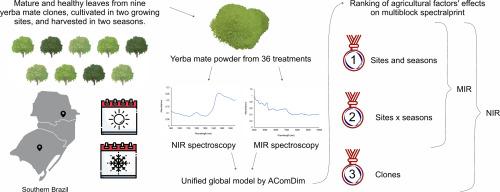
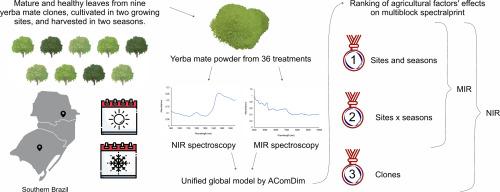
The composition of yerba mate implies significant potential in the food, pharmaceutical, and cosmetic industries, which requires standardization of the raw material. This study explores the simultaneous influence of growing sites, harvest seasons, and clones on the spectralprint of leaves through near-infrared (NIR) and mid-infrared (MIR) spectroscopy coupled with ANOVA Common Dimensions (AComDim) multivariate analysis. MIR spectroscopy identifies only the main effects of growing site and harvesting season, and the interaction between these factors. The NIR spectralprint identifies all main effects and interactions. Growing site and harvesting season individually account for approximately 7 % of the variance in the chemical composition of yerba mate, with their interaction contributing with 5.7 %. Clonal variation significantly affects the spectral profile with approximately 4 % variance, which allowed the identification of clones with the highest chemical divergence. The study demonstrates that biospectroscopics and chemometrics can enhance yerba mate quality through clonal selection and optimized agricultural practices.
期刊介绍:
Food Chemistry publishes original research papers dealing with the advancement of the chemistry and biochemistry of foods or the analytical methods/ approach used. All papers should focus on the novelty of the research carried out.



 京公网安备 11010802042870号
京ICP备2023020795号-1
京公网安备 11010802042870号
京ICP备2023020795号-1

 分享
分享
 求助内容:
求助内容: 应助结果提醒方式:
 扫码关注我们
