{"title":"Cured Memory RUL Prediction of Solid-State Batteries Combined Progressive-Topologia Fusion Health Indicators","authors":"Zhenxi Wang;Yan Ma;Jinwu Gao;Hong Chen","doi":"10.1109/TII.2025.3528576","DOIUrl":null,"url":null,"abstract":"Reliable remaining useful life (RUL) prediction provides a reference for the secure operation of solid-state batteries (SSBs). However, the intricate potential relations of degradation mechanism and limited degradation data in SSBs bring tremendous challenge. Thus, a novel RUL prediction method named cured memory strategic term moments network with attention of degradation information combined progressive-topologia fusion health indicators (IDPHIs-CMSTM) is proposed for SSBs. It is designed to obtain the implicit relations from Euclidean space and non-Euclidean space and increase the predicted precision on limited degradation data while interpretability is guaranteed. Specifically, in IDPHIs, layer-by-layer progressive fusion method with back-connections assisted by learnable dot product attention mechanism is proposed to gain deep fusion degradation health indicators (HIs) in Euclidean space. It mitigates the risk on information loss during the deep fusion HIs construction process for SSBs. Besides, the topological relations of degradation HIs are presented by graph attention network with two-layers (GAT). The IDPHIs are fed into the developed novel CMSTM to realize RUL prediction. The motivation for CMSTM comes from the early phases of the Ebbinghaus forgetting process, in which recent historical information is utilized to mitigate the forgetting rate of recent degradation information while exploring implicit relations of different degradation information in limited samples. Experiment results on real SSBs dataset show that the IDPHIs-CMSTM achieves higher than 95% predicted precision with well interpretability.","PeriodicalId":13301,"journal":{"name":"IEEE Transactions on Industrial Informatics","volume":"21 5","pages":"4051-4060"},"PeriodicalIF":9.9000,"publicationDate":"2025-02-20","publicationTypes":"Journal Article","fieldsOfStudy":null,"isOpenAccess":false,"openAccessPdf":"","citationCount":"0","resultStr":null,"platform":"Semanticscholar","paperid":null,"PeriodicalName":"IEEE Transactions on Industrial Informatics","FirstCategoryId":"94","ListUrlMain":"https://ieeexplore.ieee.org/document/10896838/","RegionNum":1,"RegionCategory":"计算机科学","ArticlePicture":[],"TitleCN":null,"AbstractTextCN":null,"PMCID":null,"EPubDate":"","PubModel":"","JCR":"Q1","JCRName":"AUTOMATION & CONTROL SYSTEMS","Score":null,"Total":0}
引用次数: 0
Abstract
Reliable remaining useful life (RUL) prediction provides a reference for the secure operation of solid-state batteries (SSBs). However, the intricate potential relations of degradation mechanism and limited degradation data in SSBs bring tremendous challenge. Thus, a novel RUL prediction method named cured memory strategic term moments network with attention of degradation information combined progressive-topologia fusion health indicators (IDPHIs-CMSTM) is proposed for SSBs. It is designed to obtain the implicit relations from Euclidean space and non-Euclidean space and increase the predicted precision on limited degradation data while interpretability is guaranteed. Specifically, in IDPHIs, layer-by-layer progressive fusion method with back-connections assisted by learnable dot product attention mechanism is proposed to gain deep fusion degradation health indicators (HIs) in Euclidean space. It mitigates the risk on information loss during the deep fusion HIs construction process for SSBs. Besides, the topological relations of degradation HIs are presented by graph attention network with two-layers (GAT). The IDPHIs are fed into the developed novel CMSTM to realize RUL prediction. The motivation for CMSTM comes from the early phases of the Ebbinghaus forgetting process, in which recent historical information is utilized to mitigate the forgetting rate of recent degradation information while exploring implicit relations of different degradation information in limited samples. Experiment results on real SSBs dataset show that the IDPHIs-CMSTM achieves higher than 95% predicted precision with well interpretability.
期刊介绍:
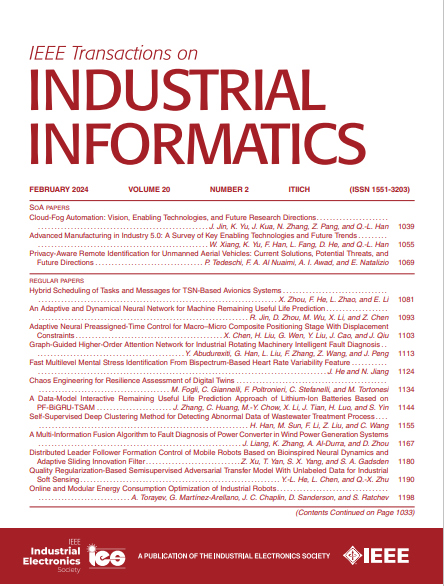
The IEEE Transactions on Industrial Informatics is a multidisciplinary journal dedicated to publishing technical papers that connect theory with practical applications of informatics in industrial settings. It focuses on the utilization of information in intelligent, distributed, and agile industrial automation and control systems. The scope includes topics such as knowledge-based and AI-enhanced automation, intelligent computer control systems, flexible and collaborative manufacturing, industrial informatics in software-defined vehicles and robotics, computer vision, industrial cyber-physical and industrial IoT systems, real-time and networked embedded systems, security in industrial processes, industrial communications, systems interoperability, and human-machine interaction.



 京公网安备 11010802042870号
京ICP备2023020795号-1
京公网安备 11010802042870号
京ICP备2023020795号-1

 分享
分享
 求助内容:
求助内容: 应助结果提醒方式:
 扫码关注我们
