Taohedul Islam, Sahar Bayat, Matthew A. Wright, Subrata Chandra Roy, Conrad Sawicki, Carrie L. Donley, Amar S. Kumbhar, Roman Chernikov, Misganaw Adigo Weret, Kamila M. Wiaderek, Chad Risko, Ruhul Amin, Saiful M. Islam
{"title":"Porous and Amorphous MnxMo3S13 Chalcogel Electrode for High-Capacity Conversion-Based Lithium-Ion Batteries","authors":"Taohedul Islam, Sahar Bayat, Matthew A. Wright, Subrata Chandra Roy, Conrad Sawicki, Carrie L. Donley, Amar S. Kumbhar, Roman Chernikov, Misganaw Adigo Weret, Kamila M. Wiaderek, Chad Risko, Ruhul Amin, Saiful M. Islam","doi":"10.1021/jacs.4c15552","DOIUrl":null,"url":null,"abstract":"While Li-ion batteries (LIBs) are a leading energy storage technology, their energy densities are limited by the low capacity of conventional intercalation cathodes, driving interest in high energy-density Li–S batteries that make use of conversion chemistry. Achieving high capacity, reversibility, and cycle stability, and controlling volume changes in conversion batteries during the charge–discharge process, however, remains challenging. Here, we present a porous, amorphous, sulfide-based Mn<sub><i>x</i></sub>Mo<sub>3</sub>S<sub>13</sub> chalcogel, which concurrently offers high capacity and cycle stability. The solution-processable room temperature synthesized Mn<sub><i>x</i></sub>Mo<sub>3</sub>S<sub>13</sub> (<i>x</i> = 0.25) chalcogel exhibits a local structure that resembles the Mo<sub>3</sub>S<sub>13</sub> cluster with Mn<sup>2+</sup> distributed across the Mo<sub>3</sub>S<sub>13</sub> matrix, as determined by synchrotron X-ray pair distribution function (PDF) and extended X-ray absorption fine structure (EXAFS). Ab initio molecular dynamics (AIMD) simulations reveal that Mn<sup>2+</sup> incorporation shortens the polysulfide chain in the gel matrix compared to the Mo<sub>3</sub>S<sub>13</sub> chalcogel, while forming a coordination environment with disulfide groups, analogous to the experimental findings. A Li/Mn<sub>0.25</sub>Mo<sub>3</sub>S<sub>13</sub> half-cell delivers 897 mAh g<sup>–1</sup> capacity during the first discharge and retains 571 mAh g<sup>–1</sup> capacity after 100 cycles at a C/3 rate. Distribution of relaxation time (DRT) unveils a stable solid–electrolyte interphase (SEI) formation upon cycling that enables charge–discharge reversibility. Here, the enhanced capacity retention and cycle stability compared to those of the Li/Mo<sub>3</sub>S<sub>13</sub> cell are attributed to the reduced dissolution of active mass into the electrolyte, facilitated by the formation of shorter polysulfide chains within the Mn<sub>0.25</sub>Mo<sub>3</sub>S<sub>13</sub> structure and the strong affinity of Lewis-acidic Mn<sup>2+</sup> for polysulfide anions generated during the charge–discharge process of the Li/Mn<sub>0.25</sub>Mo<sub>3</sub>S<sub>13</sub> cell. Thus, this work illustrates a design principle of material for high-capacity and cycle-stable Li-metal sulfide batteries.","PeriodicalId":49,"journal":{"name":"Journal of the American Chemical Society","volume":"81 1","pages":""},"PeriodicalIF":15.6000,"publicationDate":"2025-02-20","publicationTypes":"Journal Article","fieldsOfStudy":null,"isOpenAccess":false,"openAccessPdf":"","citationCount":"0","resultStr":null,"platform":"Semanticscholar","paperid":null,"PeriodicalName":"Journal of the American Chemical Society","FirstCategoryId":"92","ListUrlMain":"https://doi.org/10.1021/jacs.4c15552","RegionNum":1,"RegionCategory":"化学","ArticlePicture":[],"TitleCN":null,"AbstractTextCN":null,"PMCID":null,"EPubDate":"","PubModel":"","JCR":"Q1","JCRName":"CHEMISTRY, MULTIDISCIPLINARY","Score":null,"Total":0}
引用次数: 0
Abstract
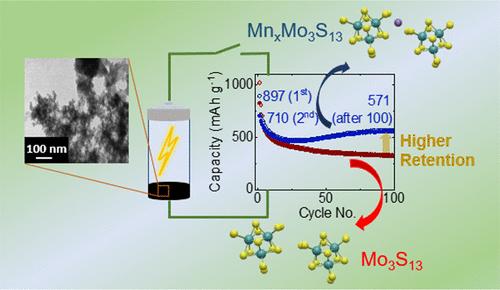
While Li-ion batteries (LIBs) are a leading energy storage technology, their energy densities are limited by the low capacity of conventional intercalation cathodes, driving interest in high energy-density Li–S batteries that make use of conversion chemistry. Achieving high capacity, reversibility, and cycle stability, and controlling volume changes in conversion batteries during the charge–discharge process, however, remains challenging. Here, we present a porous, amorphous, sulfide-based MnxMo3S13 chalcogel, which concurrently offers high capacity and cycle stability. The solution-processable room temperature synthesized MnxMo3S13 (x = 0.25) chalcogel exhibits a local structure that resembles the Mo3S13 cluster with Mn2+ distributed across the Mo3S13 matrix, as determined by synchrotron X-ray pair distribution function (PDF) and extended X-ray absorption fine structure (EXAFS). Ab initio molecular dynamics (AIMD) simulations reveal that Mn2+ incorporation shortens the polysulfide chain in the gel matrix compared to the Mo3S13 chalcogel, while forming a coordination environment with disulfide groups, analogous to the experimental findings. A Li/Mn0.25Mo3S13 half-cell delivers 897 mAh g–1 capacity during the first discharge and retains 571 mAh g–1 capacity after 100 cycles at a C/3 rate. Distribution of relaxation time (DRT) unveils a stable solid–electrolyte interphase (SEI) formation upon cycling that enables charge–discharge reversibility. Here, the enhanced capacity retention and cycle stability compared to those of the Li/Mo3S13 cell are attributed to the reduced dissolution of active mass into the electrolyte, facilitated by the formation of shorter polysulfide chains within the Mn0.25Mo3S13 structure and the strong affinity of Lewis-acidic Mn2+ for polysulfide anions generated during the charge–discharge process of the Li/Mn0.25Mo3S13 cell. Thus, this work illustrates a design principle of material for high-capacity and cycle-stable Li-metal sulfide batteries.
虽然锂离子电池(lib)是一种领先的能量存储技术,但其能量密度受到传统插入阴极容量低的限制,这促使人们对利用转化化学的高能量密度Li-S电池产生了兴趣。然而,实现高容量、可逆性和循环稳定性,并在充放电过程中控制转换电池的体积变化,仍然是一个挑战。在这里,我们提出了一种多孔的、非晶的、硫化物基的MnxMo3S13硫凝胶,它同时具有高容量和高循环稳定性。通过同步加速器x射线对分布函数(PDF)和扩展x射线吸收精细结构(EXAFS)测定,室温固溶法制得的MnxMo3S13 (x = 0.25)乙醇凝胶具有类似于Mo3S13簇的局部结构,Mn2+分布在Mo3S13基体上。从头算分子动力学(AIMD)模拟表明,与Mo3S13凝胶相比,Mn2+的掺入缩短了凝胶基质中的多硫链,同时与二硫基团形成了配位环境,与实验结果相似。Li/Mn0.25Mo3S13半电池在第一次放电时提供897 mAh g-1容量,在C/3倍率下循环100次后保持571 mAh g-1容量。弛豫时间(DRT)的分布揭示了一个稳定的固体-电解质间相(SEI)形成在循环,使充放电可逆性。在这里,与Li/Mo3S13电池相比,容量保持和循环稳定性的增强是由于活性物质在电解质中的溶解减少,这是由于在Mn0.25Mo3S13结构中形成了更短的多硫链,以及Li/Mn0.25Mo3S13电池在充放电过程中产生的多硫阴离子具有lewis酸性Mn2+的强亲和力。因此,这项工作说明了高容量和循环稳定的锂金属硫化物电池的材料设计原则。
期刊介绍:
The flagship journal of the American Chemical Society, known as the Journal of the American Chemical Society (JACS), has been a prestigious publication since its establishment in 1879. It holds a preeminent position in the field of chemistry and related interdisciplinary sciences. JACS is committed to disseminating cutting-edge research papers, covering a wide range of topics, and encompasses approximately 19,000 pages of Articles, Communications, and Perspectives annually. With a weekly publication frequency, JACS plays a vital role in advancing the field of chemistry by providing essential research.



 京公网安备 11010802042870号
京ICP备2023020795号-1
京公网安备 11010802042870号
京ICP备2023020795号-1

 分享
分享
 求助内容:
求助内容: 应助结果提醒方式:
 扫码关注我们
