G protein-coupled receptors (GPCRs) are very promising as the targets of endogenous neuropeptides/neuromodulators that, upon binding to receptors, induce profound changes in insect physiology. The Methuselan/Methuselan-like subfamily of GPCRs is reported to be associated with longevity and stress resistance. A previous study showed the fungicide jingangmycin-induced expression of Mthl2 and enhanced stress resistance in Nilaparvata lugens. However, the other physiological functions of Mthl2 remain unelucidated.
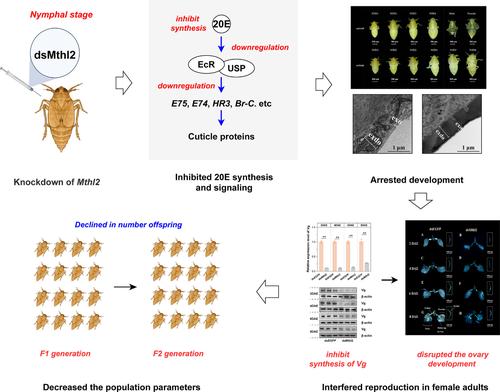
The Mthl2 was highly expressed before molting and decreased after that until the next ecdysis, showing a cyclical pattern related to molting behavior and predominantly distributed in cuticle-producing and reproductive tissues in N. lugens. Silencing Mthl2 by RNAi in nymphs disrupted the synthesis of 20E, caused downregulation of the 20E signaling-related genes, and further affected the transcription of cuticular proteins. Moreover, it led to the malformation of the integument structure and a declined emergence rate, whereas exogenous 20E could rescue the declined emergence rate caused by knockdown of Mthl2. Furthermore, depletion of Mthl2 through RNAi in the N. lugens nymphal stage influenced the development of the ovaries and fecundity in female adults. The soluble protein content in reproductive tissues, the protein and transcript levels of Vitellogenin (Vg) were significantly decreased after silencing of Mthl2, ultimately leading to a decline in the number of offspring with an obviously transgenerational consequence.
The current study revealed the physiological functions of Mthl2 in molting and fecundity of N. lugens, which can be used as an RNAi-based insecticide discovery to control this pest. © 2025 Society of Chemical Industry.







 京公网安备 11010802042870号
京ICP备2023020795号-1
京公网安备 11010802042870号
京ICP备2023020795号-1

 分享
分享
 求助内容:
求助内容: 应助结果提醒方式:
 扫码关注我们
