Alexander Stanislav Gzyl, Paul Kwesi Addo, Beatriz Molero Sanchez
{"title":"A new ionic radii scale derived from perovskite oxides","authors":"Alexander Stanislav Gzyl, Paul Kwesi Addo, Beatriz Molero Sanchez","doi":"10.1016/j.jssc.2025.125254","DOIUrl":null,"url":null,"abstract":"<div><div>The objective of this work was to develop a new radii scale to better geometrically describe perovskite oxides and aid in high-throughput discovery efforts. We hypothesized that by creating a scale dependent on anion and structure we can increase the performance of geometric descriptors for the perovskite oxide family. We partitioned the bond lengths into radii using radius ratio rules and extended the scale using a ridge regression model to increase its coverage to include more elements, coordination environments and oxidation states. As a proof of concept, we compared our scale to the more universal Shannon radii scale and its use in the Goldschmidt and Tau tolerance factors to classify ABO<sub>3</sub> compositions as perovskite or not. Using the Goldschmidt tolerance factor with our scale we were able to classify (0.814 Matthews correlation coefficient, 0.914 wt F-Score, 0.910 Balanced Accuracy) an experimental dataset of 163 ABO<sub>3</sub> compositions as perovskite or nonperovskites. Scores of 0.715, 0.867, 0.838 and 0.664, 0.838, 0.790 for Goldschmidt and Tau tolerance factor using the Shannon radii scale were obtained, respectively. The observed marked improvement encouraged us to use our scale to predict a list of feasible ABO<sub>3</sub> perovskites. Our simple methodology is not constrained to perovskites only and can easily be used to create new radii scales for other ionic systems and provide better geometric descriptions.</div></div>","PeriodicalId":378,"journal":{"name":"Journal of Solid State Chemistry","volume":"346 ","pages":"Article 125254"},"PeriodicalIF":3.5000,"publicationDate":"2025-02-12","publicationTypes":"Journal Article","fieldsOfStudy":null,"isOpenAccess":false,"openAccessPdf":"","citationCount":"0","resultStr":null,"platform":"Semanticscholar","paperid":null,"PeriodicalName":"Journal of Solid State Chemistry","FirstCategoryId":"92","ListUrlMain":"https://www.sciencedirect.com/science/article/pii/S0022459625000775","RegionNum":3,"RegionCategory":"化学","ArticlePicture":[],"TitleCN":null,"AbstractTextCN":null,"PMCID":null,"EPubDate":"","PubModel":"","JCR":"Q2","JCRName":"CHEMISTRY, INORGANIC & NUCLEAR","Score":null,"Total":0}
引用次数: 0
Abstract
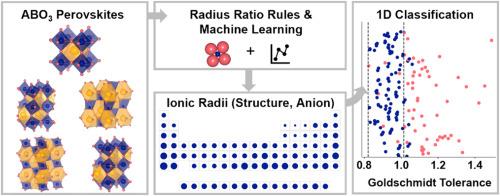
The objective of this work was to develop a new radii scale to better geometrically describe perovskite oxides and aid in high-throughput discovery efforts. We hypothesized that by creating a scale dependent on anion and structure we can increase the performance of geometric descriptors for the perovskite oxide family. We partitioned the bond lengths into radii using radius ratio rules and extended the scale using a ridge regression model to increase its coverage to include more elements, coordination environments and oxidation states. As a proof of concept, we compared our scale to the more universal Shannon radii scale and its use in the Goldschmidt and Tau tolerance factors to classify ABO3 compositions as perovskite or not. Using the Goldschmidt tolerance factor with our scale we were able to classify (0.814 Matthews correlation coefficient, 0.914 wt F-Score, 0.910 Balanced Accuracy) an experimental dataset of 163 ABO3 compositions as perovskite or nonperovskites. Scores of 0.715, 0.867, 0.838 and 0.664, 0.838, 0.790 for Goldschmidt and Tau tolerance factor using the Shannon radii scale were obtained, respectively. The observed marked improvement encouraged us to use our scale to predict a list of feasible ABO3 perovskites. Our simple methodology is not constrained to perovskites only and can easily be used to create new radii scales for other ionic systems and provide better geometric descriptions.
期刊介绍:
Covering major developments in the field of solid state chemistry and related areas such as ceramics and amorphous materials, the Journal of Solid State Chemistry features studies of chemical, structural, thermodynamic, electronic, magnetic, and optical properties and processes in solids.



 京公网安备 11010802042870号
京ICP备2023020795号-1
京公网安备 11010802042870号
京ICP备2023020795号-1

 分享
分享
 求助内容:
求助内容: 应助结果提醒方式:
 扫码关注我们
