{"title":"Unveiling the asymmetric dynamic spillovers in industry bond credit risk: Is the energy industry the prime mover?","authors":"Yi-Shuai Ren , Tony Klein , Yong Jiang","doi":"10.1016/j.irfa.2025.104014","DOIUrl":null,"url":null,"abstract":"<div><div>This study employs a novel asymmetric time-varying parameter vector autoregressive (TVP-VAR) based connectedness approach to examine the dynamic return connectedness between industry bond credit spreads in China. This study specifically focuses on identifying the factors that contribute to connectedness. The empirical findings suggest that (1) the average total connectedness index (TCI) remains consistently high throughout the period, with particularly noteworthy surges during crises such as the COVID-19 epidemic and the Russia-Ukraine war. (2) The TCI for positive returns is greater than that for negative returns for the industry bond credit spread. This confirms that the strength of inter-industry connections grows when there is an increase in credit risk in the bond market. (3) The power and coal industries are net transmitters of credit risk, while the gas and new energy industries are net receivers. This tendency is particularly noticeable in the overall returns and the positive returns spillover systems. (4) The spillover of credit risk in the industry bond market can be attributed to the connections within the supply chain among different industries. Core industries, including transportation, real estate, and non-bank financial industries, typically play a major role as net transmitters, whereas non-core industries usually as receivers. (5) The TCI is heavily influenced by global shocks, such as international oil volatility, global climate transition risk, U.S. economic policy uncertainty, and global geopolitical risks.</div></div>","PeriodicalId":48226,"journal":{"name":"International Review of Financial Analysis","volume":"101 ","pages":"Article 104014"},"PeriodicalIF":9.8000,"publicationDate":"2025-02-19","publicationTypes":"Journal Article","fieldsOfStudy":null,"isOpenAccess":false,"openAccessPdf":"","citationCount":"0","resultStr":null,"platform":"Semanticscholar","paperid":null,"PeriodicalName":"International Review of Financial Analysis","FirstCategoryId":"96","ListUrlMain":"https://www.sciencedirect.com/science/article/pii/S1057521925001012","RegionNum":1,"RegionCategory":"经济学","ArticlePicture":[],"TitleCN":null,"AbstractTextCN":null,"PMCID":null,"EPubDate":"","PubModel":"","JCR":"Q1","JCRName":"BUSINESS, FINANCE","Score":null,"Total":0}
引用次数: 0
Abstract
This study employs a novel asymmetric time-varying parameter vector autoregressive (TVP-VAR) based connectedness approach to examine the dynamic return connectedness between industry bond credit spreads in China. This study specifically focuses on identifying the factors that contribute to connectedness. The empirical findings suggest that (1) the average total connectedness index (TCI) remains consistently high throughout the period, with particularly noteworthy surges during crises such as the COVID-19 epidemic and the Russia-Ukraine war. (2) The TCI for positive returns is greater than that for negative returns for the industry bond credit spread. This confirms that the strength of inter-industry connections grows when there is an increase in credit risk in the bond market. (3) The power and coal industries are net transmitters of credit risk, while the gas and new energy industries are net receivers. This tendency is particularly noticeable in the overall returns and the positive returns spillover systems. (4) The spillover of credit risk in the industry bond market can be attributed to the connections within the supply chain among different industries. Core industries, including transportation, real estate, and non-bank financial industries, typically play a major role as net transmitters, whereas non-core industries usually as receivers. (5) The TCI is heavily influenced by global shocks, such as international oil volatility, global climate transition risk, U.S. economic policy uncertainty, and global geopolitical risks.
期刊介绍:
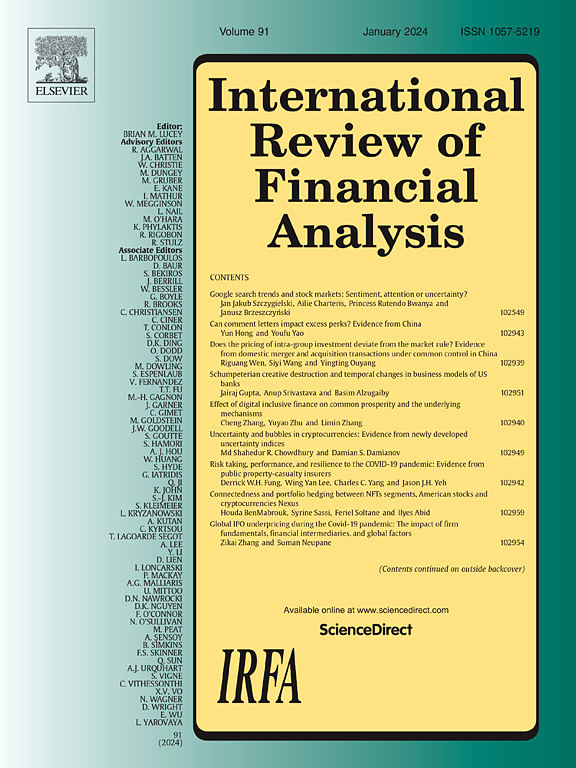
The International Review of Financial Analysis (IRFA) is an impartial refereed journal designed to serve as a platform for high-quality financial research. It welcomes a diverse range of financial research topics and maintains an unbiased selection process. While not limited to U.S.-centric subjects, IRFA, as its title suggests, is open to valuable research contributions from around the world.



 京公网安备 11010802042870号
京ICP备2023020795号-1
京公网安备 11010802042870号
京ICP备2023020795号-1

 分享
分享
 求助内容:
求助内容: 应助结果提醒方式:
 扫码关注我们
