Dr. Yongxing Wang, Dr. Rogelio Gomez Pineiro, Dr. Rébecca Leblay, Dr. Michel Giorgi, Dr. Sylvain Bertaina, Dr. Maylis Orio, Dr. Bruno Faure, Dr. Marius Réglier, Dr. A. Jalila Simaan
{"title":"Oxidation-Deformylation Cascade Catalyzed By a Mononuclear Copper Complex","authors":"Dr. Yongxing Wang, Dr. Rogelio Gomez Pineiro, Dr. Rébecca Leblay, Dr. Michel Giorgi, Dr. Sylvain Bertaina, Dr. Maylis Orio, Dr. Bruno Faure, Dr. Marius Réglier, Dr. A. Jalila Simaan","doi":"10.1002/chem.202500626","DOIUrl":null,"url":null,"abstract":"<p>In this study, two copper complexes were synthesized using N3 (arising from two pyridines and one amide group) containing ligands N-(2-picolyl)picolinamide (L<sup>1</sup>H) and bis(2-pyridylcarbonyl)amine (L<sup>2</sup>H), forming [(L<sup>1</sup>)Cu<sup>II</sup>(OH<sub>2</sub>)(NO<sub>3</sub>)] (<b>1</b>) and [(L<sup>2</sup>)Cu<sup>II</sup>(OH<sub>2</sub>)<sub>2</sub>](NO<sub>3</sub>) (<b>2</b>). The reaction of complex <b>1</b> with hydrogen peroxide in alcoholic solvents yielded a formate-bound complex. Studies with isotopically labeled <sup>13</sup>C ethanol indicated that formate originates from the C1 of ethanol after C−C bond cleavage. Complex <b>1</b> was found to catalytically convert primary alcohols into formic acid probably following a two-step process: (i) alcohol oxidation to aldehyde and (ii) aldehyde deformylation. Further experiments with 2-phenylpropionaldehyde (2-PPA) confirm the ability of complex <b>1</b> to catalyze aldehyde deformylation. Both steps of the reaction are associated with significant kinetic deuterium isotope effects (KDIE), suggesting that hydrogen atom abstractions (HAA) occur during the rate-determining steps of both conversions. Overall, this system proposes a clean catalytic process for alcohol-to-formic acid conversion, operating under mild conditions, and offering potential synthetic applications.</p>","PeriodicalId":144,"journal":{"name":"Chemistry - A European Journal","volume":"31 26","pages":""},"PeriodicalIF":3.7000,"publicationDate":"2025-02-21","publicationTypes":"Journal Article","fieldsOfStudy":null,"isOpenAccess":false,"openAccessPdf":"https://onlinelibrary.wiley.com/doi/epdf/10.1002/chem.202500626","citationCount":"0","resultStr":null,"platform":"Semanticscholar","paperid":null,"PeriodicalName":"Chemistry - A European Journal","FirstCategoryId":"92","ListUrlMain":"https://chemistry-europe.onlinelibrary.wiley.com/doi/10.1002/chem.202500626","RegionNum":2,"RegionCategory":"化学","ArticlePicture":[],"TitleCN":null,"AbstractTextCN":null,"PMCID":null,"EPubDate":"","PubModel":"","JCR":"Q2","JCRName":"CHEMISTRY, MULTIDISCIPLINARY","Score":null,"Total":0}
引用次数: 0
Abstract
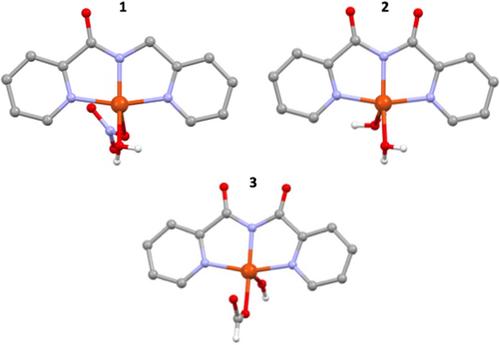
In this study, two copper complexes were synthesized using N3 (arising from two pyridines and one amide group) containing ligands N-(2-picolyl)picolinamide (L1H) and bis(2-pyridylcarbonyl)amine (L2H), forming [(L1)CuII(OH2)(NO3)] (1) and [(L2)CuII(OH2)2](NO3) (2). The reaction of complex 1 with hydrogen peroxide in alcoholic solvents yielded a formate-bound complex. Studies with isotopically labeled 13C ethanol indicated that formate originates from the C1 of ethanol after C−C bond cleavage. Complex 1 was found to catalytically convert primary alcohols into formic acid probably following a two-step process: (i) alcohol oxidation to aldehyde and (ii) aldehyde deformylation. Further experiments with 2-phenylpropionaldehyde (2-PPA) confirm the ability of complex 1 to catalyze aldehyde deformylation. Both steps of the reaction are associated with significant kinetic deuterium isotope effects (KDIE), suggesting that hydrogen atom abstractions (HAA) occur during the rate-determining steps of both conversions. Overall, this system proposes a clean catalytic process for alcohol-to-formic acid conversion, operating under mild conditions, and offering potential synthetic applications.
期刊介绍:
Chemistry—A European Journal is a truly international journal with top quality contributions (2018 ISI Impact Factor: 5.16). It publishes a wide range of outstanding Reviews, Minireviews, Concepts, Full Papers, and Communications from all areas of chemistry and related fields.
Based in Europe Chemistry—A European Journal provides an excellent platform for increasing the visibility of European chemistry as well as for featuring the best research from authors from around the world.
All manuscripts are peer-reviewed, and electronic processing ensures accurate reproduction of text and data, plus short publication times.
The Concepts section provides nonspecialist readers with a useful conceptual guide to unfamiliar areas and experts with new angles on familiar problems.
Chemistry—A European Journal is published on behalf of ChemPubSoc Europe, a group of 16 national chemical societies from within Europe, and supported by the Asian Chemical Editorial Societies. The ChemPubSoc Europe family comprises: Angewandte Chemie, Chemistry—A European Journal, European Journal of Organic Chemistry, European Journal of Inorganic Chemistry, ChemPhysChem, ChemBioChem, ChemMedChem, ChemCatChem, ChemSusChem, ChemPlusChem, ChemElectroChem, and ChemistryOpen.





 京公网安备 11010802042870号
京ICP备2023020795号-1
京公网安备 11010802042870号
京ICP备2023020795号-1

 分享
分享
 求助内容:
求助内容: 应助结果提醒方式:
 扫码关注我们
