Mengmeng Liu, Xialong Ni, J Ramanujam, Michal Brylinski
{"title":"EC2Vec: A Machine Learning Method to Embed Enzyme Commission (EC) Numbers into Vector Representations.","authors":"Mengmeng Liu, Xialong Ni, J Ramanujam, Michal Brylinski","doi":"10.1021/acs.jcim.4c02161","DOIUrl":null,"url":null,"abstract":"<p><p>Enzyme commission (EC) numbers play a vital role in classifying enzymes and understanding their functions in enzyme-related research. Although accurate and informative encoding of EC numbers is essential for enhancing the effectiveness of machine learning applications, simple EC encoding approaches suffer from limitations such as false numerical order and high sparsity. To address these issues, we developed EC2Vec, a multimodal autoencoder that preserves the categorical nature of EC numbers and leverages their hierarchical relationships, resulting in more meaningful and informative representations. EC2Vec encodes each digit of the EC number as a categorical token and then processes these embeddings through a 1D convolutional layer to capture their relationships. Comprehensive benchmarking against a large collection of EC numbers indicates that EC2Vec outperforms simple encoding methods. The t-SNE visualization of EC2Vec embeddings revealed distinct clusters corresponding to different enzyme classes, demonstrating that the hierarchical structure of the EC numbers is effectively captured. In downstream machine learning applications, EC2Vec embeddings outperformed other EC encoding methods in the reaction-EC pair classification task, underscoring its robustness and utility for enzyme-related research and bioinformatics applications.</p>","PeriodicalId":44,"journal":{"name":"Journal of Chemical Information and Modeling ","volume":" ","pages":"2173-2179"},"PeriodicalIF":5.3000,"publicationDate":"2025-03-10","publicationTypes":"Journal Article","fieldsOfStudy":null,"isOpenAccess":false,"openAccessPdf":"https://www.ncbi.nlm.nih.gov/pmc/articles/PMC11898066/pdf/","citationCount":"0","resultStr":null,"platform":"Semanticscholar","paperid":null,"PeriodicalName":"Journal of Chemical Information and Modeling ","FirstCategoryId":"92","ListUrlMain":"https://doi.org/10.1021/acs.jcim.4c02161","RegionNum":2,"RegionCategory":"化学","ArticlePicture":[],"TitleCN":null,"AbstractTextCN":null,"PMCID":null,"EPubDate":"2025/2/21 0:00:00","PubModel":"Epub","JCR":"Q1","JCRName":"CHEMISTRY, MEDICINAL","Score":null,"Total":0}
引用次数: 0
Abstract
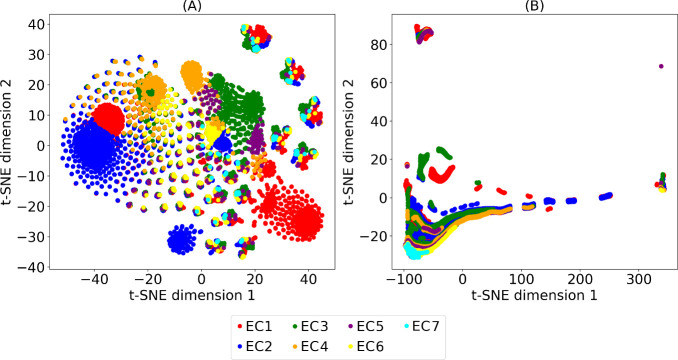
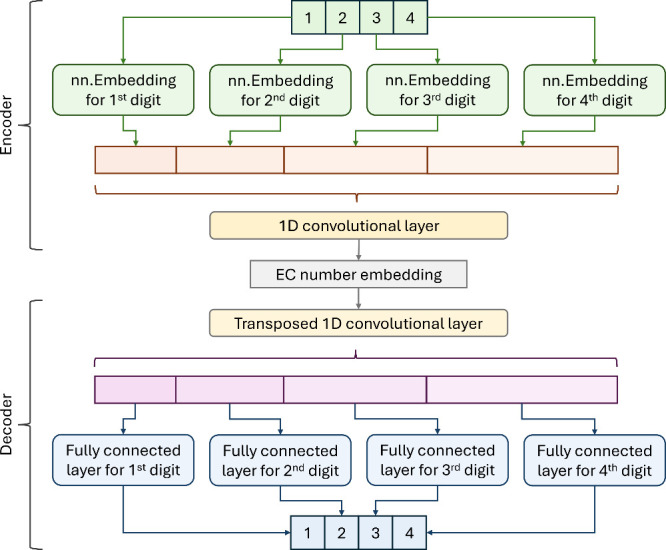
Enzyme commission (EC) numbers play a vital role in classifying enzymes and understanding their functions in enzyme-related research. Although accurate and informative encoding of EC numbers is essential for enhancing the effectiveness of machine learning applications, simple EC encoding approaches suffer from limitations such as false numerical order and high sparsity. To address these issues, we developed EC2Vec, a multimodal autoencoder that preserves the categorical nature of EC numbers and leverages their hierarchical relationships, resulting in more meaningful and informative representations. EC2Vec encodes each digit of the EC number as a categorical token and then processes these embeddings through a 1D convolutional layer to capture their relationships. Comprehensive benchmarking against a large collection of EC numbers indicates that EC2Vec outperforms simple encoding methods. The t-SNE visualization of EC2Vec embeddings revealed distinct clusters corresponding to different enzyme classes, demonstrating that the hierarchical structure of the EC numbers is effectively captured. In downstream machine learning applications, EC2Vec embeddings outperformed other EC encoding methods in the reaction-EC pair classification task, underscoring its robustness and utility for enzyme-related research and bioinformatics applications.
期刊介绍:
The Journal of Chemical Information and Modeling publishes papers reporting new methodology and/or important applications in the fields of chemical informatics and molecular modeling. Specific topics include the representation and computer-based searching of chemical databases, molecular modeling, computer-aided molecular design of new materials, catalysts, or ligands, development of new computational methods or efficient algorithms for chemical software, and biopharmaceutical chemistry including analyses of biological activity and other issues related to drug discovery.
Astute chemists, computer scientists, and information specialists look to this monthly’s insightful research studies, programming innovations, and software reviews to keep current with advances in this integral, multidisciplinary field.
As a subscriber you’ll stay abreast of database search systems, use of graph theory in chemical problems, substructure search systems, pattern recognition and clustering, analysis of chemical and physical data, molecular modeling, graphics and natural language interfaces, bibliometric and citation analysis, and synthesis design and reactions databases.




 京公网安备 11010802042870号
京ICP备2023020795号-1
京公网安备 11010802042870号
京ICP备2023020795号-1

 分享
分享
 求助内容:
求助内容: 应助结果提醒方式:
 扫码关注我们
