Mario Urtis, Marilena Tagliani, Davide Bondavalli, Chiara Paganini, Claudia Cavaliere, Viviana Vilardo, Edward Buccieri, Antonio Tescari, Michela Ferrari, Eloisa Arbustini
{"title":"The contemporary role of genetics in cardiovascular medicine: from phenotypes to precision diagnoses.","authors":"Mario Urtis, Marilena Tagliani, Davide Bondavalli, Chiara Paganini, Claudia Cavaliere, Viviana Vilardo, Edward Buccieri, Antonio Tescari, Michela Ferrari, Eloisa Arbustini","doi":"10.1093/eurheartjsupp/suae107","DOIUrl":null,"url":null,"abstract":"<p><p>The diagnostic work-up of cardiovascular genetic diseases is emerging as a reference model for precision (cause and phenotype) and personalized medicine (tailored individual management). This approach is expanding across all areas of cardiovascular medicine, ranging from monogenic diseases to multifactorial disorders where 'risk factors' such as familial hypercholesterolaemia may play a role in the risk profile. In this context, cardiomyopathies provide an ideal reference because they are monogenic yet genetically heterogeneous diseases, much like many other cardiovascular genetic disorders. In this model, the genetic path starts with deep phenotyping of the patient and relatives and progresses with genetic testing including extensive multigene panels, up to whole-exome sequencing and whole-genome sequencing. Although genetic work-ups are increasingly successful, several unresolved challenges and limitations remain. These include the interpretation and reinterpretation of variants, as many pre-American College of Medical Genetics variants previously classified as likely pathogenic or pathogenic are now recognized as variants of uncertain significance or benign/likely benign; pathogenic variants missed with short-read next generation sequencing (NGS) technologies (e.g. deep intronic variants or Copy Number Variations); gene-specific issues such as pseudogenes and pseudo-exons; and differing interpretations of pathogenicity for the same gene defects by commercial pipelines. Despite widespread NGS-based testing, about half of suspected Mendelian conditions still lack a precise molecular diagnosis. New organizational models are needed to integrate emerging knowledge and innovations incorporating both clinical and genetic data into intelligent platforms that may support shared management pathways.</p>","PeriodicalId":11956,"journal":{"name":"European Heart Journal Supplements","volume":"27 Suppl 1","pages":"i67-i72"},"PeriodicalIF":1.7000,"publicationDate":"2025-02-19","publicationTypes":"Journal Article","fieldsOfStudy":null,"isOpenAccess":false,"openAccessPdf":"https://www.ncbi.nlm.nih.gov/pmc/articles/PMC11836717/pdf/","citationCount":"0","resultStr":null,"platform":"Semanticscholar","paperid":null,"PeriodicalName":"European Heart Journal Supplements","FirstCategoryId":"3","ListUrlMain":"https://doi.org/10.1093/eurheartjsupp/suae107","RegionNum":4,"RegionCategory":"医学","ArticlePicture":[],"TitleCN":null,"AbstractTextCN":null,"PMCID":null,"EPubDate":"2025/2/1 0:00:00","PubModel":"eCollection","JCR":"Q3","JCRName":"CARDIAC & CARDIOVASCULAR SYSTEMS","Score":null,"Total":0}
引用次数: 0
Abstract
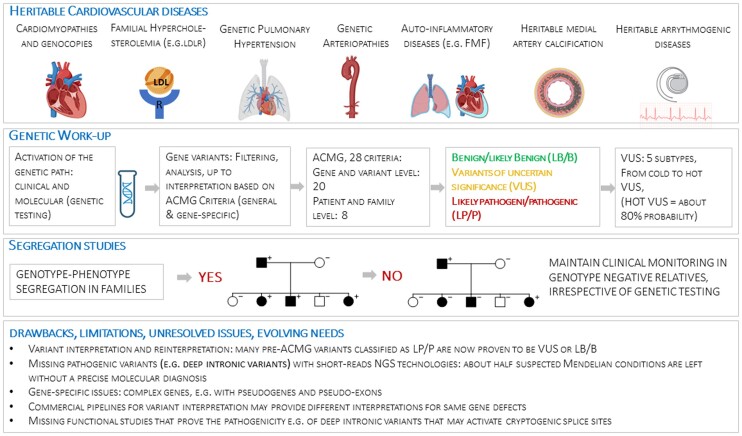
The diagnostic work-up of cardiovascular genetic diseases is emerging as a reference model for precision (cause and phenotype) and personalized medicine (tailored individual management). This approach is expanding across all areas of cardiovascular medicine, ranging from monogenic diseases to multifactorial disorders where 'risk factors' such as familial hypercholesterolaemia may play a role in the risk profile. In this context, cardiomyopathies provide an ideal reference because they are monogenic yet genetically heterogeneous diseases, much like many other cardiovascular genetic disorders. In this model, the genetic path starts with deep phenotyping of the patient and relatives and progresses with genetic testing including extensive multigene panels, up to whole-exome sequencing and whole-genome sequencing. Although genetic work-ups are increasingly successful, several unresolved challenges and limitations remain. These include the interpretation and reinterpretation of variants, as many pre-American College of Medical Genetics variants previously classified as likely pathogenic or pathogenic are now recognized as variants of uncertain significance or benign/likely benign; pathogenic variants missed with short-read next generation sequencing (NGS) technologies (e.g. deep intronic variants or Copy Number Variations); gene-specific issues such as pseudogenes and pseudo-exons; and differing interpretations of pathogenicity for the same gene defects by commercial pipelines. Despite widespread NGS-based testing, about half of suspected Mendelian conditions still lack a precise molecular diagnosis. New organizational models are needed to integrate emerging knowledge and innovations incorporating both clinical and genetic data into intelligent platforms that may support shared management pathways.
期刊介绍:
The European Heart Journal Supplements (EHJs) is a long standing member of the ESC Journal Family that serves as a publication medium for supplemental issues of the flagship European Heart Journal. Traditionally EHJs published a broad range of articles from symposia to special issues on specific topics of interest.
The Editor-in-Chief, Professor Roberto Ferrari, together with his team of eminent Associate Editors: Professor Francisco Fernández-Avilés, Professors Jeroen Bax, Michael Böhm, Frank Ruschitzka, and Thomas Lüscher from the European Heart Journal, has implemented a change of focus for the journal. This entirely refreshed version of the European Heart Journal Supplements now bears the subtitle the Heart of the Matter to give recognition to the focus the journal now has.
The EHJs – the Heart of the Matter intends to offer a dedicated, scientific space for the ESC, Institutions, National and Affiliate Societies, Associations, Working Groups and Councils to disseminate their important successes globally.




 京公网安备 11010802042870号
京ICP备2023020795号-1
京公网安备 11010802042870号
京ICP备2023020795号-1

 分享
分享
 求助内容:
求助内容: 应助结果提醒方式:
 扫码关注我们
