{"title":"Causal relationship between circulating immune cells and the risk of esophageal cancer: a Mendelian randomization study.","authors":"Shangren Wang, Ruizhen Wang, Aiqiao Zhang, Xiaofeng Duan, Xiaobin Shang, Hongjing Jiang","doi":"10.1007/s12672-025-01921-9","DOIUrl":null,"url":null,"abstract":"<p><strong>Background: </strong>Although relevant research has unveiled the intricate connections between immune cells and the occurrence and prognosis of esophageal cancer (EC), the specific impact of immune cell phenotypes on EC remains unclear.</p><p><strong>Methods: </strong>We employed bidirectional two-sample Mendelian Randomization (MR) analysis to explore the causal relationship between immune cell phenotypes and EC. The summary data for immune cell phenotypes and EC are both sourced from the GWAS (Genome-Wide Association Study) database. Sensitivity analysis was conducted on the results, utilizing a combination of MR-Egger and MR-Presso to assess horizontal pleiotropy, employing Cochran's Q test to evaluate heterogeneity.</p><p><strong>Results: </strong>We identified 24 immunophenotypes with potential causal relationships to EC. Our results are presented based on the panel results from flow cytometry detection, categorized into B-cell panel, TBNK panel, cDC panel, Maturation stages of T-cell panel, Monocyte panel, and Myeloid cell panel. In the reverse MR analysis, we found a potential negative correlation between EC and IgD + CD38dim B cell Absolute Count (OR = 0.94, 95% CI, 0.88-0.99, P = 0.023).</p><p><strong>Conclusion: </strong>This study has unveiled the causal relationship between immune cell phenotypes and EC, providing new insights for the exploration of immunotherapy targets in subsequent EC research and for the assessment of EC prognosis.</p>","PeriodicalId":11148,"journal":{"name":"Discover. Oncology","volume":"16 1","pages":"220"},"PeriodicalIF":2.9000,"publicationDate":"2025-02-21","publicationTypes":"Journal Article","fieldsOfStudy":null,"isOpenAccess":false,"openAccessPdf":"https://www.ncbi.nlm.nih.gov/pmc/articles/PMC11845655/pdf/","citationCount":"0","resultStr":null,"platform":"Semanticscholar","paperid":null,"PeriodicalName":"Discover. Oncology","FirstCategoryId":"3","ListUrlMain":"https://doi.org/10.1007/s12672-025-01921-9","RegionNum":4,"RegionCategory":"医学","ArticlePicture":[],"TitleCN":null,"AbstractTextCN":null,"PMCID":null,"EPubDate":"","PubModel":"","JCR":"Q3","JCRName":"ENDOCRINOLOGY & METABOLISM","Score":null,"Total":0}
引用次数: 0
Abstract
Background: Although relevant research has unveiled the intricate connections between immune cells and the occurrence and prognosis of esophageal cancer (EC), the specific impact of immune cell phenotypes on EC remains unclear.
Methods: We employed bidirectional two-sample Mendelian Randomization (MR) analysis to explore the causal relationship between immune cell phenotypes and EC. The summary data for immune cell phenotypes and EC are both sourced from the GWAS (Genome-Wide Association Study) database. Sensitivity analysis was conducted on the results, utilizing a combination of MR-Egger and MR-Presso to assess horizontal pleiotropy, employing Cochran's Q test to evaluate heterogeneity.
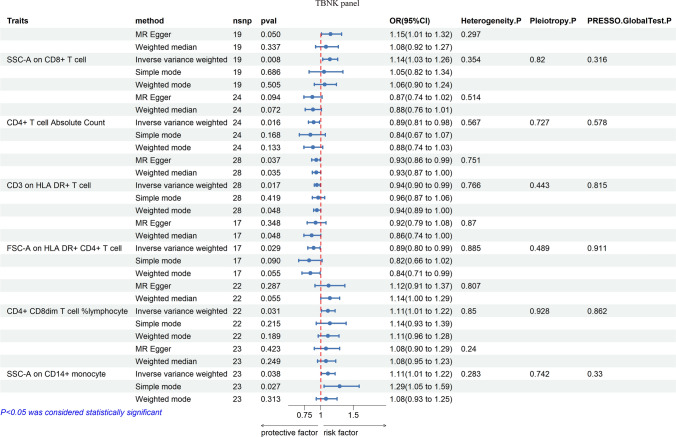
Results: We identified 24 immunophenotypes with potential causal relationships to EC. Our results are presented based on the panel results from flow cytometry detection, categorized into B-cell panel, TBNK panel, cDC panel, Maturation stages of T-cell panel, Monocyte panel, and Myeloid cell panel. In the reverse MR analysis, we found a potential negative correlation between EC and IgD + CD38dim B cell Absolute Count (OR = 0.94, 95% CI, 0.88-0.99, P = 0.023).
Conclusion: This study has unveiled the causal relationship between immune cell phenotypes and EC, providing new insights for the exploration of immunotherapy targets in subsequent EC research and for the assessment of EC prognosis.






 京公网安备 11010802042870号
京ICP备2023020795号-1
京公网安备 11010802042870号
京ICP备2023020795号-1

 分享
分享
 求助内容:
求助内容: 应助结果提醒方式:
 扫码关注我们
