Endophytic Aspergillus japonicus mediated biosynthesises of magnesium oxide nanoparticles: sustainable dye removal and in silico molecular docking evaluation of their enhanced antibacterial activity.
Reyad M El-Sharkawy, Mohamed Khairy, Magdi E A Zaki, Al-Shaimaa M Al-Tabbakh
{"title":"Endophytic Aspergillus japonicus mediated biosynthesises of magnesium oxide nanoparticles: sustainable dye removal and in silico molecular docking evaluation of their enhanced antibacterial activity.","authors":"Reyad M El-Sharkawy, Mohamed Khairy, Magdi E A Zaki, Al-Shaimaa M Al-Tabbakh","doi":"10.1186/s12934-025-02648-6","DOIUrl":null,"url":null,"abstract":"<p><p>Sustainable biosynthesis of metal oxide nanoparticles using an eco-friendly approach is a growing research area owing to their promising environmental and biomedical applications. This work aims to biosynthesize and characterize magnesium oxide nanoparticles (MgONPS@Aj) for possible application in dye biosorption and antibacterial activity. For the first time, MgONPS@Aj was successfully synthesized by harnessing exometabolites of Aspergillus japonicus. Various parameters were statistically optimized to maximize the production of MgONPS@Aj using Plackett Burman's design and central composite design. The analysis of variance (ANOVA) revealed that pH was the most significant variable, affecting the bioproduction process followed by biomass quantity and Mg<sup>2+</sup> precursor concentration. The suggested model (quadratic) was greatly significant and acceptable due to the nonsignificant lack of fit (15.10), and P-value (0.001). The optimized nanoparticles were characterized using X-ray powder diffraction, Fourier-transform infrared (FTIR) spectroscopy, transmission electron microscope (TEM), and Scanning electron microscopy. A high biosorption capacity (204.08 mg/g) of reactive black 5 dye was achieved within 40 min using a 5 mg biosorbent dose (MgONPS@Aj), 100 mg/l initial dye concentration, and pH 6.0. The biosorption process followed a pseudo-second-order (R<sup>2</sup> of 0.9842) and Langmuir isotherm (R<sup>2</sup> of 0.9422) models with a dimensionless separation factor (R<sub>L</sub>) of 8 × 10<sup>4</sup>, hinting favorable and effective biosorption of dye molecules. A biosorption capacity of 81.97 mg/g after five successive cycles hints that the nanomaterial is suitable for several time utilization. Biogenic MgONPS@Aj displayed dramatic concentration-dependent antibacterial activity with the largest inhibition zones for P. aeruginosa (24.1 ± 0.8 mm, MIC: 3.125 µg/ml), followed by E. coli (22.3 ± 0.7 mm, MIC 6.25), B. subtilis (14.7 ± 0.4 mm, MIC: 12.5 µg/ml) and S. aureus (19.2 ± 0.6 mm, MIC: 6.25 µg/ml). The antibacterial activity was further interpreted using molecular simulation analysis. The lowest binding affinity was determined between MgONPS@Aj and target bacterial proteins (chloramphenicol acetyltransferase E. coli, and S. aureus MurE). The ligand (MgONPS@Aj) can bind to the active site's residues (Tyr<sup>172</sup> and SER<sup>224</sup>), indicating a possible antibacterial mechanism. This study recommends MgONPS@Aj as an eco-friendly, and reusable alternative to traditional anionic dye sorbents and a uniquely promising candidate for antimicrobial applications.</p>","PeriodicalId":18582,"journal":{"name":"Microbial Cell Factories","volume":"24 1","pages":"44"},"PeriodicalIF":4.9000,"publicationDate":"2025-02-21","publicationTypes":"Journal Article","fieldsOfStudy":null,"isOpenAccess":false,"openAccessPdf":"https://www.ncbi.nlm.nih.gov/pmc/articles/PMC11843758/pdf/","citationCount":"0","resultStr":null,"platform":"Semanticscholar","paperid":null,"PeriodicalName":"Microbial Cell Factories","FirstCategoryId":"5","ListUrlMain":"https://doi.org/10.1186/s12934-025-02648-6","RegionNum":2,"RegionCategory":"生物学","ArticlePicture":[],"TitleCN":null,"AbstractTextCN":null,"PMCID":null,"EPubDate":"","PubModel":"","JCR":"Q1","JCRName":"BIOTECHNOLOGY & APPLIED MICROBIOLOGY","Score":null,"Total":0}
引用次数: 0
Abstract
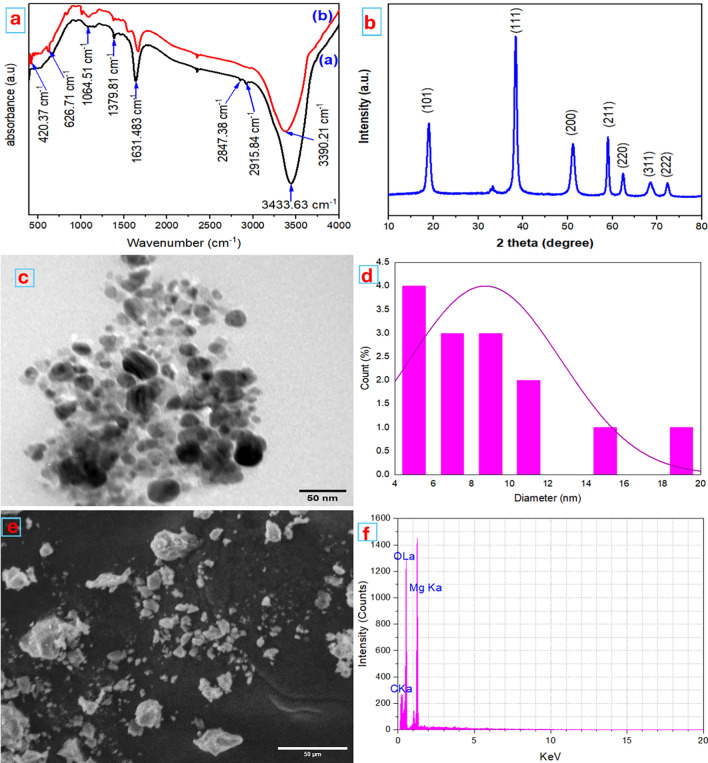
Sustainable biosynthesis of metal oxide nanoparticles using an eco-friendly approach is a growing research area owing to their promising environmental and biomedical applications. This work aims to biosynthesize and characterize magnesium oxide nanoparticles (MgONPS@Aj) for possible application in dye biosorption and antibacterial activity. For the first time, MgONPS@Aj was successfully synthesized by harnessing exometabolites of Aspergillus japonicus. Various parameters were statistically optimized to maximize the production of MgONPS@Aj using Plackett Burman's design and central composite design. The analysis of variance (ANOVA) revealed that pH was the most significant variable, affecting the bioproduction process followed by biomass quantity and Mg2+ precursor concentration. The suggested model (quadratic) was greatly significant and acceptable due to the nonsignificant lack of fit (15.10), and P-value (0.001). The optimized nanoparticles were characterized using X-ray powder diffraction, Fourier-transform infrared (FTIR) spectroscopy, transmission electron microscope (TEM), and Scanning electron microscopy. A high biosorption capacity (204.08 mg/g) of reactive black 5 dye was achieved within 40 min using a 5 mg biosorbent dose (MgONPS@Aj), 100 mg/l initial dye concentration, and pH 6.0. The biosorption process followed a pseudo-second-order (R2 of 0.9842) and Langmuir isotherm (R2 of 0.9422) models with a dimensionless separation factor (RL) of 8 × 10⁴, hinting favorable and effective biosorption of dye molecules. A biosorption capacity of 81.97 mg/g after five successive cycles hints that the nanomaterial is suitable for several time utilization. Biogenic MgONPS@Aj displayed dramatic concentration-dependent antibacterial activity with the largest inhibition zones for P. aeruginosa (24.1 ± 0.8 mm, MIC: 3.125 µg/ml), followed by E. coli (22.3 ± 0.7 mm, MIC 6.25), B. subtilis (14.7 ± 0.4 mm, MIC: 12.5 µg/ml) and S. aureus (19.2 ± 0.6 mm, MIC: 6.25 µg/ml). The antibacterial activity was further interpreted using molecular simulation analysis. The lowest binding affinity was determined between MgONPS@Aj and target bacterial proteins (chloramphenicol acetyltransferase E. coli, and S. aureus MurE). The ligand (MgONPS@Aj) can bind to the active site's residues (Tyr172 and SER224), indicating a possible antibacterial mechanism. This study recommends MgONPS@Aj as an eco-friendly, and reusable alternative to traditional anionic dye sorbents and a uniquely promising candidate for antimicrobial applications.
期刊介绍:
Microbial Cell Factories is an open access peer-reviewed journal that covers any topic related to the development, use and investigation of microbial cells as producers of recombinant proteins and natural products, or as catalyzers of biological transformations of industrial interest. Microbial Cell Factories is the world leading, primary research journal fully focusing on Applied Microbiology.
The journal is divided into the following editorial sections:
-Metabolic engineering
-Synthetic biology
-Whole-cell biocatalysis
-Microbial regulations
-Recombinant protein production/bioprocessing
-Production of natural compounds
-Systems biology of cell factories
-Microbial production processes
-Cell-free systems





 京公网安备 11010802042870号
京ICP备2023020795号-1
京公网安备 11010802042870号
京ICP备2023020795号-1

 分享
分享
 求助内容:
求助内容: 应助结果提醒方式:
 扫码关注我们
