{"title":"Anopheles arabiensis larval habitats characterization and Anopheles species diversity in water bodies from Jozini, KwaZulu-Natal Province.","authors":"Elliot Marubini, Alfred Musekiwa, Innocent Maposa, Theresa Mazarire, Windy Sekgele, Nondumiso Mabaso, Dumsani Dlamini, Hetani Mdose, Lazarus Kuonza, Givemore Munhenga","doi":"10.1186/s12936-025-05287-9","DOIUrl":null,"url":null,"abstract":"<p><strong>Background: </strong>The South African government is now implementing winter larviciding as a supplementary vector control tool. To achieve effective larviciding programme there is a need to understand the distribution of the breeding sites of vectors and their corresponding ecology. This study aimed to determine larval breeding sites of anophelines and characterize the physicochemical properties of water that promote the proliferation of Anopheles arabiensis immature stages.</p><p><strong>Methods: </strong>A desktop survey of water bodies was carried out followed by a physical search of potential Anopheles breeding sites. Anopheline larvae were sampled from breeding sites in January and April 2021. At each breeding site, physicochemical characteristics of the water, including pH, electrical conductivity, total dissolved solids, salinity and turbidity, were measured. The collected Anopheles larvae were reared to adults and identified to genus and species level using morphological and molecular techniques. Factors associated with the presence of An. arabiensis larvae in the breeding sites were determined.</p><p><strong>Results: </strong>Out of the 72 water bodies identified using desktop survey only 53% (n = 38/72) were identified through physical search. Of these 84% (n = 32/38) were positive for Anopheles larvae. A total of 598 Anopheles larvae were collected, of which 59.4% (n = 355/598) emerged into adults. Morphological identification of these adults, showed that the Anopheles gambiae complex accounted for 70% (n = 250/355) of the collections. From the 250 An. gambiae complex collected, 94% (235/250) were identified to species level by PCR and 6% (n = 15/250) failed to amplify. Of the 235 An. gambiae complex that were identified to species level, 62.5% (n = 147/235) were from January collections and 37.4% (n = 88/235) were from April collections. Molecular identification of the An. gambiae complex to species level showed predominance of An. arabiensis in April, 91% (n = 80/88). All physicochemical parameters differed significantly between the breeding site classes (p < 0.05 in all instances), except for electrical conductivity (p = 0.07). The aquatic habitats surveyed showed that the impermanency of the water bodies, neutral to alkaline pH, moderate salinity and low total dissolved solids were associated with the occurrence of An. arabiensis larvae.</p><p><strong>Conclusion: </strong>This study showed that An. arabiensis primarily breed in small temporary water bodies characterized by neutral pH.</p>","PeriodicalId":18317,"journal":{"name":"Malaria Journal","volume":"24 1","pages":"52"},"PeriodicalIF":3.0000,"publicationDate":"2025-02-20","publicationTypes":"Journal Article","fieldsOfStudy":null,"isOpenAccess":false,"openAccessPdf":"https://www.ncbi.nlm.nih.gov/pmc/articles/PMC11844105/pdf/","citationCount":"0","resultStr":null,"platform":"Semanticscholar","paperid":null,"PeriodicalName":"Malaria Journal","FirstCategoryId":"3","ListUrlMain":"https://doi.org/10.1186/s12936-025-05287-9","RegionNum":3,"RegionCategory":"医学","ArticlePicture":[],"TitleCN":null,"AbstractTextCN":null,"PMCID":null,"EPubDate":"","PubModel":"","JCR":"Q3","JCRName":"INFECTIOUS DISEASES","Score":null,"Total":0}
引用次数: 0
Abstract
Background: The South African government is now implementing winter larviciding as a supplementary vector control tool. To achieve effective larviciding programme there is a need to understand the distribution of the breeding sites of vectors and their corresponding ecology. This study aimed to determine larval breeding sites of anophelines and characterize the physicochemical properties of water that promote the proliferation of Anopheles arabiensis immature stages.
Methods: A desktop survey of water bodies was carried out followed by a physical search of potential Anopheles breeding sites. Anopheline larvae were sampled from breeding sites in January and April 2021. At each breeding site, physicochemical characteristics of the water, including pH, electrical conductivity, total dissolved solids, salinity and turbidity, were measured. The collected Anopheles larvae were reared to adults and identified to genus and species level using morphological and molecular techniques. Factors associated with the presence of An. arabiensis larvae in the breeding sites were determined.
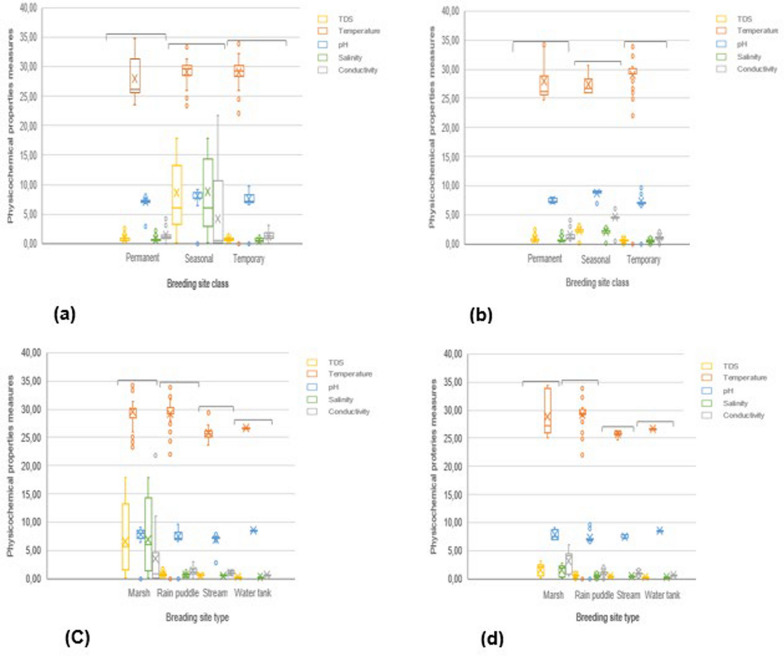
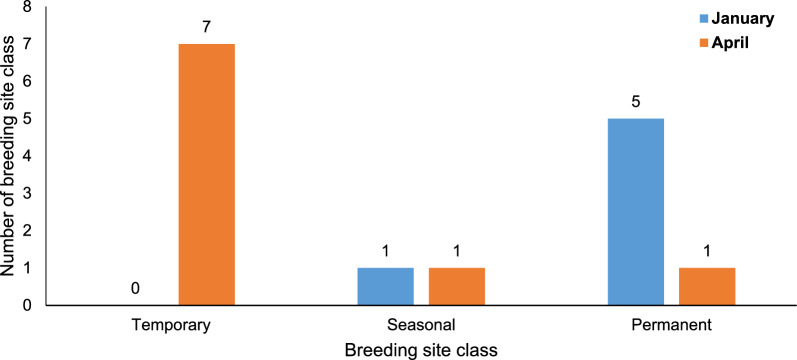
Results: Out of the 72 water bodies identified using desktop survey only 53% (n = 38/72) were identified through physical search. Of these 84% (n = 32/38) were positive for Anopheles larvae. A total of 598 Anopheles larvae were collected, of which 59.4% (n = 355/598) emerged into adults. Morphological identification of these adults, showed that the Anopheles gambiae complex accounted for 70% (n = 250/355) of the collections. From the 250 An. gambiae complex collected, 94% (235/250) were identified to species level by PCR and 6% (n = 15/250) failed to amplify. Of the 235 An. gambiae complex that were identified to species level, 62.5% (n = 147/235) were from January collections and 37.4% (n = 88/235) were from April collections. Molecular identification of the An. gambiae complex to species level showed predominance of An. arabiensis in April, 91% (n = 80/88). All physicochemical parameters differed significantly between the breeding site classes (p < 0.05 in all instances), except for electrical conductivity (p = 0.07). The aquatic habitats surveyed showed that the impermanency of the water bodies, neutral to alkaline pH, moderate salinity and low total dissolved solids were associated with the occurrence of An. arabiensis larvae.
Conclusion: This study showed that An. arabiensis primarily breed in small temporary water bodies characterized by neutral pH.
期刊介绍:
Malaria Journal is aimed at the scientific community interested in malaria in its broadest sense. It is the only journal that publishes exclusively articles on malaria and, as such, it aims to bring together knowledge from the different specialities involved in this very broad discipline, from the bench to the bedside and to the field.




 京公网安备 11010802042870号
京ICP备2023020795号-1
京公网安备 11010802042870号
京ICP备2023020795号-1

 分享
分享
 求助内容:
求助内容: 应助结果提醒方式:
 扫码关注我们
