David S Smith, Levente Lippenszky, Michele L LeNoue-Newton, Neha M Jain, Kathleen F Mittendorf, Christine M Micheel, Patrick A Cella, Jan Wolber, Travis J Osterman
{"title":"Radiomics and Deep Learning Prediction of Immunotherapy-Induced Pneumonitis From Computed Tomography.","authors":"David S Smith, Levente Lippenszky, Michele L LeNoue-Newton, Neha M Jain, Kathleen F Mittendorf, Christine M Micheel, Patrick A Cella, Jan Wolber, Travis J Osterman","doi":"10.1200/CCI-24-00198","DOIUrl":null,"url":null,"abstract":"<p><strong>Purpose: </strong>Primary barriers to application of immune checkpoint inhibitor (ICI) therapy for cancer include severe side effects (such as potentially life threatening pneumonitis [PN]), which can cause the discontinuation of treatment. Predicting which patients may develop PN while on ICI would improve both safety and potential efficacy because treatments could be safely administered for longer or discontinued before severe toxicity.</p><p><strong>Methods: </strong>Starting from a cohort of 3,351 patients with cancer who received previous ICI therapy at the Vanderbilt University Medical Center, we curated 2,700 contrast chest computed tomography (CT) volumes for 671 patients. Three different pure imaging models predicted the potential for PN using only a single time point before the first ICI dose.</p><p><strong>Results: </strong>The first model used 109 radiomics features only and achieved an AUC of 0.747 (CI, 0.705 to 0.789) with a positive predictive value (PPV) of 0.244 (CI, 0.211 to 0.276) at a sensitivity of 0.553 (CI, 0.485 to 0.621) using mainly features describing the global lung properties. The second model used a convolutional neural network (CNN) on the raw CTs to improve to an AUC of 0.819 (CI, 0.781 to 0.857) with a PPV of 0.244 (CI, 0.203 to 0.284) at a sensitivity of 0.743 (CI, 0.681 to 0.806). The third model combined both radiomics and deep learning but, with an AUC of 0.829 (CI, 0.797 to 0.862) and a PPV of 0.254 (CI, 0.228 to 0.281) at a sensitivity of 0.780 (CI, 0.721 to 0.840), did not show a significant improvement on the CNN-only model.</p><p><strong>Conclusion: </strong>This new model suggests the utility of deep learning in PN prediction over traditional pure radiomics and promises better management for patients receiving ICI and the ability to better stratify patients in immunotherapy drug trials.</p>","PeriodicalId":51626,"journal":{"name":"JCO Clinical Cancer Informatics","volume":"9 ","pages":"e2400198"},"PeriodicalIF":2.8000,"publicationDate":"2025-02-01","publicationTypes":"Journal Article","fieldsOfStudy":null,"isOpenAccess":false,"openAccessPdf":"https://www.ncbi.nlm.nih.gov/pmc/articles/PMC11867800/pdf/","citationCount":"0","resultStr":null,"platform":"Semanticscholar","paperid":null,"PeriodicalName":"JCO Clinical Cancer Informatics","FirstCategoryId":"1085","ListUrlMain":"https://doi.org/10.1200/CCI-24-00198","RegionNum":0,"RegionCategory":null,"ArticlePicture":[],"TitleCN":null,"AbstractTextCN":null,"PMCID":null,"EPubDate":"2025/2/20 0:00:00","PubModel":"Epub","JCR":"Q2","JCRName":"ONCOLOGY","Score":null,"Total":0}
引用次数: 0
Abstract
Purpose: Primary barriers to application of immune checkpoint inhibitor (ICI) therapy for cancer include severe side effects (such as potentially life threatening pneumonitis [PN]), which can cause the discontinuation of treatment. Predicting which patients may develop PN while on ICI would improve both safety and potential efficacy because treatments could be safely administered for longer or discontinued before severe toxicity.
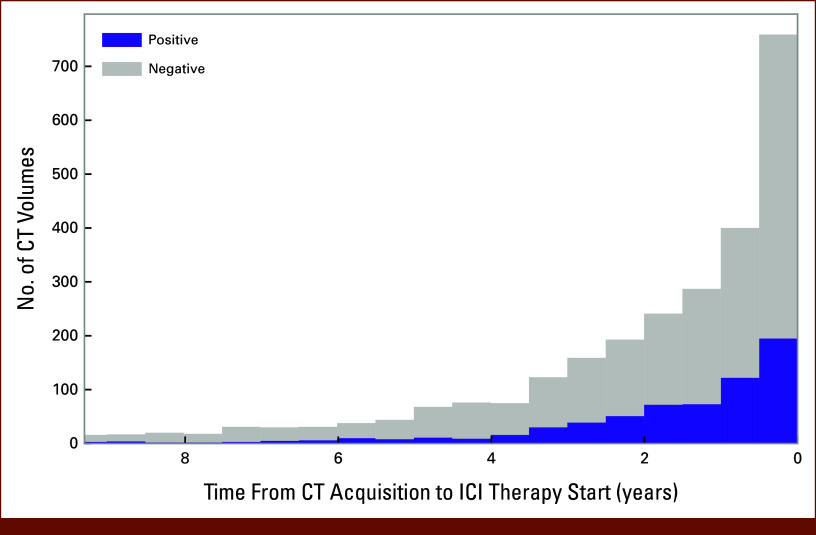
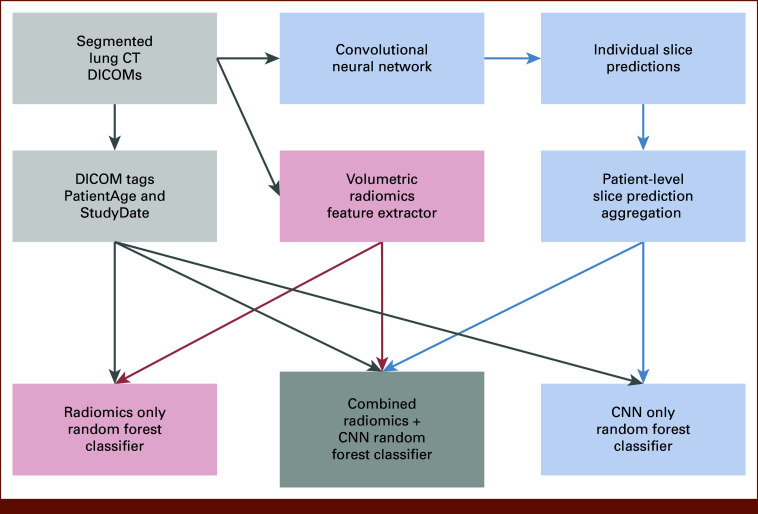
Methods: Starting from a cohort of 3,351 patients with cancer who received previous ICI therapy at the Vanderbilt University Medical Center, we curated 2,700 contrast chest computed tomography (CT) volumes for 671 patients. Three different pure imaging models predicted the potential for PN using only a single time point before the first ICI dose.
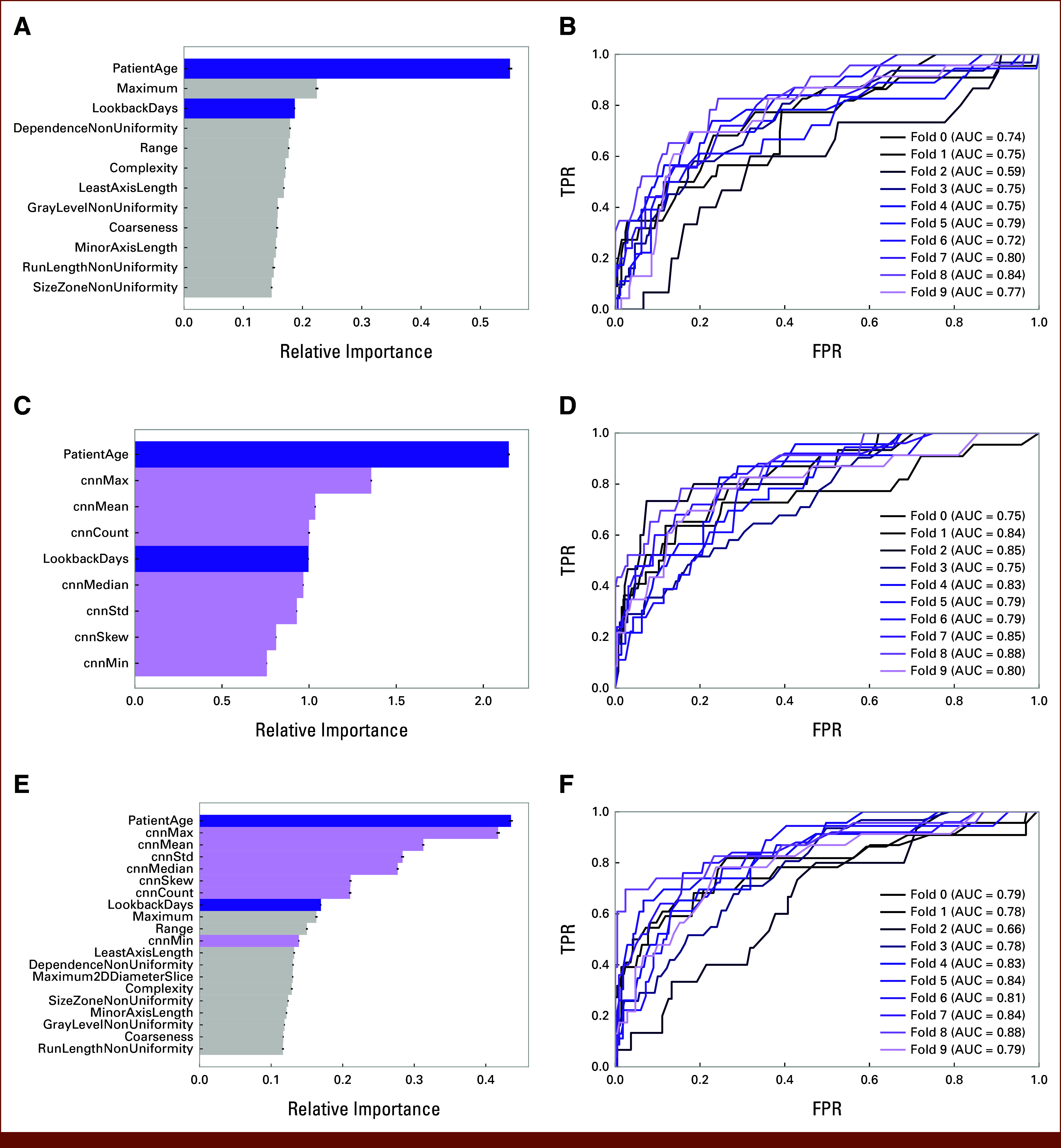
Results: The first model used 109 radiomics features only and achieved an AUC of 0.747 (CI, 0.705 to 0.789) with a positive predictive value (PPV) of 0.244 (CI, 0.211 to 0.276) at a sensitivity of 0.553 (CI, 0.485 to 0.621) using mainly features describing the global lung properties. The second model used a convolutional neural network (CNN) on the raw CTs to improve to an AUC of 0.819 (CI, 0.781 to 0.857) with a PPV of 0.244 (CI, 0.203 to 0.284) at a sensitivity of 0.743 (CI, 0.681 to 0.806). The third model combined both radiomics and deep learning but, with an AUC of 0.829 (CI, 0.797 to 0.862) and a PPV of 0.254 (CI, 0.228 to 0.281) at a sensitivity of 0.780 (CI, 0.721 to 0.840), did not show a significant improvement on the CNN-only model.
Conclusion: This new model suggests the utility of deep learning in PN prediction over traditional pure radiomics and promises better management for patients receiving ICI and the ability to better stratify patients in immunotherapy drug trials.




 京公网安备 11010802042870号
京ICP备2023020795号-1
京公网安备 11010802042870号
京ICP备2023020795号-1

 分享
分享
 求助内容:
求助内容: 应助结果提醒方式:
 扫码关注我们
