{"title":"Machine learning insights into calcium phosphate nucleation and aggregation","authors":"Jing Wang , Xin Wang , Dingguo Xu","doi":"10.1016/j.actbio.2025.02.036","DOIUrl":null,"url":null,"abstract":"<div><div>In this study, we utilized machine learning interatomic potentials (MLIPs) to investigate the nucleation mechanisms of calcium phosphate, a critical component of bone and teeth. Our analysis encompassed the process from pre-nucleation stage to the growth of amorphous calcium phosphate (ACP) in solution. We observed fluctuations in free calcium ion concentration and tracked the formation of uniform clusters in the early nucleation phases, confirming the existence of pre-nucleation clusters (PNCs). The PNCs are characterized by the composition Ca<sub>2</sub>[(PO<sub>4</sub>)<sub>1.6</sub>(HPO<sub>4</sub>)(H<sub>2</sub>PO<sub>4</sub>)<sub>0.4</sub>] and predominantly exhibit a triangular structure formed by phosphate groups. This structure is not only the core of the short-range ordered units in ACP but also exhibits the structural characteristics of the fundamental building blocks of HAP. Importantly, these clusters interact dynamically with water molecules through hydrogen bonding and proton exchange, which is essential for their stability and growth. The gradual growth of these clusters occurs via ion attachment and cluster adsorption. This work provides insights into calcium phosphate mineralization, with implications for materials science and biomedical engineering, particularly in biomaterial synthesis. The application of MLIPs demonstrates a high-accuracy, efficient approach for simulating complex systems may advance our understanding of crystallization and biomineralization processes.</div></div><div><h3>Statement of significance</h3><div>Calcium phosphate nucleation is crucial in biological mineralization and the synthesis of biomaterials, serving as a key aspect in the design of hydroxyapatite (HAP)-based biomaterials. However, the mechanisms of early nucleation remain unclear due to the complex ion-water interactions, which lead to rapid nucleation rates and small cluster sizes. This study combines MLIP with MD simulations to explore the nucleation process of calcium phosphate, revealing the transition from pre-nucleation to the formation of ACP. It clarifies the relationship between PNCs and the crystalline structure of HAP. This work addresses the knowledge gap regarding early-stage calcium phosphate nucleation and highlights the potential of MLIP in simulating complex ionic solutions, laying a solid foundation for AI-guided research in biological and biomedical materials.</div></div>","PeriodicalId":237,"journal":{"name":"Acta Biomaterialia","volume":"195 ","pages":"Pages 547-558"},"PeriodicalIF":9.6000,"publicationDate":"2025-03-15","publicationTypes":"Journal Article","fieldsOfStudy":null,"isOpenAccess":false,"openAccessPdf":"","citationCount":"0","resultStr":null,"platform":"Semanticscholar","paperid":null,"PeriodicalName":"Acta Biomaterialia","FirstCategoryId":"5","ListUrlMain":"https://www.sciencedirect.com/science/article/pii/S1742706125001308","RegionNum":1,"RegionCategory":"医学","ArticlePicture":[],"TitleCN":null,"AbstractTextCN":null,"PMCID":null,"EPubDate":"2025/2/18 0:00:00","PubModel":"Epub","JCR":"Q1","JCRName":"ENGINEERING, BIOMEDICAL","Score":null,"Total":0}
引用次数: 0
Abstract
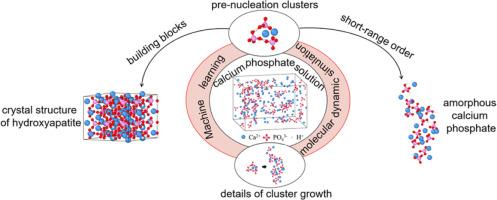
In this study, we utilized machine learning interatomic potentials (MLIPs) to investigate the nucleation mechanisms of calcium phosphate, a critical component of bone and teeth. Our analysis encompassed the process from pre-nucleation stage to the growth of amorphous calcium phosphate (ACP) in solution. We observed fluctuations in free calcium ion concentration and tracked the formation of uniform clusters in the early nucleation phases, confirming the existence of pre-nucleation clusters (PNCs). The PNCs are characterized by the composition Ca2[(PO4)1.6(HPO4)(H2PO4)0.4] and predominantly exhibit a triangular structure formed by phosphate groups. This structure is not only the core of the short-range ordered units in ACP but also exhibits the structural characteristics of the fundamental building blocks of HAP. Importantly, these clusters interact dynamically with water molecules through hydrogen bonding and proton exchange, which is essential for their stability and growth. The gradual growth of these clusters occurs via ion attachment and cluster adsorption. This work provides insights into calcium phosphate mineralization, with implications for materials science and biomedical engineering, particularly in biomaterial synthesis. The application of MLIPs demonstrates a high-accuracy, efficient approach for simulating complex systems may advance our understanding of crystallization and biomineralization processes.
Statement of significance
Calcium phosphate nucleation is crucial in biological mineralization and the synthesis of biomaterials, serving as a key aspect in the design of hydroxyapatite (HAP)-based biomaterials. However, the mechanisms of early nucleation remain unclear due to the complex ion-water interactions, which lead to rapid nucleation rates and small cluster sizes. This study combines MLIP with MD simulations to explore the nucleation process of calcium phosphate, revealing the transition from pre-nucleation to the formation of ACP. It clarifies the relationship between PNCs and the crystalline structure of HAP. This work addresses the knowledge gap regarding early-stage calcium phosphate nucleation and highlights the potential of MLIP in simulating complex ionic solutions, laying a solid foundation for AI-guided research in biological and biomedical materials.
期刊介绍:
Acta Biomaterialia is a monthly peer-reviewed scientific journal published by Elsevier. The journal was established in January 2005. The editor-in-chief is W.R. Wagner (University of Pittsburgh). The journal covers research in biomaterials science, including the interrelationship of biomaterial structure and function from macroscale to nanoscale. Topical coverage includes biomedical and biocompatible materials.



 京公网安备 11010802042870号
京ICP备2023020795号-1
京公网安备 11010802042870号
京ICP备2023020795号-1

 分享
分享
 求助内容:
求助内容: 应助结果提醒方式:
 扫码关注我们
